
Save the Green Planet! is one of the most genre-defying films to come out of South Korea in the early 2000s. Directed by Jang Joon-hwan, the film blends sci-fi paranoia, dark comedy, psychological horror, and social satire into something that feels both absurd and disturbingly real. It starts as a bizarre conspiracy thriller and slowly mutates into a tragic psychological drama that refuses to give the audience easy answers.
Detailed Summary
The Conspiracy Begins
Lee Byeong-gu (played by Shin Ha-kyun) is convinced that Earth is secretly controlled by reptilian aliens from the Andromeda galaxy. According to his theory, these aliens are disguised as powerful figures in society and are plotting to destroy the planet during an upcoming lunar eclipse.
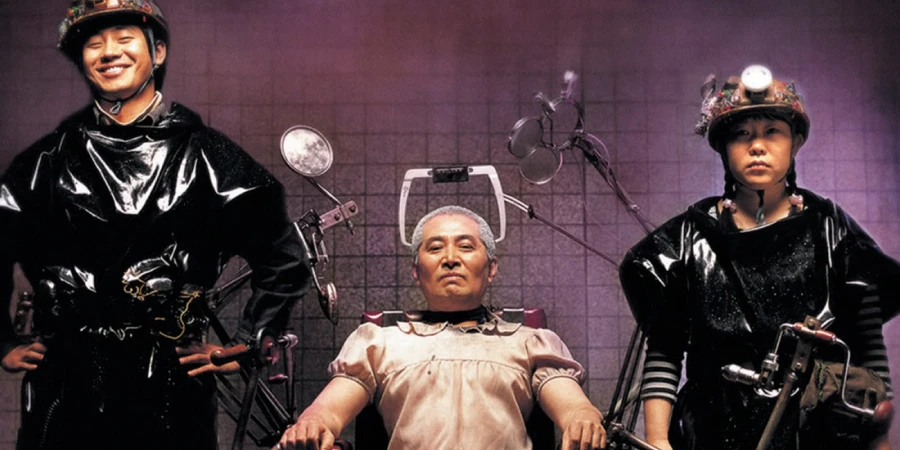
His primary target is Kang Man-shik (played by Baek Yoon-sik), the CEO of a large chemical company. Byeong-gu kidnaps him with the help of his devoted girlfriend Su-ni (Hwang Jung-min) and imprisons him in a basement workshop.
From here, the film becomes an intense chamber piece: torture, interrogation, and psychological warfare unfold as Byeong-gu attempts to extract a confession.
Psychological Breakdown or Hidden Truth?
The story constantly destabilizes the audience. Is Byeong-gu insane? Or is he actually uncovering something cosmic?
Flashbacks reveal that Byeong-gu suffered severe trauma in childhood. His mother was injured in a chemical factory accident linked to Kang’s company. He was also brutally bullied in school. These experiences shaped his fractured worldview.
Throughout the interrogation, Kang insists he is human. The police investigation slowly closes in, while the audience is left suspended between absurdity and possibility.
The tone oscillates wildly — grotesque torture scenes are followed by slapstick absurdity, then heartbreaking emotional beats. This tonal instability is deliberate. The film forces viewers to confront how trauma can mutate into delusion.
The Investigation Tightens
Two detectives begin investigating the disappearance. In a surprisingly human touch, the police are portrayed not as caricatures but as flawed, empathetic figures trying to solve a strange crime.
As the lunar eclipse approaches, Byeong-gu becomes increasingly unstable. His desperation intensifies because he genuinely believes that failure will mean planetary destruction.
The tension escalates toward a devastating final act.


Movie Ending
Byeong-gu ultimately kills Kang after failing to extract the confession he seeks. Police arrive too late to stop him. Byeong-gu is arrested and declared mentally unstable.
Up to this point, the film strongly implies that he is delusional — a tragic victim of trauma whose paranoia spiraled out of control.
However, in the final moments, the film delivers a twist that completely reframes everything.
After Byeong-gu is institutionalized and heavily medicated, the movie reveals that Kang actually was an alien. A spacecraft arrives. Other extraterrestrials confirm that Earth is indeed doomed. They discuss the failed mission and depart, leaving humanity to its fate.
The implication is staggering.
Was Byeong-gu insane — or was he the only sane person in a world that refused to believe him?
The ending forces viewers to confront uncomfortable questions:
- If someone tells the truth but sounds insane, are they still insane?
- Does trauma invalidate truth?
- Is society too quick to label dissent as madness?
The film closes on a deeply ironic and tragic note: the man who tried to save Earth was silenced, and he was right.
Are There Post-Credits Scenes?
No, there are no post-credits scenes. The twist is delivered before the credits roll, and the film ends definitively.
Type of Movie
This film is a genre-blending psychological sci-fi thriller infused with black comedy, social satire, and horror elements. It deliberately shifts tone to destabilize the audience and challenge genre expectations.
Cast
- Shin Ha-kyun as Lee Byeong-gu
- Baek Yoon-sik as Kang Man-shik
- Hwang Jung-min as Su-ni
- Lee Jae-yong as Detective Choo
Shin Ha-kyun’s performance is especially notable — he swings from manic absurdity to heartbreaking vulnerability with frightening precision.
Film Music and Composer
The score was composed by Lee Jae-jin. The music enhances the film’s tonal instability, shifting from suspenseful orchestration to quirky, almost cartoonish cues, reinforcing the uneasy blend of comedy and horror.

Filming Locations and Their Importance
The film was shot primarily in South Korea, including:
- Seoul metropolitan areas
- Industrial zones that reinforce the themes of corporate corruption
- Basement workshop sets constructed to feel claustrophobic and oppressive
The confined basement setting is particularly important — it visually mirrors Byeong-gu’s psychological entrapment. The industrial landscapes emphasize environmental damage and corporate greed, which subtly support the film’s social commentary.
Awards and Nominations
The film gained strong critical acclaim internationally despite modest domestic box office performance.
Notable recognition includes:
- Best Film at the Bucheon International Fantastic Film Festival
- Multiple nominations at the Blue Dragon Film Awards
- International festival screenings that cemented its cult reputation
Over time, it became regarded as a cult classic of Korean cinema.
Behind the Scenes Insights
- The film was difficult to finance because studios feared its genre-blending tone would confuse audiences.
- Director Jang Joon-hwan struggled to balance dark comedy with torture scenes without alienating viewers.
- Shin Ha-kyun reportedly immersed himself deeply in the character, studying paranoia and trauma disorders.
- The film’s tonal shifts were intentional — Jang wanted audiences to feel psychologically manipulated.
- It later gained international admiration from genre filmmakers.
Inspirations and References
The film draws inspiration from:
- Conspiracy culture and UFO paranoia
- Korean industrial accidents and corporate scandals
- Psychological thrillers of the 1990s
- Social satire traditions in Korean cinema
It is not based on a book but reflects anxieties of early 2000s South Korean society, especially distrust of corporations and authority.
Alternate Endings and Deleted Scenes
There were discussions during production about a more ambiguous ending that would not confirm the alien presence.
Ultimately, the director chose the definitive twist to maximize impact.
Some deleted scenes reportedly included:
- Extended police investigation material
- Additional childhood trauma sequences
These were cut to maintain pacing and avoid over-explaining Byeong-gu’s psychology.
Book Adaptations and Differences
The film is an original screenplay and is not adapted from a book. Therefore, there are no book-to-film differences.

Memorable Scenes and Quotes
Key Scenes
- The opening kidnapping sequence, which blends absurd comedy with sudden brutality
- Byeong-gu’s elaborate alien-detection torture methods
- Flashbacks of factory negligence that hint at social critique
- The final alien spacecraft reveal
Iconic Quotes
- “You are from Andromeda.”
- “The eclipse is coming. Tell them not to destroy Earth.”
- “You humans never listen.”
These lines carry more weight after the ending reframes everything.
Easter Eggs and Hidden Details
- The chemical company’s background subtly mirrors real Korean industrial disasters.
- Alien design incorporates classic 1950s UFO imagery.
- News broadcasts in the background hint at environmental collapse.
- The lunar eclipse timing mirrors doomsday conspiracy theories popular in early 2000s Asia.
Trivia
- The film became a midnight-movie favorite internationally.
- A Hollywood remake was announced multiple times but never materialized.
- It was South Korea’s official submission for the Academy Awards’ Best Foreign Language Film category.
- Director Jang Joon-hwan would not release another feature film for over a decade.
Why Watch?
Because it is bold, refuses to behave and weaponizes genre against your expectations.
If you enjoy films that start absurd, become tragic, and end existential, this one is unforgettable. It is emotionally destabilizing in the best possible way.
Director’s Other Works
Directed by Jang Joon-hwan:
- Hwayi: A Monster Boy (2013)
- 1987: When the Day Comes (2017)