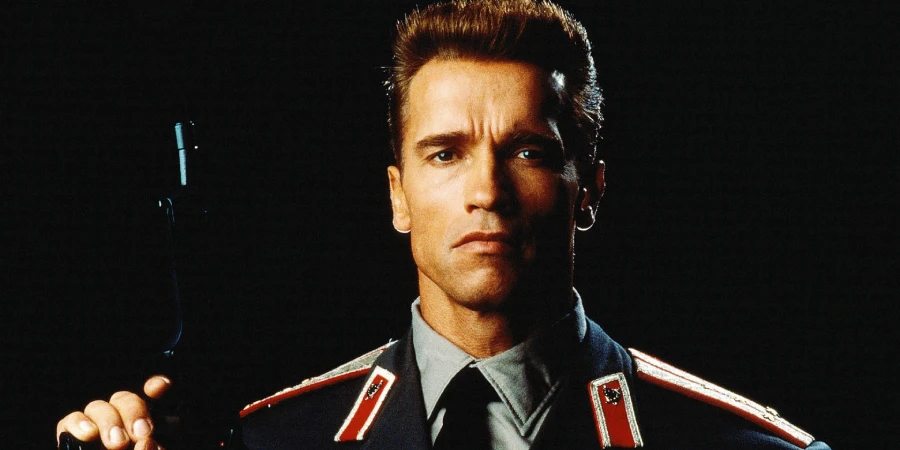

Red Heat (1988) is a Cold War–era action film that pairs two wildly different cops from opposite sides of the Iron Curtain. Directed by Walter Hill, the movie blends gritty police action with buddy-cop comedy, anchored by the unlikely pairing of Arnold Schwarzenegger and James Belushi.
The film became a cult favorite thanks to its East-meets-West premise, memorable one-liners, and the novelty of Schwarzenegger playing a Soviet officer during the late Cold War period.
Detailed Summary
Opening in the Soviet Union
The film begins in the Soviet Union where Captain Ivan Danko (Arnold Schwarzenegger), a disciplined and stoic Moscow police officer, is pursuing a Georgian drug lord named Viktor Rostavili (Ed O’Ross).
During a brutal confrontation in a bathhouse shootout, Rostavili manages to escape. Worse, Danko’s partner is killed during the encounter. This personal loss fuels Danko’s relentless determination to capture Rostavili.
Rostavili’s Arrest… and Escape
Eventually Rostavili is captured by Soviet authorities and is set to be extradited from the United States after conducting drug deals there.
Danko travels to Chicago to retrieve the prisoner and escort him back to Moscow. However, during the prisoner transfer at the airport, Rostavili’s gang ambushes the convoy. The criminals kill several officers and free Rostavili.
Now stranded in the United States without jurisdiction, Danko is forced to cooperate with the Chicago Police Department.
The Odd-Couple Partnership
Danko is paired with Detective Art Ridzik (James Belushi), a loud, sarcastic Chicago cop who couldn’t be more different from the rigid Soviet officer.
Their partnership forms the heart of the movie. Ridzik jokes constantly while Danko speaks bluntly and with minimal emotion. Cultural misunderstandings and Ridzik’s relentless teasing create much of the film’s humor.
Despite their differences, both men share one thing: a stubborn commitment to catching Rostavili.
Investigating the Drug Operation
As they dig deeper, Danko and Ridzik uncover Rostavili’s plan to establish a massive drug distribution network between Chicago and the Soviet Union.
Their investigation takes them through Chicago’s criminal underworld, including encounters with mob figures, informants, and shootouts with Rostavili’s henchmen.
During this stage of the film, Ridzik slowly begins to respect Danko’s professionalism, while Danko develops a grudging appreciation for Ridzik’s street smarts.
The Trap at the Bus Station
The police discover that Rostavili plans to conduct a large drug exchange at a crowded city bus terminal.
Danko and Ridzik organize an operation to intercept the criminals. However, Rostavili anticipates the ambush and chaos erupts.
Gunfire breaks out in the terminal, leading to one of the film’s most intense action sequences.

Movie Ending
The climactic sequence takes place during the bus station drug deal.
Rostavili arrives with a suitcase containing cocaine while his gang prepares to distribute it to buyers. Danko and Ridzik move in to arrest him, but the situation quickly turns violent as Rostavili’s men open fire.
A chaotic shootout unfolds throughout the station.
During the gunfight, Ridzik is wounded, raising the stakes dramatically. Despite being injured, he continues helping Danko pursue Rostavili.
Rostavili escapes the station and attempts to flee in a city bus packed with civilians. Danko and Ridzik chase him through the streets of Chicago.
Eventually Danko boards the bus and confronts Rostavili in a brutal hand-to-hand fight. The two men struggle violently as the bus crashes and chaos spreads around them.
In the final moments of the confrontation, Danko manages to overpower Rostavili and kills him, finally avenging his partner and ending the drug lord’s operation.
After the battle, Ridzik survives his injuries and shares a final moment of mutual respect with Danko. The Soviet officer prepares to return to Moscow, but before leaving he gives Ridzik a symbolic Soviet gift—showing that their unlikely partnership has turned into genuine friendship.
The ending emphasizes the theme that despite political differences between nations, individual people can still find common ground.
Are There Post-Credits Scenes?
No. Red Heat does not include a post-credits scene. Once the story concludes, the film ends in traditional 1980s fashion without additional teasers or follow-ups.
Type of Movie
Red Heat is primarily an action-comedy buddy cop film set against the backdrop of the Cold War. It mixes hard-hitting shootouts and car chases with culture-clash humor between an American detective and a Soviet officer.
Cast
- Arnold Schwarzenegger as Captain Ivan Danko
- James Belushi as Detective Art Ridzik
- Ed O’Ross as Viktor Rostavili
- Peter Boyle as Commander Lou Donnelly
- Laurence Fishburne as Lt. Charlie Stobbs
- Gina Gershon as Cat Manzetti
- Richard Bright as Sgt. Gallagher
Film Music and Composer
The film’s score was composed by James Horner. His music blends orchestral action themes with darker tones that reflect the tense Cold War atmosphere of the story.

Filming Locations
Much of the movie was filmed in Chicago, which provides the gritty urban backdrop for the investigation and action scenes.
Key locations include Chicago streets, police stations, and transit areas used for the climactic chase and bus terminal shootout.
The opening sequence was filmed in Moscow, making Red Heat notable as one of the first American films allowed to shoot scenes in the Soviet Union during the Cold War. This added authenticity to Danko’s origins and helped establish the film’s East-West premise.
Awards and Nominations
The film was not a major awards contender but gained attention for its action sequences and Schwarzenegger’s unusual casting as a Soviet officer.
It received nominations in genre-focused awards circuits and later gained cult status among action movie fans.
Behind the Scenes Insights
- Arnold Schwarzenegger had to deliver many lines in Russian, which required phonetic memorization.
- The film was one of the first Hollywood productions partially filmed in Moscow during the late Cold War period.
- Director Walter Hill originally wanted a darker tone, but the studio encouraged more comedy to balance the story.
- James Belushi improvised many of Ridzik’s jokes and sarcastic remarks.
- Schwarzenegger deliberately played Danko with very minimal emotional expression to emphasize the character’s rigid Soviet upbringing.
Inspirations and References
The film draws heavily from the buddy cop formula popularized in the 1980s, especially movies like 48 Hrs. and Lethal Weapon.
Its central idea—an American cop working with a Soviet officer—reflects the political tensions and curiosity between East and West during the Cold War era.
Alternate Endings and Deleted Scenes
Early drafts of the script reportedly included a darker ending where Danko would return to Moscow under suspicion from Soviet authorities due to his time working with Americans.
Some deleted scenes expanded on Ridzik’s personal life and Chicago police politics, but these were removed to keep the pacing tighter.
Book Adaptations and Differences
Red Heat is not based on a book. It was written as an original screenplay by Walter Hill, Troy Kennedy Martin, and Harry Kleiner.

Memorable Scenes and Quotes
Key Scenes
- The brutal bathhouse shootout in Moscow that sets the story in motion.
- Danko’s arrival in Chicago and his awkward first meeting with Ridzik.
- The interrogation scene where Danko intimidates suspects with cold efficiency.
- The chaotic bus terminal shootout.
- The final fight between Danko and Rostavili aboard the bus.
Iconic Quotes
- “Cocaineum.” — Ivan Danko identifying drugs with his trademark seriousness.
- “This is Chicago. You got rules?” — Ridzik mocking Danko’s strict Soviet mindset.
- “I do not break rules.” — Danko’s blunt response that defines his character.
Easter Eggs and Hidden Details
- Danko’s pistol is a Podbyrin 9.2mm, a fictional Soviet weapon created for the film.
- Schwarzenegger’s character rarely smiles throughout the movie, reinforcing the stereotype of a stoic Soviet officer.
- The film subtly contrasts Soviet and American policing styles through interrogation techniques and bureaucracy.
- Some background extras in Moscow scenes were reportedly real Soviet citizens, adding authenticity.
Trivia
- Arnold Schwarzenegger reportedly gained several pounds of muscle for the role to make Danko appear physically imposing.
- The film’s Moscow scenes were shot shortly before the collapse of the Soviet Union, giving it historical significance.
- This was one of James Belushi’s earliest major leading roles in an action film.
- Walter Hill specialized in gritty action stories featuring tough male partnerships.
Why Watch?
Red Heat is worth watching because it captures a very specific moment in history when Hollywood began exploring the idea of cooperation between East and West.
Beyond the politics, it’s simply a fun action movie. The chemistry between Schwarzenegger and Belushi carries the film, and the mix of action, humor, and Cold War tension makes it a memorable entry in the 1980s action genre.
For fans of classic buddy cop movies, it’s a fascinating blend of action spectacle and cultural comedy.
Director’s Other Works (Movies)
- The Warriors (1979)
- 48 Hrs. (1982)
- Streets of Fire (1984)
- Another 48 Hrs. (1990)
- Last Man Standing (1996)
- Bullet to the Head (2012)
Recommended Films for Fans
- Lethal Weapon (1987)
- 48 Hrs. (1982)
- Tango & Cash (1989)
- Rush Hour (1998)
- The Last Boy Scout (1991)
- Beverly Hills Cop (1984)