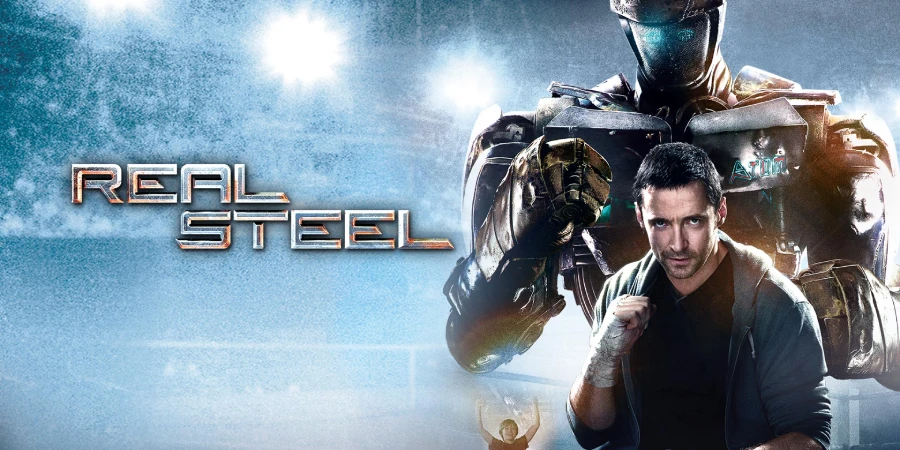

Real Steel (2011) is one of those films that looks like a robot boxing movie on the surface but turns out to be a surprisingly emotional father–son story underneath all the steel and sparks. Directed by Shawn Levy and starring Hugh Jackman, the film blends sports drama, science fiction, and heartfelt character development in a way that makes it far more memorable than its premise suggests.
Detailed Summary – Critical Moments Explained
The World of Robot Boxing
Set in the near future, human boxing has been replaced by robot boxing, where towering steel machines fight in brutal, crowd-pleasing matches. Robots are remotely controlled by humans, and the sport ranges from underground scrapyard fights to massive professional arenas. This futuristic setting immediately establishes the film’s core theme: technology has replaced humanity in the ring, but not in the heart.
Charlie Kenton: A Broken Fighter
Charlie Kenton (Hugh Jackman) is a former boxer who never quite made it. Now he survives by controlling outdated robots in low-level fights. He’s arrogant, irresponsible, and deeply in debt. Charlie represents someone stuck in the past, unable to adapt, both emotionally and professionally.
The Arrival of Max
Charlie learns that his ex-girlfriend has passed away, leaving behind their son, Max (Dakota Goyo). Charlie initially wants nothing to do with parenting and agrees to take Max only temporarily in exchange for money. Their relationship starts off cold and transactional, with zero emotional connection.
Discovering Atom
While scavenging for robot parts, Max discovers Atom, a discarded sparring robot designed to take hits rather than deliver them. Unlike other robots, Atom has a shadow-function, allowing it to mimic human movements. This discovery becomes the turning point of the entire film.
Training, Bonding, and Rising Through the Ranks
As Charlie and Max repair Atom, they begin competing in underground fights. Atom proves resilient and adaptable, and Max bonds with the robot on a deeply emotional level. Meanwhile, Charlie starts reconnecting with his boxing roots by training Atom using his own moves. The robot becomes a bridge between father and son, allowing them to slowly build trust.
Enter Zeus
Zeus, the undefeated world champion robot, looms over the story as an unstoppable force. Owned by a wealthy corporation and controlled by elite technicians, Zeus represents perfection, money, and cold efficiency. The contrast between Zeus and Atom mirrors the contrast between polished professionalism and raw human spirit.
Movie Ending
The final act takes place at a massive championship event where Atom faces Zeus in what is supposed to be an easy exhibition match for the champion. No one expects Atom to survive, let alone compete.
At the start of the fight, Zeus completely dominates Atom, landing devastating blows that nearly shut him down. Charlie realizes traditional remote controls won’t be enough. When Atom’s control system is damaged, Charlie switches to shadow boxing mode, stepping into the ring himself.
Here is where the film fully delivers its emotional payoff:
Charlie physically boxes Zeus by shadowing movements that Atom mirrors. For the first time, Charlie is truly back in the ring, fighting not for money or ego, but for his son. Max watches with pride, realizing his father is no longer running away.
Atom survives all rounds against Zeus, something no robot has ever done. Although Atom loses by judges’ decision, the crowd erupts in applause. Zeus technically remains champion, but Atom becomes the people’s champion.
In the closing moments:
- Charlie accepts that Atom doesn’t need to win to be meaningful.
- Max and Charlie finally acknowledge each other as father and son.
- Charlie turns down a rematch with Zeus, choosing his relationship with Max over fame.
The ending emphasizes that winning isn’t always about titles, but about redemption, connection, and self-respect.
Are There Post-Credits Scenes?
No, Real Steel does not have any post-credits or mid-credits scenes. Once the credits roll, the story is fully concluded with no teasers or sequel hooks.
Type of Movie
Real Steel is a science fiction sports drama that blends futuristic action with a classic underdog story and a strong emotional father–son narrative. Despite its robotic setting, the film is deeply human at its core.
Cast
- Hugh Jackman as Charlie Kenton
- Dakota Goyo as Max Kenton
- Evangeline Lilly as Bailey Tallet
- Anthony Mackie as Finn
- Kevin Durand as Ricky
- Olga Fonda as Farra Lemkova
Film Music and Composer
The film’s score was composed by Danny Elfman, known for his ability to blend emotional depth with grand spectacle. The music enhances both the intense boxing matches and the quieter, emotional moments between Charlie and Max, without overpowering the story.

Filming Locations and Their Importance
Real Steel was filmed across Michigan, Pennsylvania, and California.
- Detroit, Michigan was used extensively to represent a gritty, industrial future, reinforcing the rough, working-class nature of robot boxing.
- Abandoned factories and steel yards added authenticity to the underground fighting scenes.
- Studio filming in California allowed for advanced motion-capture and CGI work, especially during robot fights.
These locations help ground the futuristic concept in a believable, worn-down world.
Awards and Nominations
While it didn’t dominate major award ceremonies, Real Steel received recognition for its technical achievements:
- Academy Award nomination for Best Visual Effects
- Saturn Award nomination for Best Science Fiction Film
- Several Visual Effects Society nominations
Behind the Scenes Insights
- Hugh Jackman performed many of the boxing movements himself for shadow mode scenes.
- Atom was brought to life using a combination of CGI and real, full-sized robot props.
- Dakota Goyo worked closely with boxing trainers to make Max’s coaching believable.
- Director Shawn Levy emphasized that the movie was always about family first, robots second.
Inspirations and References
The film is loosely inspired by the short story “Steel” by Richard Matheson, which was also adapted into a Twilight Zone episode. Unlike the original story, Real Steel adds emotional depth and a family storyline, expanding the concept significantly.
Alternate Endings and Deleted Scenes
Several deleted scenes explore Charlie’s past boxing career in more detail, but they were cut to maintain pacing. There were early drafts where Atom actually defeats Zeus, but the filmmakers chose a more grounded ending to emphasize emotional victory over literal success.
Book Adaptations and Differences
Richard Matheson’s original short story focused almost entirely on boxing and survival, with no father–son relationship. The movie expands the premise into a character-driven drama, making the emotional arc the centerpiece rather than the sport itself.



Memorable Scenes and Quotes
Key Scenes
- Max discovering Atom in the scrapyard
- Atom’s first underground fight
- Charlie shadow boxing in the final match
- The crowd chanting Atom’s name despite the loss
Iconic Quotes
- Charlie: “I didn’t know how to be your father.”
- Max: “You don’t have to be perfect. Just don’t quit.”
- Bailey: “That robot didn’t make you better. Your kid did.”
Easter Eggs and Hidden Details
- Atom’s blue design subtly mirrors classic underdog sports uniforms.
- Zeus’s movements are intentionally more mechanical to contrast Atom’s human-like style.
- Several robot names reference boxing legends and Greek mythology.
Trivia
- Atom is the only robot in the film capable of independent movement.
- Hugh Jackman has cited Real Steel as one of his most emotionally rewarding roles.
- The robot fights were choreographed like real boxing matches, complete with footwork strategies.
Why Watch?
Because it’s far more than a robot movie. It delivers action, heart, and a genuinely satisfying emotional arc. If you enjoy underdog stories, redemption tales, or sports dramas with a sci-fi twist, this one punches well above its weight.
Director’s Other Works (Movies)
- Night at the Museum (2006)
- Night at the Museum: Battle of the Smithsonian (2009)
- Date Night (2010)
- The Internship (2013)
- Free Guy (2021)
- This Is Where I Leave You (2014)