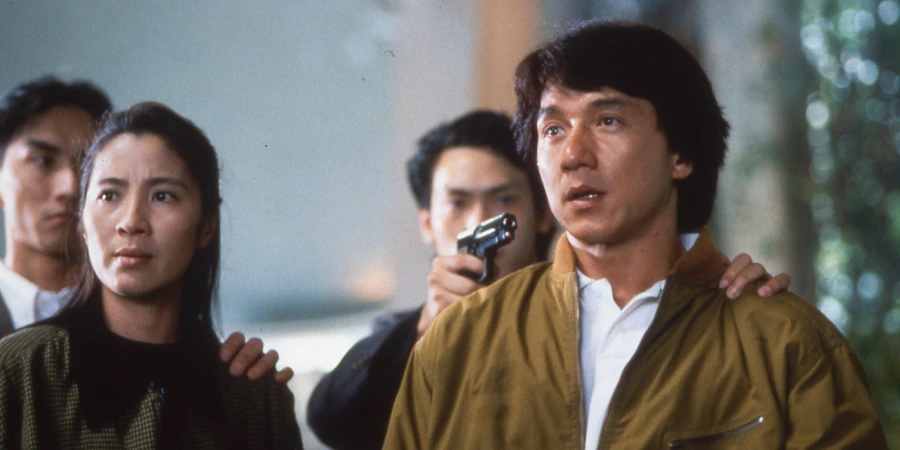

Police Story 3: Super Cop is often considered one of the peak entries in Jackie Chan’s legendary Police Story franchise. Directed by Stanley Tong and released in 1992, the film escalates the series from Hong Kong streets to an international stage, combining insane practical stunts, globe-trotting action, and buddy-cop dynamics that helped redefine action cinema in the early 90s.
Detailed Summary
Undercover Operation and International Stakes
The film opens with Inspector Chan Ka-Kui being recruited for a high-risk undercover mission involving a powerful drug cartel operating across Southeast Asia. This time, the Hong Kong police collaborate with Chinese authorities, introducing Inspector Yang Chien-Hua, played by Michelle Yeoh.
Chan Ka-Kui must infiltrate the cartel by posing as a criminal associate, while Yang goes undercover as a mainland Chinese officer with her own secret agenda. From the start, the mission is layered with lies, shifting identities, and constant danger, making trust a rare commodity.
Building Trust in a World of Criminals
As Chan and Yang are forced to work closely together, the film balances tension and humor. Their contrasting personalities lead to friction, but also mutual respect. The cartel leader, Panther, is portrayed as ruthless yet intelligent, keeping both protagonists under constant suspicion.
Key undercover moments involve prison break operations, jungle pursuits, and border-crossing missions, all designed to test whether Chan’s cover will hold. Every success only raises the stakes further.
Escalation: Betrayals and Explosive Set Pieces
Once the cartel begins to suspect internal betrayal, the film shifts into high gear. Chan and Yang are pushed into increasingly dangerous situations, including forced participation in violent operations to prove loyalty.
This middle section is packed with signature Jackie Chan action choreography, blending comedy, improvisation, and brutal realism. Michelle Yeoh’s presence elevates the film, as she performs her own stunts with precision and fearlessness, standing toe-to-toe with Chan rather than acting as a sidekick.
Final Act Setup: No Way Out
As the authorities move in and the cartel closes ranks, Chan’s cover is nearly blown. Communication breaks down, alliances fracture, and survival becomes the primary objective. The stage is set for a finale that would become one of the most famous stunt sequences in action movie history.
Movie Ending
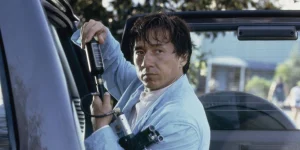
The climax takes place at a military base near the border, where the cartel attempts to escape with drugs and hostages using a helicopter and armored vehicles. Chan Ka-Kui and Inspector Yang launch a desperate assault to stop them.
The ending is defined by two legendary stunt sequences:
- Chan dangling from a ladder beneath a flying helicopter as it moves over rugged terrain.
- Michelle Yeoh riding a motorcycle onto a moving train and then into a helicopter, a stunt performed with minimal safety measures.
As chaos unfolds, the cartel members are either captured or killed, and Panther’s operation is completely dismantled. Chan narrowly survives multiple near-death moments, reinforcing the film’s recurring theme: justice achieved at extreme personal cost.
In the final moments, Chan and Yang emerge battered but victorious. The mission is officially concluded, their partnership acknowledged, and their bravery recognized by both Hong Kong and Chinese authorities. The ending emphasizes professional respect over sentimentality, staying true to the franchise’s tone.
Are There Post-Credits Scenes?
No. Police Story 3: Super Cop does not include post-credits or mid-credits scenes. However, like many Jackie Chan films, the credits feature blooper reels and stunt outtakes, showcasing failed takes, injuries, and behind-the-scenes footage that highlight the real danger involved in the production.
Type of Movie
Police Story 3: Super Cop is a high-octane action-crime film with strong elements of martial arts cinema and undercover thriller storytelling. It blends physical comedy with extreme realism in stunt work, a hallmark of Jackie Chan’s style.
Cast
- Jackie Chan as Inspector Chan Ka-Kui
- Michelle Yeoh as Inspector Yang Chien-Hua
- Maggie Cheung as May
- Kenneth Tsang as Panther
- Yuen Wah as Panther’s enforcer
Film Music and Composer
The film’s score was composed by Mac Chew, delivering a soundtrack that emphasizes tension and momentum rather than melody. The music supports the action without overpowering it, allowing the physical performances to remain the focal point.
Filming Locations
The movie was filmed across Hong Kong, Mainland China, and Malaysia, giving it a truly international feel.
- Hong Kong: Urban action scenes and police operations.
- Mainland China: Military bases and rural locations added realism and political weight.
- Malaysia: Jungle terrain and border regions were crucial for the final act’s large-scale action.
These locations weren’t just visual backdrops; they reinforced the story’s themes of cross-border crime and international cooperation.
Awards and Nominations
- Hong Kong Film Awards: Best Action Choreography (Won)
- Golden Horse Awards: Best Action Film (Nominated)
The film was particularly praised for its innovation in stunt design and Michelle Yeoh’s groundbreaking performance.
Behind the Scenes Insights
- Jackie Chan dislocated his shoulder during the helicopter ladder stunt but continued filming.
- Michelle Yeoh performed nearly all her stunts without a double.
- Safety regulations were minimal by modern standards, contributing to the film’s raw authenticity.
- Jackie Chan insisted on including bloopers to show the real cost of practical action filmmaking.
Inspirations and References
The film draws inspiration from real-world anti-drug operations in Southeast Asia, combined with the long-standing traditions of Hong Kong martial arts cinema. It also reflects the early 90s political climate regarding cooperation between Hong Kong and Mainland China.
Alternate Endings and Deleted Scenes
No confirmed alternate endings exist, but several extended action beats and character moments were trimmed to improve pacing. Early scripts reportedly gave Maggie Cheung’s character a larger role, which was reduced in the final cut.
Book Adaptations and Differences
The film is not based on a book. It is an original screenplay developed specifically for the Police Story franchise.

Memorable Scenes and Quotes
Key Scenes
- The prison escape sequence that solidifies Chan’s undercover identity.
- Michelle Yeoh’s motorcycle jump onto the train.
- The helicopter ladder climax over uneven terrain.
Iconic Quotes
- “In my line of work, survival is already a victory.”
- “Trust is the most dangerous weapon.”
Easter Eggs and Hidden Details
- The film references earlier Police Story cases through dialogue and police files.
- Jackie Chan’s character number remains consistent across the franchise.
- Some stunt setups mirror moments from Police Story (1985), acting as visual callbacks.
Trivia
- The helicopter stunt was filmed without safety wires.
- Quentin Tarantino has cited this film as a major influence.
- The movie was marketed in the U.S. as Supercop and helped introduce Michelle Yeoh to Western audiences.
Why Watch?
If you value real stunts over CGI, Police Story 3: Super Cop is essential viewing. It represents a time when action films were made with actual risk, precision choreography, and fearless performers, resulting in sequences that still feel unmatched today.
Director’s Other Works (Movies)
- Rumble in the Bronx (1995)
- First Strike (1996)
- The Myth (2005)
- Kung Fu Yoga (2017)
Recommended Films for Fans
- Police Story (1985)
- Police Story 2 (1988)
- Project A (1983)
- Yes, Madam! (1985)
- The Raid (2011)