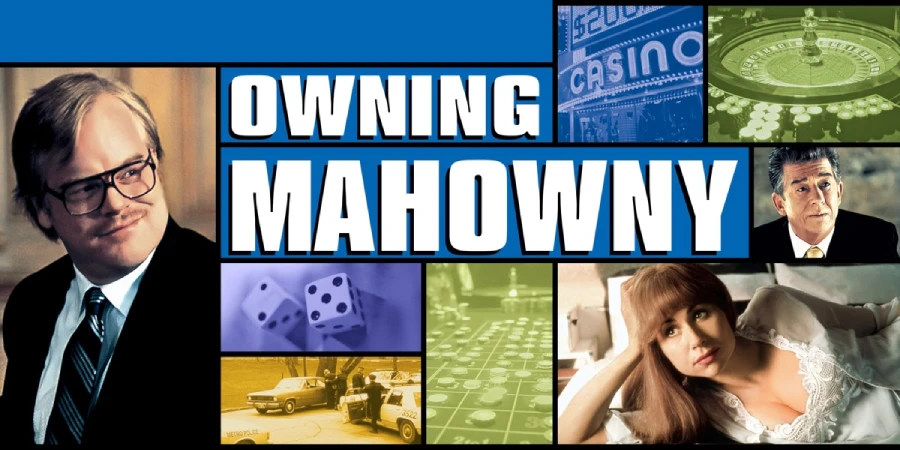

Philip Seymour Hoffman’s turn as Dan Mahowny is not just a performance; it is a complete disappearing act into the hollow shell of a man. Owning Mahowny presents one of cinema’s most chillingly accurate portraits of addiction. It is a slow-motion car crash, quiet, methodical, and utterly devastating.
Detailed Summary
A Banker’s Secret Life
Dan Mahowny is an assistant branch manager at the Canadian Imperial Bank of Commerce in Toronto. To his colleagues and his girlfriend, Belinda, he seems painfully average. Consequently, his quiet demeanor masks a furious gambling addiction.
He places high-stakes sports bets with a local bookie, Frank, but his losses are mounting. To cover his debts, Mahowny begins creating fake loans for non-existent clients. His position gives him access to multi-million dollar accounts, a temptation he cannot resist.
The Atlantic City Connection
Mahowny takes his ill-gotten gains to Atlantic City. At a casino, he meets the ambitious manager, Victor Foss. Victor sees Mahowny not as an addict, but as a “whale,” a high-roller who can bring massive business to the casino.
Victor showers Mahowny with comps: a luxury suite, expensive meals, and private jets. Mahowny, however, cares for none of it. He is only interested in the action at the gambling tables, where he loses enormous sums of money with unsettling calm.
Escalating Fraud
Back in Toronto, Mahowny’s fraud grows more audacious. He promotes himself to a bigger role at the bank’s main branch, giving him even greater authority to approve loans. He creates a massive, intricate web of over 20 fake accounts to funnel money to himself.
Meanwhile, his personal life deteriorates. Belinda grows suspicious of his constant weekend trips and his emotional vacancy. She finds his betting slips, but he convinces her it is a minor issue he has under control. In reality, he has embezzled over $10 million.
The Net Closes In
Mahowny’s bookie gets arrested by the police. During the investigation, detectives uncover Mahowny’s name and the large amounts of cash he is wagering. This prompts them to look into his finances, leading them to his employer, the bank.
Simultaneously, the bank’s internal auditors begin to notice discrepancies. A simple check reveals one of his largest loan accounts belongs to a fake company. The carefully constructed house of cards starts to crumble.


Movie Ending
Realizing his scheme is about to be exposed, Mahowny makes one last, desperate trip to Atlantic City. He convinces Victor to give him a massive line of credit, hoping for a single miraculous win to solve everything. Over a harrowing a weekend, he loses it all, including the last of the embezzled money.
Defeated and empty, he flies back to Toronto. Police are waiting for him at the airport and arrest him on the jet bridge. Mahowny confesses to everything immediately, showing more relief than remorse.
A final title card reveals he was sentenced to six years in prison. His therapist asks him if he would gamble again if he had the chance. After a long pause, Mahowny gives a small, inscrutable smile, leaving the audience to ponder the unbreakable grip of his addiction.
Are There Post-Credits Scenes?
No, there are no post-credits or mid-credits scenes in Owning Mahowny.
Type of Movie
Owning Mahowny is a biographical crime drama and a profound psychological study. The film’s tone is intentionally muted and observational, focusing on the mundane mechanics of Mahowny’s fraud and his internal state.
Unlike many gambling movies, it forgoes glamour and high-octane thrills. Instead, it captures the monotonous, compulsive nature of true addiction, making it a tense and unsettling character piece.
Cast
- Philip Seymour Hoffman – Dan Mahowny
- Minnie Driver – Belinda
- John Hurt – Victor Foss
- Maury Chaykin – Frank Perlin
- Sonja Smits – Dana Selkirk
- Ian Tracey – Detective Ben Ross
Film Music and Composer
The score was composed by The Insects, a duo composed of Bob Locke and Tim Norfolk. Their music is minimalist and electronic, creating a soundscape of persistent anxiety. The score masterfully avoids dramatic swells, mirroring Mahowny’s own flat emotional state.
There are no standout “hits” on the soundtrack. Furthermore, its purpose is purely atmospheric, underscoring the tension and the cold, mechanical process of Mahowny’s self-destruction.

Filming Locations
The film was primarily shot on location in Toronto, Ontario. These scenes are characterized by a palette of grey and beige, reflecting the dreary bureaucracy of Mahowny’s work life. This visual style establishes the bland world he seeks to escape.
In contrast, the casino scenes were filmed in Atlantic City, New Jersey. The garish lights and chaotic sounds of the casino floor provide a stark visual and auditory juxtaposition to the quiet order of the bank in Toronto. This contrast effectively highlights the two halves of Mahowny’s life.
Awards and Nominations
Owning Mahowny received critical acclaim, particularly for its screenplay and lead performance. The film was nominated for four Genie Awards, Canada’s premier film awards. Nominations included Best Motion Picture, Best Performance by an Actor in a Leading Role (Philip Seymour Hoffman), and Best Adapted Screenplay.
Behind the Scenes Insights
- Philip Seymour Hoffman reportedly spent time with gambling addicts and visited casinos to observe their behavior, but he intentionally never placed a bet himself.
- Director Richard Kwietniowski insisted on a non-judgmental portrayal, stating he wanted the audience to observe Mahowny’s addiction like a scientist studying a specimen.
- John Hurt based his character, Victor Foss, on several real-life casino executives, aiming for a portrayal that was charming yet predatory.
- The budget was modest, and the production had limited time to shoot inside the real casinos, requiring meticulous planning to capture the necessary footage.
Inspirations and References
The film is based on the true story of Brian Molony, a Toronto bank clerk who embezzled over $10.2 million in the early 1980s to fund his gambling addiction. Molony’s story was chronicled in the 1987 non-fiction book Stung: The Incredible Obsession of Brian Molony by journalist Gary Stephen Ross.
The filmmakers used the book as their primary source material. They aimed to adhere closely to the psychological profile of Molony presented in Ross’s reporting.
Alternate Endings and Deleted Scenes
There are no known alternate endings or officially released deleted scenes for Owning Mahowny. Director Richard Kwietniowski’s final cut is the only version of the film that has been made public. The narrative is considered lean and focused, suggesting little was left on the cutting room floor.
Book Adaptations and Differences
Owning Mahowny is a faithful adaptation of the book Stung, but it takes certain liberties for cinematic effect. The film compresses the 18-month timeline of Brian Molony’s fraud into a shorter, more intense period. It also streamlines the cast of characters, for instance, combining several casino employees into the singular character of Victor Foss.
Notably, the film focuses more intensely on Mahowny’s internal psychological state. In contrast, the book spends more time detailing the mechanics of the banking system and the specifics of the police investigation that eventually brought Molony down.


Memorable Scenes and Quotes
Key Scenes
- The First Big Score: Mahowny’s first successful embezzlement, where he calmly walks out of the bank with a briefcase full of cash, establishing the ease with which he commits his crimes.
- The Empty Suite: After being gifted a luxurious penthouse suite by Victor, Mahowny ignores the champagne and stunning views, immediately sitting down to calculate his next bet, showing his complete disinterest in the perks of being a whale.
- Belinda’s Discovery: Belinda finds a massive ledger of Mahowny’s bets hidden in their apartment. His casual dismissal of her concerns is one of the film’s most chilling moments.
Iconic Quotes
- Victor Foss: “He doesn’t have a gambling problem. He has a financial problem.”
- Dan Mahowny: “I don’t think I ever really felt I was stealing. I was just… moving it. I was always gonna put it back.”
- Belinda: “So what’s the rush?” Dan Mahowny: “The rush is that it’s… not losing.”
Easter Eggs and Hidden Details
- Throughout the film, Mahowny wears ill-fitting, cheap suits, even when he has access to millions of dollars. This subtle detail reinforces that the money holds no value to him beyond its use for gambling.
- The bank’s logo and branding are for the “Canadian Imperial Bank of Commerce,” the actual bank where the real Brian Molony worked. Using the real name adds a layer of authenticity to the story.
- In the background of many casino scenes, other gamblers are shown reacting wildly to wins and losses. Mahowny’s unchanging, stoic expression stands in stark contrast, highlighting how his addiction is devoid of joy or typical excitement.
Trivia
- The real Brian Molony, after serving his prison sentence, became a financial consultant and has not gambled since his release.
- Philip Seymour Hoffman was director Richard Kwietniowski’s first and only choice for the lead role.
- John Hurt’s character, Victor Foss, wears a different elaborate tie in every scene he appears in, a visual tic meant to represent the flashy but superficial world of casino management.
Why Watch?
This film is essential viewing for Philip Seymour Hoffman’s masterful performance. It is a quiet, gripping, and frighteningly realistic examination of addiction’s true nature. You will not find a more honest movie about the subject.
Director’s Other Movies
- Love and Death on Long Island (1997)
- A Night with a Regen (2012)
Recommended Films for Fans
- The Color of Money (1986)
- The Gambler (1974)
- Mississippi Grind (2015)
- Hard Eight (1996)
- Rounders (1998)
- Uncut Gems (2019)