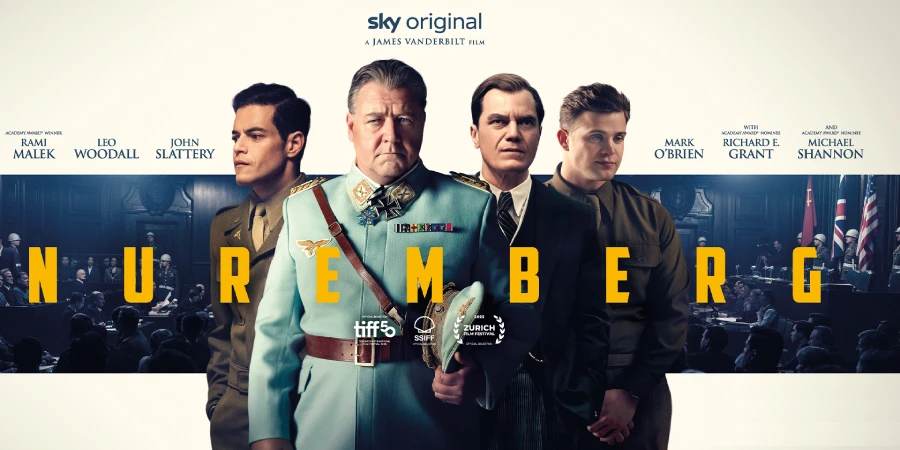

Nuremberg (2025) is an American historical drama and psychological thriller written, produced, and directed by James Vanderbilt. The film is a deep dive into the psychological and moral battles at the end of World War II, centered on the real-life Nuremberg Trials and the intense human dramas that played out behind closed doors.
Detailed Summary
Setting the Table: Post-War Europe and the Birth of Justice
In the immediate aftermath of World War II, Allied forces have defeated Nazi Germany but face a monumental challenge: how to hold its leaders accountable for unprecedented crimes against humanity. Supreme Court Justice Robert H. Jackson and his team prepare an international tribunal in Nuremberg, Germany — an event that will become a defining moment for modern law and war crimes prosecution.
The Unlikely Desk Job: Psychiatrist Douglas Kelley
Enter Major Douglas Kelley (Rami Malek), a U.S. Army psychiatrist tasked with evaluating the mental state of captured Nazi leaders — most notably Reichsmarschall Hermann Göring (Russell Crowe). Kelley’s assignment is clinical on the surface: assess whether these men are fit to stand trial and not at risk of suicide. What begins as bureaucratic duty swiftly turns into a psychological duel exploring ideology, conscience, and the darkness of power.
Mind Games with a Monster
Göring is charismatic, narcissistic, and relentless. Rather than a one-dimensional villain, he becomes a fascinating study in manipulation — charming, mocking, and psychologically probing Kelley in return. Their conversations are the emotional backbone of the movie, juxtaposing clinical objectivity with human vulnerability.
Courtroom Strategy and International Balance
As trials begin, we see attorneys like Robert H. Jackson (Michael Shannon) and Sir David Maxwell Fyfe (Richard E. Grant) wrestle with legal strategy, competing national interests, and the challenge of presenting atrocities in a way that does justice to the victims without descending into spectacle.
The Personal Toll
Kelley’s work weighs on him. Scenes focus on his internal struggle as he tries to reconcile his duty with the humanity (or lack thereof) in those he examines. Göring’s deft attempts to influence the psychiatrist and the courtroom blur the lines between psychological evaluation and intellectual combat.

Movie Ending
In the climactic final act, the Nuremberg Trials reach their terrifying culmination. Despite brilliant legal work from the prosecution, the core thematic battle remains the psychological one between Kelley and Göring. Kelley, having spent hours dissecting the minds of war architects, begins to realize that these men know precisely what they did and justify their actions with warped logic and pride.
In one of the film’s most harrowing sequences, the documentary-style courtroom scenes begin to intercut with very real footage and testimony that make it impossible for the audience — and the characters — to remain detached observers. Göring’s charisma and calculated denial evaporate as overwhelming evidence and survivor testimony expose the brutal reality of the Holocaust.
Ultimately, Göring rejects any sincere repentance and is found guilty — joining other high-ranking Nazis who are condemned for their crimes. Justice is served, but at a grim cost. Kelley’s professional detachment collapses; he understands that his role was never just a clinical job but a moral reckoning. The film closes with an emphasis on accountability and the fragility of justice, leaving the viewer with a powerful sense that the world has crossed a threshold in holding leaders accountable for atrocities.
Are There Post-Credits Scenes?
No. There are no post-credits scenes or additional sequences after the credits roll. Once the narrative concludes, the film ends definitively with its historical resolution.
Type of Movie
Nuremberg is a historical drama with psychological thriller elements, melding courtroom tension with intense interpersonal confrontations. It feels like both a period piece and a thought experiment about human conscience in the face of evil.
Cast
• Russell Crowe as Hermann Göring
• Rami Malek as Douglas Kelley
• Michael Shannon as Justice Robert H. Jackson
• Richard E. Grant as Sir David Maxwell Fyfe
• Leo Woodall, John Slattery, Mark O’Brien, Colin Hanks, Wrenn Schmidt, Lydia Peckham and others.
Film Music and Composer
The original score was composed by Brian Tyler, known for crafting bold, evocative themes that enhance both tension and emotional depth — fitting for a film where every scene wrestles with history and morale.


Filming Locations & Their Importance
Production took place primarily in Budapest, Hungary. Though the story is set in post-war Germany, Budapest’s historic architecture and controlled filmmaking environment provided a convincing stand-in for 1940s Nuremberg and allied military locations, helping ground the drama in realism.
Awards and Nominations
Nuremberg has earned several noteworthy nominations:
• AACTA International Awards 2026 — Best Film & Best Actor (Russell Crowe) nominations
• AARP Movies for Grownups Awards — Best Supporting Actor (Michael Shannon) nomination
• New York Film Critics Online — Best Picture nomination
• Various critics’ association nods for ensemble portrayal and historical depiction.
Behind the Scenes Insights
• Director James Vanderbilt researched extensively to honor historical accuracy.
• Russell Crowe learned German phrases for authenticity.
• Filming wrapped in mid-2024 and the movie premiered to a long standing ovation at TIFF 2025.
• Editor Tom Eagles brought a pacing style that some viewers found unexpectedly light in early scenes (especially humorous cuts), contrasting with the subject’s weight.
Inspirations and References
The film is based on the 2013 non-fiction book The Nazi and the Psychiatrist by Jack El-Hai, which explores true historical events around the Nuremberg trials and the psychological profiling of Nazi leaders.
Alternate Endings and Deleted Scenes
As of now, no alternate endings have been publicly released. Deleted scenes likely involve additional trial exchanges or deeper looks at certain defendants, but none have been officially shared. Keeping with most historical dramas, trimming was done in service of narrative flow rather than alternate conclusions.
Book Adaptation and Differences
While the movie draws heavily from El-Hai’s book, it condenses certain legal and psychological complexities for cinematic storytelling. The book goes further into psychiatric theory and historical documents beyond what the film can portray in 148 minutes.



Memorable Scenes and Quotes
Key Scenes
• Kelley and Göring’s first tense psychological evaluation.
• Trial testimony intercut with archival footage.
• Jackson’s courtroom strategy sessions as the tribunal unfolds.
Iconic Quotes
• “You think you understand evil… but you are only beginning.”
• “Truth is both shield and sword in this hall.”
Easter Eggs and Hidden Details
• The production design replicates real Nuremberg court documents and insignia.
• Multiple scenes feature period-accurate propaganda posters and courtroom visuals that history buffs will notice.
• Some background extras are based on real figures from trial archives.
Trivia
• Many cast members prepared with historical reading on their characters.
• Russell Crowe’s performance is widely considered a comeback effort for recognition in awards circuits.
• The depiction of routine psychiatric sessions is drawn from actual psychological reports.
Why Watch?
If you’re drawn to real history, moral complexity, exceptional character confrontations, and powerful performances, Nuremberg offers a thought-provoking experience that goes beyond a typical courtroom drama. Its focus on the human psyche amid atrocity makes it a resonant film in any era.
Director’s Other Works
- Zodiac (2007)
- Truth (2015)
- The Amazing Spider-Man 2 (2014)
- The Kingdom (2007)
Recommended Films for Fans
- Judgment at Nuremberg (1961)
- Schindler’s List (1993)
- The Reader (2008)
- A Hidden Life (2019)