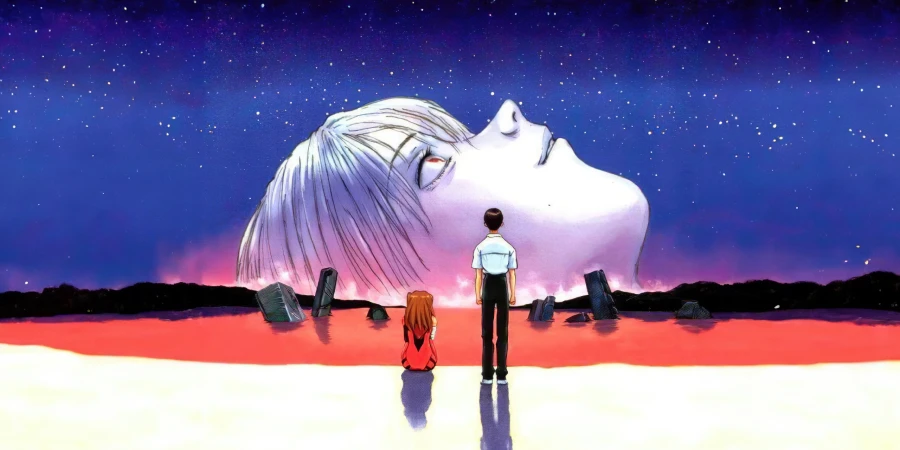

The End of Evangelion is not just a movie—it is a psychological breakdown, a philosophical statement, and a controversial farewell to one of the most influential anime series ever created. Directed by Hideaki Anno, the film serves as an alternate and complementary ending to the original Neon Genesis Evangelion TV series, replacing Episodes 25 and 26 with something far darker, louder, and brutally explicit.
Detailed Summary
The World on the Brink of Collapse
The film opens with a traumatized Shinji Ikari, emotionally shattered after the events of the series. NERV is under siege by SEELE, a secret organization determined to trigger the Human Instrumentality Project—a forced evolution of humanity into a single, shared consciousness.
From the very beginning, the tone is merciless. Humanity is not being saved. It is being dismantled.
SEELE vs NERV: Total Annihilation
SEELE launches a full-scale military assault on NERV headquarters. Unlike previous Angel battles, this is humans killing humans. Soldiers massacre NERV staff, including civilians. The violence is raw, chaotic, and intentionally uncomfortable.
Misato Katsuragi fights desperately to protect Shinji and ensure he reaches Eva Unit-01. Her final moments are a mix of heroism, regret, and unresolved emotional damage. Her death is sudden and unglamorous—exactly the point.
Asuka’s Final Stand
Revived and synchronized with Eva Unit-02, Asuka Langley Soryu experiences a psychological breakthrough. She realizes her mother’s soul is within her Eva, finally giving her the validation she always sought.
What follows is one of anime’s most iconic sequences: Asuka single-handedly annihilates SEELE’s Mass Production Evas. For a brief moment, she is unstoppable. Then reality crashes back in.
The Mass Production Evas regenerate. Asuka is brutally impaled, dismembered, and killed. Her death is long, graphic, and cruel—designed to shatter any illusion of heroism.
Shinji and the Birth of Instrumentality
Shinji merges with Eva Unit-01 as SEELE initiates Instrumentality using Rei Ayanami, who has fused with Lilith. Rei rejects Gendo Ikari’s attempt to control her and instead chooses Shinji.
This choice hands Shinji god-like authority over human existence.
Reality dissolves. Individual bodies turn into LCL, a primordial fluid. Human souls merge. There is no pain. No loneliness. No identity.
But also, no self.


Movie Ending
Shinji experiences Instrumentality as a shared mental space where all human consciousness blends together. Every fear, desire, memory, and self-loathing is exposed. He confronts visions of Misato, Asuka, Rei, and himself—each representing his inability to connect with others without pain.
At first, Shinji accepts Instrumentality. The absence of boundaries means no rejection, no abandonment, no suffering. But he realizes that without individuality, happiness has no meaning. Pain exists because connection exists. If people cannot hurt each other, they also cannot truly love each other.
Shinji makes a critical decision: he rejects Instrumentality.
This choice reverses the process. Humanity is given the option—not a guarantee—to return to physical form if they possess the will to exist as individuals again.
The world is left ruined. Red oceans. A dead god-like Rei/Lilith corpse. Silence.
In the final scene, Shinji awakens on a desolate beach beside Asuka, the first person to return from Instrumentality. Overwhelmed by fear and confusion, Shinji begins to strangle her—testing whether this reality is real, whether pain still exists.
Asuka touches his face gently and says:
“How disgusting.”
Shinji breaks down and cries.
This ending confirms that:
- Instrumentality has ended
- Individual existence has returned
- Pain, rejection, and misunderstanding still exist
- But so does choice
The ending is not hopeful in a traditional sense—but it is honest.
Are There Post-Credits Scenes?
No.
The End of Evangelion does not contain any post-credits or mid-credits scenes. Once the film ends, the silence is intentional. There is nothing left to explain.
Type of Movie
The End of Evangelion is a psychological sci-fi anime film that blends apocalyptic action with existential philosophy. It functions simultaneously as a mecha film, a character study, and a meta-commentary on audience expectations.
Cast
- Megumi Ogata – Shinji Ikari
- Yuko Miyamura – Asuka Langley Soryu
- Megumi Hayashibara – Rei Ayanami / Yui Ikari
- Kotono Mitsuishi – Misato Katsuragi
- Fumihiko Tachiki – Gendo Ikari
- Motomu Kiyokawa – SEELE Chairman Keel Lorenz
Film Music and Composer
The score was composed by Shiro Sagisu, whose music blends orchestral, choral, and experimental elements.
Tracks like “Komm, süsser Tod” play a crucial narrative role, ironically underscoring humanity’s extinction with a pop-like melody.


Filming Locations
As an animated film, The End of Evangelion was produced at Gainax studios in Japan. Its importance lies not in physical locations but in its production environment, created under extreme time pressure and emotional strain following backlash to the TV series ending.
Awards and Nominations
- Japan Media Arts Festival – Jury Selection (1997)
- Animage Anime Grand Prix – Feature Film Recognition
While not heavily awarded at release, the film’s critical reputation has grown enormously over time.
Behind the Scenes Insights
- The film was partially funded by fans due to Gainax’s financial issues.
- Some live-action sequences include real letters from angry fans criticizing the TV ending.
- Hideaki Anno was reportedly suffering from severe depression during production.
- The hospital scene was intentionally designed to shock and alienate the audience.
- The film directly responds to criticism of the TV series ending.
Inspirations and References
- Freudian and Jungian psychology
- Judeo-Christian imagery (used symbolically, not religiously)
- Arthur Schopenhauer’s philosophy of suffering
- Anno’s personal struggles with depression
- Earlier mecha anime like Space Runaway Ideon
Alternate Endings and Deleted Scenes
There is no traditional alternate ending, but:
- Episodes 25 and 26 of the TV series represent a different perspective of Instrumentality
- Some deleted animation sequences were cut due to time constraints
- Early drafts were reportedly even more nihilistic
Book Adaptations and Differences
The film is part of the Neon Genesis Evangelion franchise, originally an anime, not a book.
However, manga adaptations by Yoshiyuki Sadamoto offer more character clarity and emotional grounding, especially for Shinji and Asuka, compared to the film’s abstract brutality.



Memorable Scenes and Quotes
Key Scenes
- The assault on NERV headquarters
- Asuka vs Mass Production Evas
- Rei’s betrayal of Gendo
- The Third Impact sequence
- Shinji and Asuka on the beach
Iconic Quotes
- “Anywhere can be paradise as long as you have the will to live.”
- “This is the end of Evangelion.”
- “How disgusting.”
Easter Eggs and Hidden Details
- Cross-shaped explosions parody Western religious symbolism
- SEELE’s monoliths resemble coffins
- Live-action footage blurs fiction and reality
- Eva Unit-01 is framed as both god and monster
- Red ocean symbolizes irreversible trauma
Trivia
- The film caused walkouts during its initial theatrical release
- It was banned or censored in some regions
- Quentin Tarantino has cited Evangelion as influential
- The hospital scene remains one of anime’s most controversial moments
- The title card appears after the world ends
Why Watch?
Because The End of Evangelion is not comfortable, not reassuring, and not forgiving.
It challenges the viewer emotionally and philosophically, asking whether existence—with all its pain—is still worth choosing.
Director’s Other Works (Movies)
- Love & Pop (1998)
- Ritual (2000)
- Shiki-Jitsu (2000)
- Cutie Honey (2004)
- Evangelion: 1.0 You Are (Not) Alone (2007)
- Evangelion: 2.0 You Can (Not) Advance (2009)
- Evangelion: 3.0 You Can (Not) Redo (2012)
- Evangelion: 3.0+1.0 Thrice Upon a Time (2021)
Recommended Films for Fans
- Akira (1988)
- Ghost in the Shell (1995)
- Perfect Blue (1997)
- Paprika (2006)
- Angel’s Egg (1985)
- Serial Experiments Lain (1998)