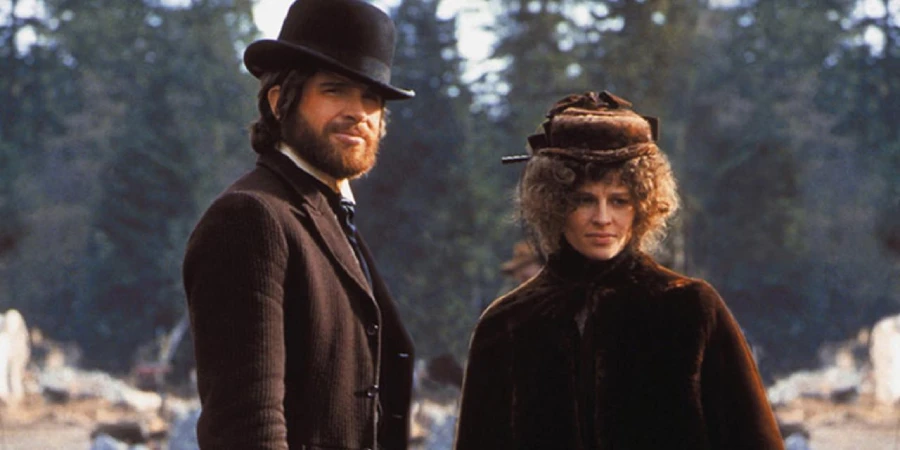

Robert Altman’s McCabe & Mrs. Miller is not your typical Western. It quietly dismantles the myth of the American frontier and replaces it with something colder, sadder, and far more human. Released in 1971, the film has since become one of the most influential anti-Westerns ever made.
Detailed Summary
Arrival of a Not-So-Confident Gunman
John McCabe arrives in the muddy frontier town of Presbyterian Church, Washington, projecting confidence but clearly improvising his reputation. Rumors suggest he’s a famous gunfighter, yet Altman deliberately undermines this myth from the start. McCabe builds status not through violence, but through storytelling, bluffing, and business deals.
Enter Mrs. Miller: Pragmatism Meets Illusion
Constance Miller arrives soon after and quickly proves herself sharper than everyone else. She partners with McCabe to run a profitable brothel, introducing order, accounting, and capitalism to his loose ambitions. Their relationship is transactional, emotionally distant, and painfully modern for a Western.
Civilization as a Threat
As the town grows, large mining interests notice McCabe’s success. Representatives from the Harrison Shaughnessy corporation offer to buy him out. McCabe refuses, believing his own legend. This decision seals his fate. In Altman’s world, capitalism is more dangerous than guns.
The Slow Approach of Violence
Rather than escalating into a heroic showdown, the film drifts toward violence with dread and inevitability. Hired killers arrive quietly. The town continues its daily routine, indifferent. There is no rallying of allies, no swelling music, no honor.
Movie Ending
McCabe is hunted through the snow-covered town by three professional killers. He is terrified, improvising traps, hiding behind buildings, and barely surviving through luck rather than skill. One by one, he manages to kill them, not heroically, but desperately.
In the final moments, McCabe is shot and collapses alone in the snow. No one comes to help him. The town is distracted by a church fire, symbolizing misplaced priorities and the rise of hollow civilization. McCabe bleeds to death unnoticed.
Meanwhile, Mrs. Miller isolates herself in an opium den, choosing numbness over grief. They never say goodbye. They never truly connect. The film ends with parallel loneliness: McCabe dead in the snow, Mrs. Miller lost in smoke.
This ending deliberately denies the audience catharsis. There is no victory, no justice, and no romance. The frontier does not reward dreams—it erases them.
Are There Post-Credits Scenes?
No. McCabe & Mrs. Miller does not include post-credits or mid-credits scenes. The film ends quietly and definitively, consistent with its somber tone.
Type of Movie
McCabe & Mrs. Miller is a revisionist Western that blends drama and romance while actively rejecting traditional Western heroism. It focuses on atmosphere, realism, and emotional distance rather than action or moral clarity.
Cast
- Warren Beatty as John McCabe
- Julie Christie as Constance Miller
- René Auberjonois as Sheehan
- Michael Murphy as Sears
- Shelley Duvall as Ida Coyle
Julie Christie’s performance, in particular, stands out for its restraint and emotional opacity.
Film Music and Composer
The soundtrack is built almost entirely around songs by Leonard Cohen, including “The Stranger Song” and “Sisters of Mercy.” Rather than functioning as background music, the songs act as emotional commentary, reinforcing the film’s themes of isolation and quiet despair.
Filming Locations and Their Importance
The film was shot primarily in West Vancouver and Squamish, British Columbia.
The constant rain, fog, and mud were not artificial; Altman embraced the harsh weather to strip the West of its romantic sheen. These locations reinforce the idea that the frontier is uncomfortable, hostile, and morally indifferent.
Awards and Nominations
- Nominated for Academy Award – Best Actress in a Leading Role (Julie Christie)
- Nominated for Academy Award – Best Cinematography
Though not a box-office success at release, the film is now widely regarded as a classic.
Behind-the-Scenes Insights
- Robert Altman encouraged overlapping dialogue, confusing many actors initially.
- Snowfall in the final scenes was real and unplanned, adding to the ending’s realism.
- Warren Beatty later admitted the film challenged his star image intentionally.
- The muddy town was constructed from scratch and left to decay naturally during shooting.
Inspirations and References
- Inspired by Edmund Naughton’s novel McCabe (1959)
- Influenced by European art cinema, particularly French New Wave realism
- A direct response to classic Hollywood Westerns that glorified lone gunmen
Alternate Endings and Deleted Scenes
No alternate ending was filmed. Altman was firm about the bleak conclusion. Several character moments were trimmed during editing, mostly involving town residents, to preserve the film’s drifting, detached rhythm.
Book Adaptation and Differences
While based on Naughton’s novel, the film significantly softens McCabe and deepens Mrs. Miller’s character. The novel presents McCabe as more traditionally assertive, whereas the film portrays him as fragile and self-deluding.
Memorable Scenes and Quotes
Key Scenes
- McCabe’s first appearance, awkwardly establishing his reputation
- Mrs. Miller negotiating business terms with icy precision
- The silent snowbound final chase
Iconic Quotes
- “I got poetry in me.” – McCabe
- “You’re a damn fool, McCabe.” – Mrs. Miller
Easter Eggs and Hidden Details
- The church fire mirrors McCabe’s death, symbolizing false progress
- Many background conversations contain plot hints but are intentionally hard to hear
- Mrs. Miller’s increasing opium use visually replaces emotional dialogue
Trivia
- The film ranked #8 in the AFI Top 10 Westerns
- Altman considered it his most personal film
- Leonard Cohen reportedly didn’t know his music was used until after release
Why Watch McCabe & Mrs. Miller?
If you’re tired of clean heroes and clear morals, this film is essential viewing. It’s a Western about loneliness, capitalism, and emotional failure, wrapped in snow and silence. It rewards patience and reflection rather than excitement.
Director’s Other Works
- M*A*S*H (1970)
- The Long Goodbye (1973)
- Nashville (1975)
- Short Cuts (1993)
- Gosford Park (2001)
Recommended Films for Fans
- The Assassination of Jesse James by the Coward Robert Ford (2007)
- Dead Man (1995)
- Unforgiven (1992)
- Pat Garrett & Billy the Kid (1973)
- Heaven’s Gate (1980)