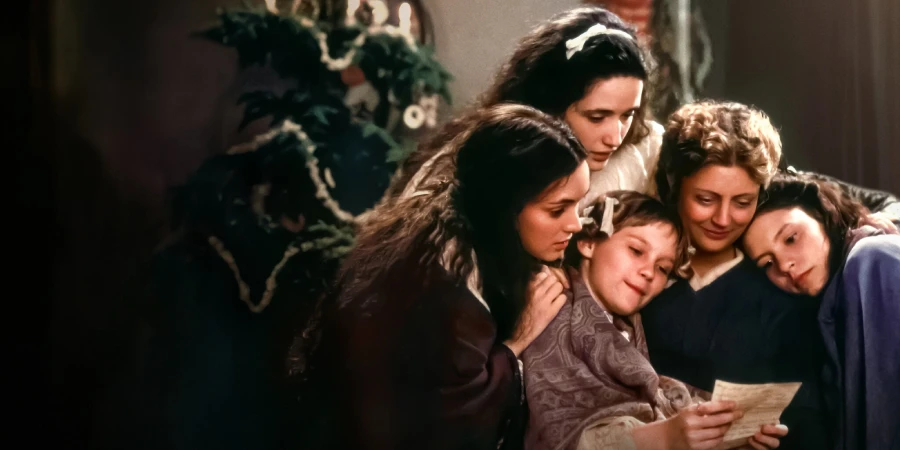

Little Women (1994) is a heartfelt literary adaptation that balances warmth, restraint, and emotional depth. Directed by Gillian Armstrong, the film is often regarded as one of the most faithful and emotionally resonant versions of Louisa May Alcott’s classic novel.
Detailed Summary
A Family Shaped by Absence and Love
Set during and after the American Civil War, the story centers on the March family: Marmee and her four daughters—Meg, Jo, Beth, and Amy—living modestly in Massachusetts while their father serves as a chaplain in the war. The girls grow up navigating poverty, ambition, illness, love, and loss, each representing different paths available to women in the 19th century.
Jo March and the Desire for Independence
Jo, the most headstrong of the sisters, dreams of becoming a writer and fiercely resists traditional expectations of marriage. Her friendship with the wealthy and charming Laurie provides emotional grounding, though their temperaments clash romantically. Jo’s journey is the emotional backbone of the film, highlighting the tension between personal freedom and societal norms.
Meg’s Choice: Love Over Wealth
Meg experiences the temptations of high society but ultimately chooses a simpler life with John Brooke, valuing love and dignity over luxury. Her storyline reinforces one of the film’s central ideas: fulfillment does not always come from ambition or status.
Beth’s Illness and Quiet Strength
Beth, the gentlest sister, contracts scarlet fever after caring for a poor family. Though she initially recovers, her health never fully returns. Her quiet acceptance of life and death deeply affects Jo and marks the film’s most emotionally devastating arc.
Amy’s Growth and Unexpected Romance
Amy begins as vain and impulsive but matures through hardship and self-awareness. While traveling in Europe with Aunt March, she reconnects with Laurie. Their shared growth leads to a romance that surprises Jo—and the audience—by its sincerity and balance.


Movie Ending
The film’s final act carefully resolves each character’s arc with emotional clarity. Beth passes away peacefully, a loss that profoundly reshapes the March family and especially Jo, who finally confronts her fear of emotional attachment. Beth’s death is not sensationalized; it is quiet, intimate, and deeply human.
Laurie returns married to Amy, having found in her a partner who shares both affection and ambition. Jo, initially heartbroken, ultimately accepts that their bond was always rooted in friendship rather than romantic destiny.
Jo travels to New York, where she befriends Professor Friedrich Bhaer, an older, thoughtful intellectual who challenges her writing and worldview. After rejecting his proposal out of fear and uncertainty, Jo returns home. When she learns that her novel about her family has been accepted for publication—on the condition that the heroine marries—she compromises creatively but not emotionally.
In the final scenes, Jo realizes that love does not require surrendering independence. She runs after Bhaer in the rain, confessing her love. The film closes with Jo opening a school in the family home, funded by her book’s success, symbolizing a future where creativity, love, and independence coexist.
Are There Post-Credits Scenes?
No. Little Women (1994) does not include any post-credits or mid-credits scenes. The story concludes fully within the final moments of the film.
Type of Movie
Little Women is a period drama and literary adaptation that focuses on family, personal growth, and women’s roles in society, with strong emotional and character-driven storytelling rather than plot twists or spectacle.
Cast
- Winona Ryder as Jo March
- Susan Sarandon as Marmee
- Trini Alvarado as Meg March
- Samantha Mathis as Amy March
- Claire Danes as Beth March
- Christian Bale as Laurie
- Gabriel Byrne as Professor Bhaer
- Kirsten Dunst as young Amy March
Film Music and Composer
The score was composed by Thomas Newman, whose music subtly enhances the film’s emotional texture. The soundtrack emphasizes warmth and nostalgia without overwhelming the narrative, supporting intimate family moments rather than dominating them.



Filming Locations
- Massachusetts: Used extensively to capture the authentic New England setting of the March family home.
- Virginia and Canada: Provided period-accurate landscapes for winter and rural scenes.
These locations reinforce the film’s grounded realism and emotional intimacy, making the setting feel lived-in rather than theatrical.
Awards and Nominations
- Academy Awards (1995)
- Nominated: Best Actress (Winona Ryder)
- Nominated: Best Costume Design
- Nominated: Best Original Score
- BAFTA Awards
- Nominated: Best Actress
The film was especially praised for its performances and faithfulness to the source material.
Behind the Scenes Insights
- Gillian Armstrong intentionally framed the story through Jo’s perspective, emphasizing female agency.
- Winona Ryder was instrumental in getting the film made and served as an uncredited producer.
- Susan Sarandon drew inspiration from her own experiences as a mother.
- The production emphasized natural lighting to enhance realism and warmth.
Inspirations and References
- Based on “Little Women” (1868) by Louisa May Alcott.
- Influenced by Alcott’s semi-autobiographical life.
- The film draws stylistically from classic literary adaptations of the 1940s while maintaining a modern emotional sensibility.
Alternate Endings and Deleted Scenes
- Some extended family scenes were trimmed for pacing, particularly those involving Aunt March.
- No known alternate ending exists; Armstrong was committed to honoring the novel’s conclusion, including Jo’s marriage, while framing it as a conscious choice rather than surrender.
Book Adaptations and Differences
- The film remains largely faithful but softens Jo’s resistance to marriage, making her choice feel more emotionally driven.
- Amy is portrayed more sympathetically than in the book.
- The timeline is slightly condensed to maintain narrative flow.


Memorable Scenes and Quotes
Key Scenes
- Jo selling her hair to help her family
- Beth’s final moments with Jo
- Jo running through the rain to find Professor Bhaer
- The sisters performing plays in their attic
Iconic Quotes
- “I want to do something splendid before I go into my castle.” – Jo
- “I am not afraid of storms, for I am learning how to sail my ship.” – Amy
- “Women have minds and souls as well as hearts.” – Jo
Easter Eggs and Hidden Details
- Jo’s manuscript closely resembles Alcott’s original handwriting style.
- Costume colors subtly shift as the sisters mature.
- The school at the end mirrors Alcott’s real-life educational interests.
Trivia
- Christian Bale was not initially cast as Laurie; he replaced another actor late in pre-production.
- Kirsten Dunst was only 11 years old during filming.
- The film helped redefine Winona Ryder’s career toward literary and dramatic roles.
Why Watch?
Because it is emotionally sincere, literarily respectful, and quietly powerful. This adaptation understands that growth is often subtle, painful, and deeply human. It remains one of the most beloved versions for a reason.
Director’s Other Works
- My Brilliant Career (1979)
- Mrs. Soffel (1984)
- Oscar and Lucinda (1997)
- Charlotte Gray (2001)
Recommended Films for Fans
- Sense and Sensibility (1995)
- Pride & Prejudice (2005)
- Emma (1996)
- The Age of Innocence (1993)
- Anne of Green Gables (1985)