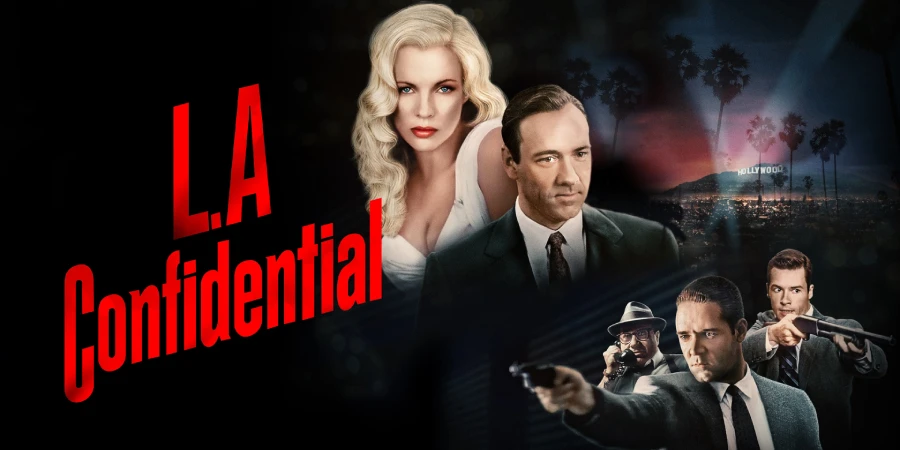
L.A. Confidential plunges viewers into the sun-drenched corruption of 1950s Hollywood. Its genius lies not just in its intricate mystery, but in its trio of flawed policemen, each chasing a different version of justice. This is a story where heroism and villainy wear the same badge, and the truth is buried under layers of ambition and deceit.
Detailed Summary
The “Bloody Christmas” Scandal
The film introduces us to three LAPD detectives on Christmas Eve 1951. Sergeant Ed Exley (Guy Pearce) is an ambitious, by-the-book officer, eager to climb the ladder and escape his famous detective father’s shadow. In contrast, Officer Bud White (Russell Crowe) is a brutish enforcer, using his fists to dispense his own brand of justice, especially against men who abuse women.
Rounding out the trio is Sergeant Jack Vincennes (Kevin Spacey), a slick celebrity cop who acts as a technical advisor on a TV show called Badge of Honor. He also works with Sid Hudgens (Danny DeVito), the publisher of the sleazy tabloid Hush-Hush, to stage celebrity arrests for a fee. Consequently, a fight at a police station, where officers beat up several Hispanic prisoners, becomes a public scandal known as “Bloody Christmas.” Exley testifies against his fellow officers, earning him a promotion but also the deep-seated hatred of his colleagues, especially Bud.
The Nite Owl Massacre
The central plot ignites with a brutal mass murder at the Nite Owl coffee shop. Among the dead is a disgraced ex-cop, Dick Stensland, who was Bud White’s former partner. This personal connection drives Bud to investigate the crime independently, focusing his attention on one of the victims, a young woman named Susan Lefferts.
Meanwhile, the ambitious Exley sees the high-profile case as his ticket to the top. He meticulously follows the official leads, believing a straightforward investigation will solve the crime. The two detectives, already at odds, begin to circle the same dark conspiracy from completely different angles.
A Frame-Up and a “Hero”
Exley’s investigation points to three young Black men as the primary suspects in the Nite Owl massacre. Following a lead, Exley corners them in their hideout. As a result, a violent shootout ensues, and Exley kills one of the men in what appears to be self-defense before the others are gunned down by backup officers.
The LAPD declares the Nite Owl case solved, and Exley is hailed as a hero, earning him the prestigious Detective Lieutenant rank. However, Bud White and Jack Vincennes both suspect the resolution is too neat. The evidence feels planted, and the official story simply does not add up.
The Unraveling Conspiracy
Bud’s investigation into Susan Lefferts leads him to her employer, Pierce Patchett (David Strathairn). Patchett runs a high-end prostitution ring called Fleur-de-Lis, where his girls are surgically altered to resemble famous movie stars. It is here that Bud meets and falls for Lynn Bracken (Kim Basinger), a prostitute who looks like Veronica Lake.
Meanwhile, Jack Vincennes investigates the death of a young actor he helped set up for a bust. This leads him to the same dark world of Patchett and his operation. He and Exley reluctantly team up, realizing the Nite Owl case, the prostitution ring, and city corruption are all deeply intertwined.
“Rollo Tomasi”
A crucial turning point for Exley comes when he interrogates one of the framed Nite Owl suspects. He realizes the men are innocent but fails to stop their deaths. Later, when an informant is murdered before he can talk, Exley asks the dying man for the killer’s name. The man has no idea, so Exley asks him to name the man who got away with it.
The man gasps, “Rollo Tomasi.” Exley adopts this name as a symbol for the faceless criminals who escape justice. For the first time, his ambition is superseded by a true desire to find the real truth, no matter the cost.
Connecting the Dots
Exley and Vincennes discover that the slain officer from the Nite Owl, Dick Stensland, was being paid by Patchett. They suspect Patchett, along with organized crime figure Mickey Cohen‘s former muscle, is trying to seize control of L.A.’s criminal empire. Their investigation, however, leads them straight to their own commanding officer, Captain Dudley Smith (James Cromwell).
Vincennes goes to Smith’s house to confront him, only for Smith to reveal himself as the conspiracy’s mastermind. Smith shoots and kills Vincennes, uttering the name “Rollo Tomasi” as Jack dies. This confirms to a horrified Exley that his own captain is the villain he has been hunting.
Movie Ending
The final act explodes at the derelict Victory Motel. Bud White, believing Exley and Lynn Bracken are having an affair, confronts Exley in an interrogation room. Exley finally convinces Bud that Captain Dudley Smith is the real enemy, the man behind the Nite Owl massacre and the entire criminal conspiracy.
They arrange a trap for Smith and his corrupt cops at the motel. A ferocious, bloody shootout erupts, with Bud and Exley fighting for their lives against Smith’s men. Bud sustains life-threatening injuries while saving Exley, and in return, Exley uses his tactical mind to methodically eliminate the remaining crooked officers.
In the end, only Exley and a wounded Dudley Smith remain. Smith, confident in his untouchable status, tries to talk his way out of it. Instead, Exley shoots him dead. To protect the LAPD’s reputation from a catastrophic scandal, the department brass agrees to a cover-up. They posthumously paint Dudley Smith as a hero who died fighting criminals at the motel. Exley is promoted again, finally getting the glory he craved, but now tainted by the corrupt compromise he had to make. Bud White survives his injuries, and Lynn Bracken drives him away to start a new, quiet life in Arizona, leaving the City of Angels behind for good.
Are There Post-Credits Scenes?
No, L.A. Confidential has no post-credits scenes. The film was released in 1997, before the trend of adding extra scenes after the credits became common practice, especially for crime dramas.
Type of Movie
L.A. Confidential is a quintessential neo-noir crime thriller. It embodies the classic noir elements of a cynical worldview, a complex criminal mystery, and a morally ambiguous protagonist (or in this case, three of them). However, its modern filmmaking techniques, color cinematography, and explicit violence firmly place it in the neo-noir subgenre.
The tone is dark, sophisticated, and deeply cynical. It presents a glamorous 1950s Los Angeles on the surface, while meticulously revealing the rot and corruption festering underneath. Ultimately, it’s a story about the near-impossibility of true justice in a broken system.
Cast
- Russell Crowe – Officer Wendell “Bud” White
- Guy Pearce – Sgt. Edmund “Ed” Exley
- Kevin Spacey – Sgt. Jack Vincennes
- Kim Basinger – Lynn Bracken
- James Cromwell – Captain Dudley Smith
- Danny DeVito – Sid Hudgens
- David Strathairn – Pierce Patchett
- Ron Rifkin – D.A. Ellis Loew
Film Music and Composer
The score for L.A. Confidential was composed by the legendary Jerry Goldsmith. His work on the film earned him an Academy Award nomination for Best Original Dramatic Score. The music is a masterful blend of jazz-infused themes that evoke the 1950s setting and tense, orchestral arrangements that heighten the suspense.
Goldsmith’s main theme is both sleek and ominous, perfectly capturing the film’s dual nature of Hollywood glamour and dark underbelly. Notably, the score avoids typical noir clichés, instead creating a modern, psychologically-driven soundscape that supports the complex narrative.

Filming Locations
Director Curtis Hanson insisted on shooting L.A. Confidential in and around Los Angeles to achieve maximum authenticity. Many of the locations were historic spots that still retained their 1950s character. For instance, scenes were filmed at the Frolic Room on Hollywood Boulevard, a real vintage bar visited by historical figures like Howard Hughes.
Other key locations included City Hall, the Pacific Electric Building, and various neighborhoods in Hollywood and Echo Park. Using these real locations was crucial, as they ground the fictional story in a tangible, historical reality and make the city itself a central character in the film.
Awards and Nominations
L.A. Confidential was a major critical success and a prominent contender during the 1998 awards season. It received nine Academy Award nominations, including for Best Picture and Best Director. Ultimately, it won two Oscars.
Kim Basinger won the Academy Award for Best Supporting Actress for her portrayal of Lynn Bracken. Director Curtis Hanson and screenwriter Brian Helgeland also won the Oscar for Best Adapted Screenplay for their brilliant condensation of James Ellroy’s massive novel.
Behind the Scenes Insights
- Director Curtis Hanson had to fight to cast Australian actors Russell Crowe and Guy Pearce, who were relatively unknown in America at the time. Studio executives were nervous, but Hanson’s vision prevailed.
- To pitch his vision for the film, Hanson created a “look book” of vintage photographs, postcards, and articles to show producers what he wanted the city and characters to feel like.
- Hanson made Crowe and Pearce live in Los Angeles for several months before filming to immerse themselves in the city and lose their Australian accents.
- A genuine friction reportedly existed between Crowe and Pearce off-screen during the production. Both actors have since admitted that this tension helped fuel their characters’ on-screen animosity.
Inspirations and References
The film’s plot is fiction, but it is deeply rooted in the real history of 1950s Los Angeles. The “Bloody Christmas” incident depicted at the start of the film was based on a real police brutality scandal that occurred at the LAPD in 1951. Additionally, the power vacuum left by the real-life imprisonment of mob boss Mickey Cohen is a central plot driver.
The film’s atmosphere is also heavily inspired by the sensationalist tabloid journalism of the era, epitomized by the fictional Hush-Hush magazine, which was a stand-in for the real, infamous scandal sheet Confidential.
Alternate Endings and Deleted Scenes
No major alternate ending for L.A. Confidential has ever been released. The conclusion seen in the film, where Bud leaves with Lynn and Exley stays behind, is the definitive one. This ending differs slightly from the book but was considered the most satisfying conclusion for the cinematic story.
Several deleted scenes exist but were removed for pacing. These include more footage of Jack Vincennes on the set of his TV show Badge of Honor and an extended sequence where Sid Hudgens details his sordid business to Jack.
Book Adaptations and Differences
L.A. Confidential is based on the 1990 novel of the same name by crime author James Ellroy. Ellroy’s book is famously dense, sprawling, and significantly darker than the film. It features numerous additional subplots, a larger cast of characters, and a far more complex conspiracy.
Screenwriters Brian Helgeland and Curtis Hanson skillfully streamlined the narrative to focus on the core trio of White, Exley, and Vincennes. They cut many characters and intricate plot threads, such as a major storyline involving a troubled family and a series of copycat killings. As a result, the film is a masterclass in adaptation, capturing the spirit of Ellroy’s world while creating a tight, focused cinematic experience.

Memorable Scenes and Quotes
Key Scenes
- The Nite Owl Massacre: The discovery of the bodies at the coffee shop, a chilling and brutal inciting incident that sets the tone for the entire film.
- The “Rollo Tomasi” Interrogation: Exley’s haunting conversation with a dying informant, which becomes the philosophical and moral turning point for his character.
- The Death of Jack Vincennes: A shocking and sudden twist where Captain Dudley Smith reveals his villainy and murders Jack in his own home.
- The Victory Motel Shootout: The climactic, brilliantly choreographed gunfight where Bud and Exley finally take on Dudley’s entire corrupt crew in a brutal battle for survival.
Iconic Quotes
- “Rollo Tomasi.” – Ed Exley
- “Go back to Jersey, sonny. This is the City of the Angels, and you haven’t got any wings.” – Captain Dudley Smith
- “A rumor is not a reckless disregard for the truth.” – Sid Hudgens
- “Some men get the world. Others get ex-hookers and a trip to Arizona.” – Lynn Bracken
- “Would you be willing to beat a confession out of a suspect you knew to be guilty… to close a case on a drug that’s poisoning the youth of our city?” – Ed Exley
Easter Eggs and Hidden Details
- The gossip magazine Hush-Hush is a direct parody of the real 1950s scandal magazine Confidential, which was known for exposing the secret lives of Hollywood stars.
- Throughout the film, real-life mobsters Mickey Cohen and Johnny Stompanato are mentioned, grounding the fictional plot in real-world gangland history.
- When D.A. Ellis Loew is blackmailed, the photos show him with another man. The actor in the photo with him is writer and producer Brian Helgeland in a cameo.
- Lana Turner, a real movie star, makes a brief appearance in a scene with Jack Vincennes. Her boyfriend at the time was the aforementioned gangster Johnny Stompanato.
Trivia
- Director Curtis Hanson gave his three lead actors different films to watch to prepare for their roles. Guy Pearce watched The Man Who Shot Liberty Valance, Russell Crowe watched The Killing, and Kevin Spacey watched films starring Dean Martin for his character’s suave demeanor.
- The title of Jack Vincennes’ TV show, Badge of Honor, is a clear homage to Jack Webb’s hugely popular and influential police procedural series, Dragnet.
- James Ellroy, the author of the source novel, was extremely pleased with the film adaptation. He praised it for capturing the essence of his work while succeeding as a standalone piece of cinema.
Why Watch?
This film is a masterclass in storytelling. With powerhouse performances and a dizzyingly clever script, it delivers a complex mystery that respects its audience’s intelligence. It remains a high watermark for modern crime cinema and a truly unforgettable watch.
Director’s Other Movies
- The Hand That Rocks the Cradle (1992)
- The River Wild (1994)
- Wonder Boys (2000)
- 8 Mile (2002)
Recommended Films for Fans
- Chinatown (1974)
- The Usual Suspects (1995)
- The Big Sleep (1946)
- Se7en (1995)
- Zodiac (2007)
- The Black Dahlia (2006)
- Mulholland Drive (2001)
- The Maltese Falcon (1941)
- Farewell, My Lovely (1975)
- Snake Eyes (1998)
- Hollywoodland (2006)
- No Sudden Move (2021)