
Detailed Summary
Beginning: Pop Stars and Secret Fighters
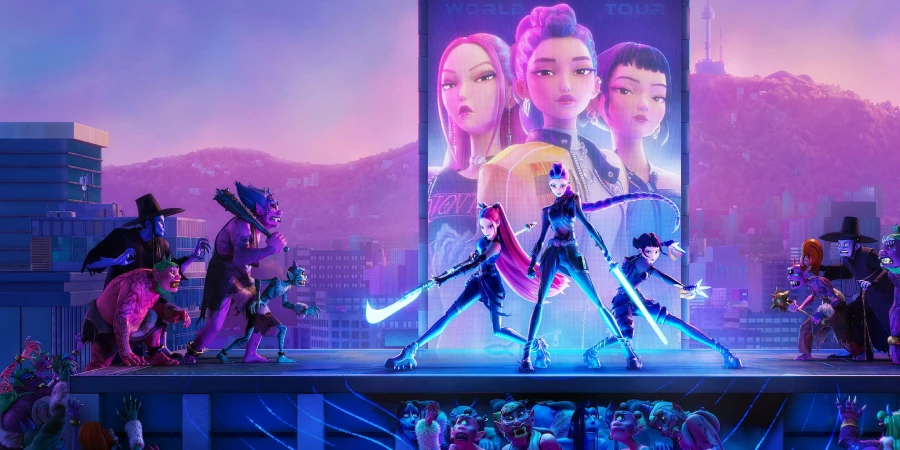
The film introduces the girl-group Huntr/x, composed of Rumi, Mira, and Zoey, as global K-pop superstars who on the surface sell out concerts — but behind the curtain lead a double life: they are secretly demon hunters protecting humanity from supernatural threats.
We quickly see action early: demons attempt to attack during one of their shows — Huntr/x fights them off, proving that their world-tour persona and demon-slaying identity go hand in hand.
Rising Conflict: The Rival Band and Hidden Mythology
The main antagonistic thrust emerges when a demon named Jinu (voiced by Ahn Hyo-seop) is allowed by the demon lord Gwi‑Ma to form a rival boy-band — the Saja Boys. Their mission: steal fans away from Huntr/x and thereby weaken the barrier keeping demons out of the human world.
Meanwhile, viewers learn about the concept of the Honmoon, a protective barrier powered by the fans’ devotion and Huntr/x’s music. If the Honmoon remains strong, it keeps demons sealed away. But if the rival band drains their fan base, the world becomes vulnerable.
As the Saja Boys rise, the stakes escalate. Huntr/x struggles not just with external demon attacks — but with internal doubts, identity issues (especially for Rumi), and the difficult balance between fame and duty.
Climax: The Battle for Souls and the Truth Behind the Mission
Tensions culminate when the plan of Gwi-Ma and the Saja Boys is revealed: by stealing fans and corrupting the Honmoon, demons could flood the human world and consume souls. Huntr/x must confront not only demons but also the moral implications of what they are doing — and question whether sealing away demons is the right path.
Rumi in particular grapples with her identity (she has demonic heritage, as revealed in the film), making the threat deeply personal.


Movie Ending
By the film’s end, after a dramatic final showdown — accompanied by the energetic anthem “What It Sounds Like” — Rumi realizes the existing plan (sealing demons via the Honmoon) is fundamentally flawed. Instead of reinforcing the barrier, she chooses to destroy the Honmoon along with the notion of a permanent demon/human divide.
In doing so, she returns Jinu’s soul (he had been manipulated), and thereby the Saja Boys’ threat dissolves. Huntr/x defeats the demonic conspiracy, saving their fans and restoring balance. The ending conveys a message of self-acceptance: Rumi no longer hides her demonic patterns — she embraces her identity.
The film concludes with Rumi, Mira and Zoey deciding not to take a break — instead they reconnect with their fans, celebrating victory and unity.
Are There Post-Credits Scenes?
No — there are no post-credits scenes in KPop Demon Hunters. The film ends conclusively with the restoration of balance and the group’s decision to stay together.
Type of Movie
KPop Demon Hunters is an animated musical fantasy film with heavy influences from pop culture, K-pop aesthetics and action-comedy — mixing supernatural fantasy, musical numbers, and stylized combat in a vibrant urban-fantasy setting.
Cast
- Arden Cho as Rumi (voice)
- May Hong as Mira (voice)
- Ji-young Yoo as Zoey (voice)
- Ahn Hyo-seop as Jinu (voice) / member of Saja Boys
- Byung-hun Lee as Gwi-Ma, the demon lord
- Additional voices: Ken Jeong, Daniel Dae Kim, Yunjin Kim, Joel Kim Booster, Liza Koshy, among others.
Film Music and Composer
The score was composed by Marcelo Zarvos, and the film features a dynamic soundtrack filled with original songs by the fictional group Huntr/x — blending pop, fantasy, and action sensibilities.
The music is widely regarded as one of the film’s strongest assets, contributing significantly to its energy, emotional weight, and overall appeal.



Awards and Nominations
- KPop Demon Hunters (2025) quickly became one of the most celebrated animated films of the year. Critics praised its vibrant animation and infectious soundtrack, and audiences responded in kind, making it a cultural phenomenon.
- At the 98th Academy Awards (2026), it won Best Animated Feature, marking a milestone for K‑Pop-inspired cinema.
- The film’s signature song, “Golden”, earned both an Oscar and a Grammy for Best Original Song and Best Song Written for Visual Media, respectively—an unprecedented achievement for a K‑Pop track in a Western film context.
- It also won Best Animated Feature at the Golden Globes and the Critics’ Choice Awards, cementing its critical acclaim.
- Beyond awards, the film’s soundtrack dominated charts, and its streaming success helped define 2025 as a landmark year for animated films blending music and storytelling. while not traditional “awards” — mark it as one of the defining animated films of 2025.
Behind the Scenes Insights
- The concept originated from co-director Maggie Kang, who wanted to combine her Korean cultural heritage with mythology, demonology, and modern pop music to create something fresh.
- The film was produced by Sony Pictures Animation, and animated by its in-house team, with strong influences from concert lighting, music video cinematography, and even Korean dramas — a deliberate stylistic choice blending music-video aesthetics and fantasy animation.
- The writing team (Maggie Kang, Chris Appelhans, Danya Jimenez, Hannah McMechan) balanced musical sequences, action, mythological lore and pop culture references — a complex juggling act that gives the film both its rhythm and emotional core.
Inspirations and References
The film draws from:
- Korean pop (K-pop) culture and the global idol phenomenon — the idea of a girl group balancing fame and a hidden life.
- Urban fantasy and demonology tropes, mixing supernatural horror (demons, souls, ancient evil) with modern entertainment world tropes, creating a unique hybrid.
- Visual inspirations from music videos, concert stage lighting and choreography, giving animated sequences the energy and visual flair typical of idol performances.
Alternate Endings and Deleted Scenes
As of now, there is no public information about alternate endings or significant deleted scenes. The film ends definitively with the destruction of the Honmoon barrier and resolution of the main conflict. Official sources do not mention any “alternate take” released to audiences.
Memorable Scenes and Quotes
Key Scenes
- The opening concert-cum-demon-fight — demons crash a live show, but Huntr/x fights them off and then continues performing as if nothing happened. Sets the tone: pop + danger.
- The reveal of the Honmoon concept — the mystical barrier protected by fans’ belief and music. It reframes the idol-fan relationship as literal world-saving power.
- The final showdown where Huntr/x battles the Saja Boys and demon forces, culminating in the decision to destroy the barrier and reject the old dichotomy between humans and demons.
Iconic Quotes
Because the film is musical and fast-paced, many impactful lines are delivered during songs rather than isolated dialogue — but the emotional turn by Rumi, realizing what they fight for, serves as a thematic fulcrum. Several fans have noted that “the soundtrack hits harder than expected.”
Easter Eggs and Hidden Details
- The lore of the Honmoon subtly mirrors classic “idol fandom energy” — implying what fans give emotionally (support, devotion) can be literal power.
- The designs, color schemes and performance sequences often reference real-world K-pop concert aesthetics — stage lighting, choreography, poster-frames, backstage posters — paying homage to actual idol culture.
- Some fans point out that the story structure echoes “magical-girl” anime tropes fused with “pop idol” tropes — a hybrid genre not often seen in Western animation.


Trivia
- KPop Demon Hunters became the most-watched original film in Netflix history.
- The film’s soundtrack made history: multiple songs charted high, and the soundtrack itself received five Grammy nominations.
- Though animated and fantastical, the movie is surprisingly rooted in real-life inspiration: K-pop idol culture, fan dynamics, and the global appeal of music as community.
Why Watch?
If you enjoy colorful animation, energetic music, pop culture blended with fantasy, and a story that doesn’t take itself too seriously but still offers emotional payoff — KPop Demon Hunters delivers. It’s a fresh mash-up: K-pop, demons, dance battles and heartfelt moments. The soundtrack alone is worth it, and the film’s themes of identity, fame, fandom and self-acceptance resonate surprisingly well.
Directors’ Other Works
- The Mitchells vs. the Machines (2021)
- KPop Demon Hunters 2 (upcoming)