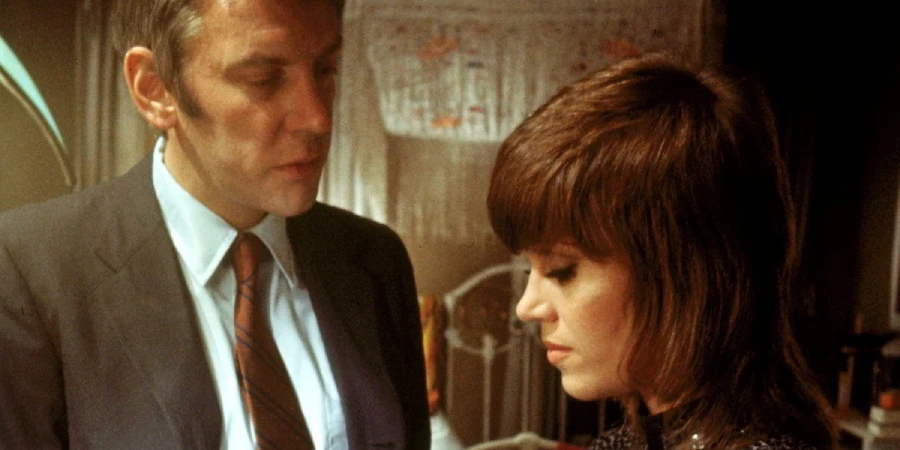

Klute (1971) is a tense, character-driven thriller directed by Alan J. Pakula and starring Jane Fonda and Donald Sutherland. While it begins like a traditional missing-person mystery, the film quickly evolves into a psychologically complex story about identity, paranoia, loneliness, and survival in 1970s New York.
It is also the first entry in Pakula’s famous “Paranoia Trilogy”, followed by The Parallax View (1974) and All the President’s Men (1976).
Detailed Summary
The Disappearance That Starts It All
The film begins with the mysterious disappearance of Tom Gruneman, a Pennsylvania businessman. Months pass with no progress in the case until police discover that he had secretly written several sexually explicit letters to a New York call girl named Bree Daniels.
Enter John Klute, a quiet and observant private detective hired by Gruneman’s friend to investigate the disappearance. Klute travels to New York City to track down Bree and determine whether she knows anything about the missing man.
At first glance, the case appears straightforward: track down the prostitute who received the letters. But the investigation soon leads into something much darker.
Bree Daniels: The Real Center of the Story
Although Klute is the investigator, the movie gradually reveals that Bree Daniels is the true protagonist.
Bree is a high-end call girl trying to transition into an acting career. She attends therapy sessions where she openly discusses her life, revealing a deeply conflicted personality. She insists she enjoys her work and the control it gives her over men, yet her therapist senses fear, insecurity, and emotional detachment beneath the surface.
These therapy sessions serve as a psychological window into Bree’s mind, and they are some of the most revealing scenes in the film.
Bree initially denies knowing anything about Gruneman, but eventually she admits that he had been one of her clients.
A Murder That Changes the Investigation
As Klute continues digging into the case, a woman connected to Bree’s world is brutally murdered. The killing appears to be the work of a sadistic man who secretly records women during sexual encounters.
Soon Bree begins to suspect she is being followed and watched. The tension escalates when she realizes someone may be targeting women like her.
Klute moves into Bree’s apartment building to protect her while continuing his investigation.
During this time, the two develop a complicated relationship. Bree is fascinated by Klute’s quiet, patient demeanor, while Klute becomes emotionally invested in her safety.
Yet Bree resists intimacy, insisting that relationships make her feel trapped.
Discovering the Killer
Klute uncovers disturbing evidence suggesting that Tom Gruneman had stumbled onto something dangerous. The missing businessman had been investigating sexual behavior and had unknowingly crossed paths with a violent individual.
The investigation eventually leads to Peter Cable, a corporate executive with disturbing sexual compulsions.
Cable secretly records encounters with prostitutes and is consumed by violent fantasies. The tapes he keeps reveal his increasingly dangerous mindset.
The film’s tension rises as Bree unknowingly walks closer to the truth.
Movie Ending
The final act reveals that Peter Cable is the killer and that Tom Gruneman had discovered Cable’s disturbing habits before disappearing. Gruneman confronted him and was murdered to keep the secret buried.
Cable becomes obsessed with Bree after interacting with her earlier. His fixation grows into violent rage, especially when he senses that she might expose him.
The climax unfolds when Cable kidnaps Bree and takes her to an abandoned building.
Klute arrives in time to confront him, leading to a tense showdown in the darkened building. Cable attempts to manipulate Bree psychologically, switching between charm and menace in an effort to control her.
But Bree refuses to submit to him.
As Cable tries to attack, Klute intervenes and shoots him, killing him and ending the threat.
In the aftermath, the film shifts back to Bree’s emotional journey. Throughout the story she has insisted she prefers independence and fears emotional attachment.
However, by the end she admits something important in therapy: she is afraid of loneliness.
The film closes with Bree considering leaving prostitution and possibly starting a new life. Her relationship with Klute remains uncertain, but there is a sense that she may finally allow herself to trust someone.
The ending is intentionally quiet and introspective rather than triumphant, emphasizing personal transformation rather than victory.
Are There Post-Credits Scenes?
No. Klute was released in an era when post-credits scenes were not a common filmmaking practice, so the film ends completely once the credits begin.
Type of Movie
Klute is best described as a neo-noir psychological thriller blended with elements of crime drama and character study. While the plot revolves around a murder investigation, the film’s real focus is the psychological complexity of Bree Daniels and the atmosphere of paranoia surrounding the case.
Cast
- Jane Fonda — Bree Daniels
- Donald Sutherland — John Klute
- Charles Cioffi — Peter Cable
- Roy Scheider — Frank Ligourin
- Dorothy Tristan — Arlyn Page
- Nathan George — Trask
Film Music and Composer
The haunting minimalist score was composed by Michael Small. His music uses sparse instrumentation and eerie tones that reinforce the film’s unsettling mood and themes of surveillance and paranoia.
The score became influential in shaping the sound design of many later psychological thrillers.


Filming Locations
Most of the film was shot in New York City, particularly in Manhattan.
These locations were crucial to the film’s atmosphere because 1970s New York was portrayed as gritty, anonymous, and slightly dangerous. The city becomes almost a character itself, reflecting Bree’s isolation and the sense that someone could be watching from anywhere.
The urban landscape emphasizes the movie’s themes of alienation and surveillance.
Awards and Nominations
The film received significant critical recognition, especially for Jane Fonda’s performance.
Major achievements include:
- Academy Award for Best Actress — won by Jane Fonda
- Nominated for Best Adapted Screenplay
- Nominated for Best Sound
- Golden Globe Award for Best Actress – Drama (Jane Fonda)
- Multiple critics’ awards for acting and screenplay
Fonda’s performance is widely considered one of the defining performances of 1970s cinema.
Behind the Scenes Insights
- Jane Fonda prepared for the role by interviewing real call girls in New York.
- The therapy scenes were partially improvised to create a natural psychological tone.
- Director Alan J. Pakula intentionally minimized dialogue from Klute to emphasize his mysterious presence.
- Many scenes were shot with hidden microphones and long lenses to create a feeling of voyeurism.
- Fonda later said the role helped her better understand the emotional complexity of sex work.
Inspirations and References
The screenplay was written by Andy Lewis and Dave Lewis.
While not based on a specific true story, the film draws inspiration from:
- the rise of psychological thrillers in the late 1960s
- urban crime culture in 1970s New York
- Freudian psychology and therapy culture of the time
The film also helped establish the style later associated with 1970s paranoia cinema.
Alternate Endings and Deleted Scenes
Early drafts of the script contained a darker ending in which Bree completely rejects Klute and leaves New York alone.
Some deleted material included:
- longer therapy sessions exploring Bree’s childhood
- extended investigation scenes involving police corruption
- additional sequences involving the killer’s recordings
These scenes were removed to maintain the film’s tight pacing and mystery.
Book Adaptations and Differences
Klute was not based on a novel. The film was written directly for the screen, though it later inspired novelizations and academic analysis of its psychological themes.

Memorable Scenes and Quotes
Key Scenes
- Bree’s therapy session where she admits she enjoys control over men
- Klute discovering the killer’s disturbing tape recordings
- The moment Bree realizes she is being followed
- The dark, tense confrontation in the abandoned building
- The quiet final therapy scene reflecting on loneliness
Iconic Quotes
- “I enjoy my work.” — Bree Daniels
- “You’re afraid of being alone.” — Therapist
- “You’re not like the others.” — Bree to Klute
Easter Eggs and Hidden Details
- The tape recordings heard throughout the film foreshadow the killer’s identity long before it is revealed.
- Bree’s acting auditions subtly mirror her real life — she is always performing roles for others.
- Pakula frequently frames Bree through windows, mirrors, and doorways to emphasize surveillance.
- The film’s lighting intentionally mimics classic film noir shadow techniques.
Trivia
- Jane Fonda won the Oscar while she was politically controversial due to her anti-Vietnam War activism.
- Donald Sutherland reportedly based Klute’s calm demeanor on real private investigators.
- The film is considered a key early example of feminist character study within a thriller.
- Many critics consider Bree Daniels one of the most complex female characters in 1970s cinema.
Why Watch?
Klute stands out because it is not just a murder mystery.
The film is really about:
- identity and loneliness
- emotional vulnerability
- power dynamics between men and women
- urban paranoia
Jane Fonda’s performance alone makes the film worth watching, as she brings extraordinary nuance and humanity to a character who could easily have been a stereotype.
Director’s Other Works
Other notable films directed by Alan J. Pakula include:
- The Parallax View (1974)
- All the President’s Men (1976)
- Sophie’s Choice (1982)
- Presumed Innocent (1990)
- The Pelican Brief (1993)
Recommended Films for Fans
- Taxi Driver (1976)
- Chinatown (1974)
- Blow Out (1981)
- Body Heat (1981)
- The Conversation (1974)
- Night Moves (1975)