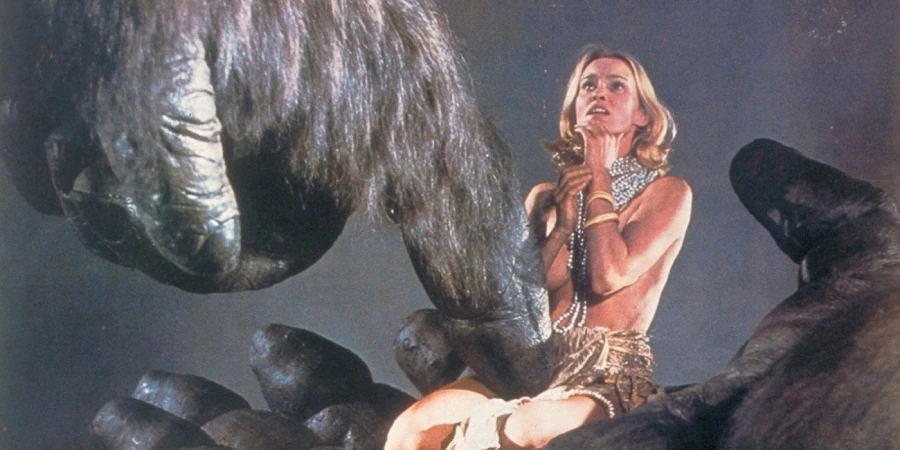

The 1976 version of King Kong is a glossy, big-budget remake of the 1933 classic, directed by John Guillermin and produced by Dino De Laurentiis. Starring Jeff Bridges, Jessica Lange (in her film debut), and Charles Grodin, this version updates the story for the 1970s with oil companies, corporate greed, and a surprisingly tragic romantic core. It’s larger, louder, and more commercially minded than the original—but it still delivers one of cinema’s most iconic giant-monkey finales.
Detailed Summary
The Oil Expedition and a Mysterious Island
The story begins with Petrox Oil Company, led by ambitious executive Fred Wilson (Charles Grodin), searching for a massive oil reserve. Satellite imagery reveals an uncharted island hidden by a strange permanent fog bank in the Indian Ocean. Convinced it holds untapped riches, Wilson launches an expedition.
Onboard the ship is Jack Prescott (Jeff Bridges), a primatologist who suspects the island may contain undiscovered species. Also aboard—after being rescued from a life raft—is Dwan (Jessica Lange), an aspiring actress whose Hollywood dreams have gone spectacularly wrong. She becomes the emotional center of the film.
Arrival at Skull Island
When the crew reaches the island, they discover a massive wall separating two worlds: a primitive indigenous village on one side and something terrifying beyond it. The villagers live in fear of a god they call “Kong.”
That night, the villagers kidnap Dwan as an offering to Kong. She is bound to a giant wooden structure as drums pound in the darkness. Then he appears.
Kong Revealed
Kong emerges as a towering, imposing giant ape—less fantastical than earlier versions, more grounded in animalistic realism. Instead of immediately killing Dwan, he is fascinated by her. Their dynamic shifts from terror to curiosity to something strangely tender.
Prescott ventures into the jungle to rescue her, encountering prehistoric creatures and deadly terrain. The film leans heavily into jungle adventure during this section, complete with massive snake battles and slow-building tension.
Capture of Kong
Instead of killing Kong, Wilson sees profit. He decides to capture him and bring him back to America as a corporate spectacle. Using gas bombs, they subdue the giant ape.
This decision marks a key thematic turn: the true villain of the film becomes corporate greed.
Movie Ending
Kong is transported to New York and unveiled in a grotesque publicity stunt called “Kong Day.” Shackled and displayed like a circus attraction, he is presented as proof of Petrox’s triumph.
Dwan is forced to stand beside him in a staged wedding gown presentation. Flashbulbs explode, reporters shout, and the spectacle becomes overwhelming. The chaos triggers Kong’s panic and rage.
He breaks free.
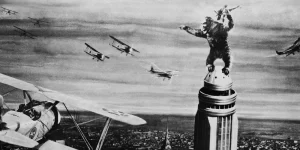
In one of the film’s most iconic sequences, Kong rampages through New York City. Unlike the 1933 version, he does not climb the Empire State Building. Instead, in this remake, he ascends the twin towers of the World Trade Center, which were newly completed at the time and symbolized modern American power.
Helicopters surround him. Kong swats at them while clutching Dwan. He climbs to the top of one of the towers, cornered and confused rather than purely enraged. Gunfire erupts from hovering helicopters. Bullets tear into him repeatedly.
The moment is prolonged and tragic. Kong weakens, bleeds, and finally loses his grip. He falls from the top of the tower in slow, devastating fashion.
Crowds gather around his massive body. Dwan, visibly shaken, approaches him. Unlike earlier versions, the film lingers on the emptiness of the spectacle. Kong is no longer a monster—he is a victim of exploitation.
The final image leaves viewers with a sobering message: beauty may have killed the beast, but greed loaded the gun.
Are There Post-Credits Scenes?
No. King Kong (1976) does not include a post-credits or mid-credits scene. The film ends definitively with Kong’s death and the aftermath.
Type of Movie
King Kong (1976) is a monster adventure film blended with romantic tragedy and corporate satire. It mixes blockbuster spectacle with surprisingly pointed commentary about capitalism and exploitation.
Cast
- Jeff Bridges as Jack Prescott
- Jessica Lange as Dwan
- Charles Grodin as Fred Wilson
- John Randolph as Captain Ross
- Rene Auberjonois as Bagley
Jessica Lange’s performance earned significant attention and launched her long, Oscar-winning career.
Film Music and Composer
The sweeping, dramatic score was composed by John Barry. His music elevates the emotional tone, especially in Kong and Dwan’s scenes. The romantic orchestral themes make Kong feel less like a creature feature and more like a doomed love story.

Filming Locations and Their Importance
- Hawaii was used extensively for Skull Island jungle sequences, providing lush, untamed landscapes.
- Los Angeles sound stages handled interior village and large-scale effects shots.
- The climactic sequences were filmed around the World Trade Center in New York City, giving the film contemporary visual impact and grounding the fantasy in recognizable modern architecture.
Using the World Trade Center instead of the Empire State Building modernized the story and emphasized 1970s American ambition.
Awards and Nominations
- Won an Academy Award for Best Visual Effects at the 49th Academy Awards
- Nominated for Best Cinematography
- Nominated for Best Sound
The visual effects were groundbreaking for their time, particularly the full-scale Kong animatronic.
Behind the Scenes Insights
- A 40-foot mechanical Kong was built but rarely worked properly on set.
- Many close-up shots relied on suit performer Rick Baker, who later became a legendary makeup artist.
- The film had intense legal disputes with Universal Pictures, which was developing its own King Kong project.
- Jessica Lange reportedly found early press coverage overwhelming, as marketing focused heavily on her appearance.
- The production was one of the most expensive films of its time.
Inspirations and References
The film is a remake of the 1933 classic King Kong directed by Merian C. Cooper and Ernest B. Schoedsack.
While not based on a novel, the concept reflects 1930s pulp adventure storytelling and echoes themes found in Beauty and the Beast mythology.
Alternate Endings and Deleted Scenes
There were no officially released alternate endings. However:
- Some extended jungle material was trimmed for pacing.
- Additional Kong interaction scenes with Dwan were reportedly shortened.
- More animatronic footage was planned but abandoned due to technical issues.
Memorable Scenes and Quotes
Key Scenes
- Kong’s first full reveal in the foggy jungle clearing
- The giant snake battle
- Kong’s public unveiling in New York
- The helicopter assault atop the World Trade Center
Iconic Quotes
- “It wasn’t the airplanes. It was beauty killed the beast.”
(A reworked echo of the 1933 film’s famous line) - Dwan’s wide-eyed philosophical ramblings about fame and destiny


Easter Eggs and Hidden Details
- The oil-company plotline reflects 1970s energy crisis anxieties.
- The World Trade Center setting symbolized modern industrial power.
- Kong’s design intentionally avoided making him too monstrous to enhance sympathy.
- The romantic framing mirrors Beauty and the Beast dynamics more than pure monster horror.
Trivia
- Jessica Lange received a Golden Globe for New Star of the Year.
- The giant Kong hand prop was large enough for multiple actors to sit inside.
- The film was a major box office hit in 1976.
- It directly inspired the sequel King Kong Lives.
Why Watch King Kong (1976)?
If you enjoy large-scale practical effects, 1970s blockbuster ambition, and a monster movie that leans into tragic romance rather than pure destruction, this version offers a unique tone. It’s imperfect—but fascinating. And its ending remains emotionally powerful.
Director’s Other Works (John Guillermin)
- The Towering Inferno (1974)
- Death on the Nile (1978)
- King Kong Lives (1986)