
When people talk about the birth of the modern blockbuster monster movie, they’re talking about King Kong (1933). Directed by Merian C. Cooper and Ernest B. Schoedsack, this film didn’t just introduce a giant ape—it redefined what cinema could do. Groundbreaking visual effects, ambitious storytelling, and emotional depth turned a “giant monster movie” into something mythic.
Detailed Summary
The Struggling Filmmaker and the Mysterious Island
In Depression-era New York, ambitious filmmaker Carl Denham (Robert Armstrong) is desperate to complete his new film. He’s secretive about the shooting location but promises something the world has never seen. To add glamour, he recruits struggling actress Ann Darrow (Fay Wray), offering her adventure instead of hunger.
Denham charters a ship, the Venture, and sets sail toward an uncharted island known only by a cryptic map. The crew is skeptical, the captain is cautious, and Ann senses something strange—but Denham is obsessed. That obsession becomes the driving force of the entire story.
Skull Island: Civilization Meets the Unknown
Upon arrival, they discover Skull Island—a terrifying, primeval world cut off from modern civilization. A massive wall separates a native village from the jungle beyond. The atmosphere shifts from adventure to dread.
That night, the islanders attempt to sacrifice Ann to a mysterious god: Kong.
The Reveal of Kong
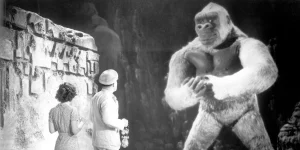
Kong emerges from the jungle—and cinema history changes forever. The stop-motion animation by Willis O’Brien brings the giant ape to life with shocking realism for 1933 audiences.
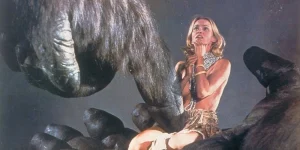
But Kong is not mindless. He is powerful, curious, territorial—and strangely gentle with Ann. He abducts her and carries her into the jungle. What follows is a relentless survival adventure.
The Jungle of Nightmares
The rescue mission becomes a descent into prehistoric horror. The crew battles dinosaurs, giant insects, and natural hazards. Some of the most famous sequences include:
- Kong fighting a Tyrannosaurus
- The log bridge scene where sailors are shaken into a ravine
- Ann trapped in a tree while Kong battles a Pteranodon
The film constantly escalates the danger, blending action and suspense in ways that were revolutionary at the time.
Denham’s Decision
After witnessing Kong’s power, Denham makes a pivotal choice. Rather than respecting the creature’s territory, he sees profit. Kong is subdued with gas bombs and transported to New York as “The Eighth Wonder of the World.”
This decision shifts the story from jungle adventure to tragic spectacle.
Movie Ending
In New York, Kong is chained on stage before a massive audience. He is displayed like a trophy, restrained and humiliated. Flashbulbs from photographers agitate him—an important detail that triggers his panic.
Kong breaks free.
The city becomes a battleground. Kong searches desperately for Ann, smashing through buildings, overturning trains, and causing widespread chaos. But unlike the jungle, he is now vulnerable. The city represents modernity, technology, and control.
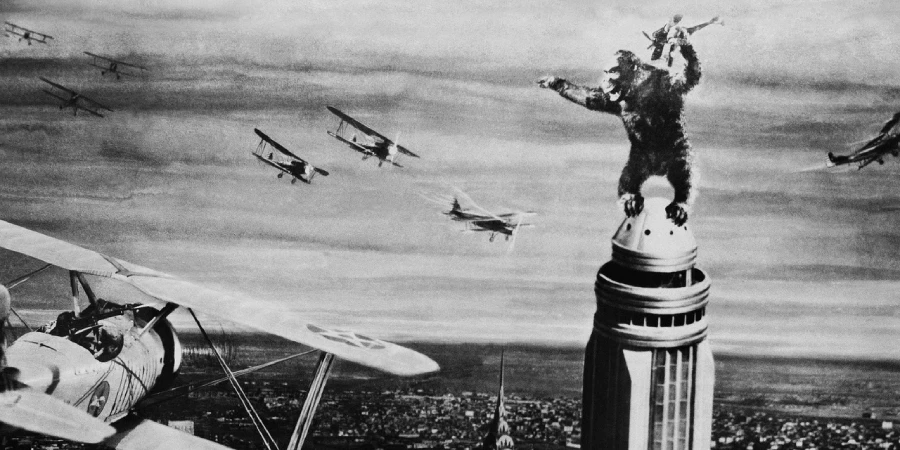
He finds Ann and climbs the Empire State Building—then the tallest building in the world. This scene is not just spectacle; it is symbolic. Kong at the top of civilization’s tallest monument is both majestic and doomed.
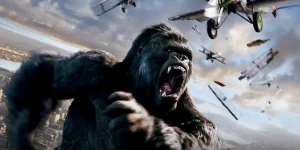
Biplanes are sent to stop him. Kong swats at them, even destroying some, but he is overwhelmed by gunfire. Shot repeatedly, weakened, and still protecting Ann, he eventually loses his grip and falls to his death from the skyscraper.
The final line, delivered by Denham, cements the tragedy:
“It wasn’t the airplanes. It was Beauty killed the Beast.”
The ending fully embraces tragedy. Kong is not a villain. He is a displaced force of nature destroyed by human greed and spectacle. The audience is left not with triumph—but melancholy.
Are There Post-Credits Scenes?
No. King Kong (1933) does not have a post-credits scene. The film ends definitively with Kong’s death and Denham’s closing line.
Type of Movie
King Kong (1933) is a groundbreaking adventure-fantasy monster film with strong elements of tragedy. While it delivers spectacle and action, at its core it is a surprisingly emotional story about exploitation and misplaced ambition.
Cast
- Fay Wray as Ann Darrow
- Robert Armstrong as Carl Denham
- Bruce Cabot as Jack Driscoll
- Frank Reicher as Captain Englehorn
Film Music and Composer
The score was composed by Max Steiner. This was one of the first films to feature a fully integrated orchestral score synchronized to the action. Steiner’s dramatic music elevated tension and emotion, helping define how film scores function today. Many consider it one of the first great cinematic soundtracks.

Filming Locations and Their Importance
The jungle scenes were filmed on elaborate soundstages at RKO Radio Pictures in Hollywood. Miniature sets and rear projection were heavily used.
The New York finale prominently features the Empire State Building. At the time, it was the tallest building in the world, symbolizing human achievement. Kong’s fall from it serves as a visual metaphor: nature cannot survive in modern civilization.
Awards and Nominations
At the time of its release, the Academy Awards did not yet have visual effects categories. As a result, the film received no Oscar nominations. However, it has since been preserved by the Library of Congress and is widely considered one of the most influential films ever made.
Behind the Scenes Insights
- Willis O’Brien’s stop-motion techniques required painstaking frame-by-frame animation
- Fay Wray often acted against empty space, imagining Kong’s presence
- The famous “spider pit” sequence was filmed but later cut and is now considered lost
- The film reportedly caused audience members to scream and faint during its original release
- The Empire State Building climax was partly inspired by Cooper’s fascination with aviation
Inspirations and References
The story was inspired partly by adventure tales and explorer myths popular in the early 20th century. Cooper was influenced by real expedition stories and his own experiences in exotic locations.
The film later influenced everything from Godzilla to Jurassic Park.
Alternate Endings and Deleted Scenes
The most famous deleted sequence is the “Spider Pit Scene,” where sailors fall into a ravine and are devoured by giant insects. Test audiences found it too disturbing, and it was removed. The footage is now lost, though it has been recreated in later adaptations.
There are no officially documented alternate endings; Kong’s tragic death was always intended as the conclusion.
Book Adaptations and Differences
A novelization by Delos W. Lovelace was released shortly after the film. It expands on Skull Island lore and Kong’s thoughts, giving more psychological depth. However, the core narrative remains faithful to the movie.


Memorable Scenes and Quotes
Key Scenes
- Kong battling the Tyrannosaurus
- The log bridge sequence
- Kong breaking free on Broadway
- The climb up the Empire State Building
Iconic Quotes
- “It was Beauty killed the Beast.”
- “We’re millionaires, boys! I’ll share it with all of you.”
Easter Eggs and Hidden Details
- Some dinosaur models were reused from earlier RKO productions
- Kong’s roar was created by mixing lion and tiger sounds
- The film subtly critiques colonial exploitation through Denham’s character
- The scale of Kong subtly shifts between scenes to enhance drama
Trivia
- Kong was animated using a 18-inch armature model
- The film was re-released multiple times with slight edits
- It was one of the highest-grossing films of 1933
- Adolf Hitler reportedly admired the film
Why Watch King Kong (1933)?
Because it’s not just a monster movie. It’s the blueprint. The emotional weight, technical innovation, and tragic storytelling still resonate nearly a century later. Watching it today is like witnessing the birth of cinematic spectacle.
Directors’ Other Works
Merian C. Cooper
- The Most Dangerous Game (1932)
- She (1935)
Ernest B. Schoedsack
- The Most Dangerous Game (1932)
- Son of Kong (1933)
Recommended Films for Fans
- Son of Kong (1933)
- Mighty Joe Young (1949)
- Godzilla (1954)
- King Kong (2005)