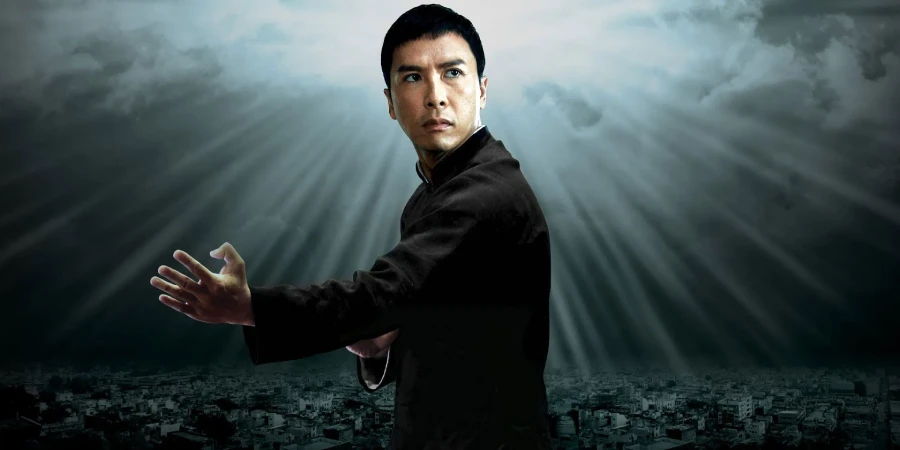
Ip Man 2 (2010) continues the story of the legendary Wing Chun master Ip Man, blending martial arts excellence with cultural pride, honor, and personal integrity. Directed by Wilson Yip and starring Donnie Yen, the film expands the scope of the original by moving the story to Hong Kong and introducing a powerful East-vs-West conflict.
Detailed Summary
A New Beginning in Hong Kong
After the events of the first film, Ip Man relocates to post-war Hong Kong, hoping to live a quiet life and establish a Wing Chun school. However, he quickly discovers that Hong Kong’s martial arts community is highly competitive and deeply territorial. Each school answers to powerful associations, and newcomers are viewed with suspicion.
Ip Man struggles financially and socially, as Wing Chun is not yet respected in Hong Kong. Despite his reputation, he is forced to prove himself again from scratch.
Tensions Among Martial Arts Schools
Ip Man becomes entangled with the local martial arts guild led by Hung Chun master Hung Gar (Sammo Hung). Initially, the two clash due to misunderstandings and pride between their respective schools. This section of the film emphasizes traditional Chinese values such as respect, hierarchy, and unity.
Through a series of challenges and confrontations, Ip Man earns Hung Gar’s respect, and the two masters eventually form a bond rooted in mutual honor rather than rivalry.
The Arrival of the Western Threat
The story takes a dramatic turn with the arrival of British boxer Twister, who publicly humiliates Chinese martial artists by mocking their traditions and defeating them in exhibition matches. The situation worsens when one master dies during a fight, turning what was once a sports rivalry into a national and cultural crisis.
Twister represents not just a physical threat, but colonial arrogance and cultural disrespect, raising the stakes far beyond personal pride.
Ip Man Steps Forward
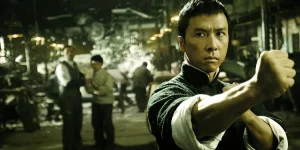
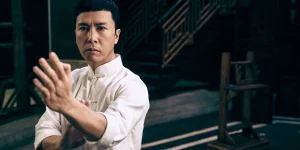
With tensions escalating and Chinese martial arts being ridiculed, Ip Man volunteers to fight Twister in a public boxing match. His motivation is not fame or revenge, but to restore dignity and prove that Chinese martial arts are not inferior.
As the fight approaches, Ip Man faces personal sacrifices, physical limitations, and emotional pressure, all while maintaining his calm and disciplined philosophy.

Movie Ending
The final act centers on the boxing match between Ip Man and Twister, held in front of both Chinese citizens and British authorities. The fight is brutal and grueling, highlighting the stark contrast between Western boxing’s raw power and Wing Chun’s efficiency and precision.
Twister dominates the early rounds with sheer strength, causing Ip Man to suffer serious injuries. However, Ip Man adapts, using Wing Chun’s close-range techniques to neutralize Twister’s reach and aggression. In the final round, Ip Man unleashes a relentless chain of strikes, finally knocking Twister out.
This victory is more than physical. Ip Man restores honor to Chinese martial arts, silences the mockery, and proves that respect must be earned through character as much as strength.
After the match, Ip Man refuses fame or wealth. Instead, he quietly returns to teaching. In the film’s closing moments, a young boy named Bruce Lee approaches Ip Man, asking to become his student. Ip Man accepts him, subtly foreshadowing the birth of a future legend and closing the film on a note of legacy and continuity.
Are There Post-Credits Scenes?
No. Ip Man 2 does not include any post-credits or mid-credits scenes. The story concludes fully before the credits roll.
Type of Movie
Ip Man 2 is a martial arts drama that blends biographical elements with action, focusing on cultural identity, honor, and perseverance rather than nonstop spectacle.
Cast
- Donnie Yen as Ip Man
- Sammo Hung as Hung Chun Nam
- Lynn Hung as Cheung Wing-sing
- Darren Shahlavi as Twister
- Huang Xiaoming as Wong Leung
- Kent Cheng as Fatso
Film Music and Composer
The film’s score was composed by Kenji Kawai, known for his ability to combine traditional instrumentation with dramatic tension. The music reinforces emotional moments without overshadowing the fight choreography, especially during the climactic boxing match.
Filming Locations
- Hong Kong – Used to authentically depict post-war colonial Hong Kong and its martial arts culture
- Shanghai film studios – Provided controlled environments for large-scale fight scenes
These locations are crucial in contrasting traditional Chinese values with Western colonial influence, a core theme of the film.
Awards and Nominations
- Won Best Action Choreography at the Hong Kong Film Awards
- Nominated for Best Film, Best Actor (Donnie Yen), and Best Director at multiple Asian film festivals
Behind the Scenes Insights
- Donnie Yen performed most of his own stunts despite injuries during filming
- Sammo Hung, also the action choreographer, intentionally limited fight cuts to showcase real martial skill
- The boxing scenes required Donnie Yen to train extensively in endurance and footwork
- Darren Shahlavi trained in boxing and MMA to bring realism to Twister’s fighting style
Inspirations and References
The film is loosely inspired by the real-life Ip Man, though many events are dramatized. It also draws from classic kung fu cinema themes, particularly the idea of martial arts as a symbol of national identity rather than violence.
Alternate Endings and Deleted Scenes
No official alternate ending has been released. Some deleted scenes reportedly focused on extended interactions between Ip Man and his wife, which were trimmed to maintain pacing and focus on the central conflict.
Book Adaptations and Differences
There is no direct book adaptation. However, the film differs from historical accounts. In reality, Ip Man did not publicly fight a Western boxer in this manner. The confrontation is symbolic rather than factual, designed to represent cultural struggle rather than biography.

Memorable Scenes and Quotes
Key Scenes
- Ip Man defeating multiple masters using only Wing Chun fundamentals
- The intense table-breaking fight between Ip Man and Hung Chun
- The final boxing match against Twister
Iconic Quotes
- Ip Man: “Chinese martial arts are not about fighting. They are about discipline and respect.”
- Hung Chun: “We fight not to win, but to preserve our way.”
Easter Eggs and Hidden Details
- The Bruce Lee cameo subtly mirrors historical photographs of his first meeting with Ip Man
- Several Wing Chun forms shown are authentic and traditionally accurate
- Twister’s insults echo real colonial-era attitudes documented in Hong Kong history
Trivia
- This was Sammo Hung’s first major on-screen fight role in years
- Donnie Yen lost significant weight during training for endurance scenes
- The film significantly increased international interest in Wing Chun
Why Watch?
If you enjoy martial arts with meaning, Ip Man 2 delivers powerful action combined with emotional depth. It’s not just about who punches harder, but why they fight.
Director’s Other Works (Movies)
- Ip Man (2008)
- Ip Man 3 (2015)
- Ip Man 4: The Finale (2019)
- Flash Point (2007)
- Paradox (2017)