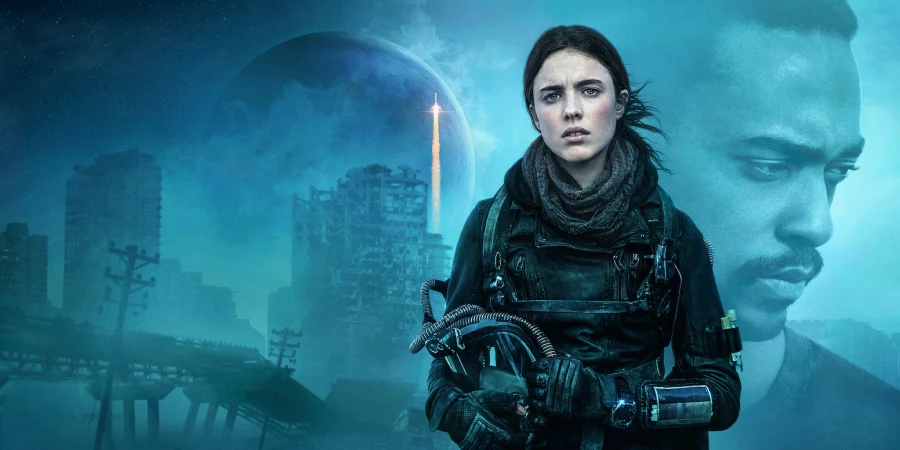

IO is a quiet, melancholic sci-fi drama directed by Jonathan Helpert. Unlike loud, explosion-heavy space movies, this one asks a much simpler question: What if Earth isn’t worth saving anymore… but someone still believes it is?
Detailed Summary
A Dying Earth
The film is set in a near future where Earth has become largely uninhabitable due to extreme atmospheric toxicity. Humanity has evacuated to a space station orbiting Jupiter’s moon IO. Only a few stubborn individuals remain on Earth, including Sam Walden (Margaret Qualley), a young scientist living alone in the mountains.
Sam is researching whether Earth can regenerate and become habitable again. She believes the planet might still sustain life at higher altitudes where oxygen levels are slightly better. She refuses to abandon hope, even after her father—who once shared her dream—leaves Earth for IO.
Her isolation is heavy. She communicates with her mentor and boyfriend Elon via delayed messages. The world around her feels empty, silent, and hauntingly beautiful.
The Arrival of Micah
Everything changes when Micah (Anthony Mackie), a balloonist and one of the last survivors, arrives near Sam’s home. He plans to reach the final shuttle launch that will take the remaining humans to IO.
Micah is pragmatic. Earth is done, he says. Survival means leaving.
Sam is idealistic. Earth can heal, she insists. Leaving means surrender.
Their dynamic forms the emotional core of the film. What starts as tension slowly becomes connection. They challenge each other’s beliefs, fears, and motivations.
The Final Shuttle Decision
News spreads that the last shuttle launch has been moved up. This is humanity’s final evacuation opportunity. After this, Earth will officially be abandoned.
Micah prepares to leave. He urges Sam to come with him. At first, she refuses—committed to her research and her father’s legacy. But when her experiments appear to fail and she realizes how alone she truly is, doubt creeps in.
Together, they set off on a journey to reach the launch site.
The Journey and Emotional Shift
During their trek, they experience physical exhaustion, oxygen deprivation, and emotional vulnerability. Sam begins questioning whether her hope is scientific determination—or denial of grief.
Meanwhile, Micah reveals his own fears. He isn’t simply running from Earth; he’s running toward the possibility of community, survival, and a future.
Their relationship deepens in quiet, understated ways. The film never becomes overly dramatic, but the intimacy builds gradually.

Movie Ending
Here is where the film makes its boldest choice.
Sam and Micah reach the launch site—only to discover that the final shuttle has already departed.
Humanity has left Earth.
There is no rescue. No second chance. No backup plan.
At this moment, the film could have collapsed into despair. Instead, it shifts perspective.
Sam realizes that her earlier experiments weren’t complete failures. She had discovered bees surviving at high altitude—an indicator that ecosystems may slowly adapt. Life, even in toxicity, persists.
The ending suggests something powerful: Earth may not need saving in the way humans imagined. It may simply evolve without them.
Sam and Micah choose not to give up. They decide to return to the mountains together rather than succumb to hopelessness.
The final scenes imply that humanity might survive in small, adapted pockets—or perhaps evolve alongside Earth’s new atmosphere. It’s ambiguous, but hopeful in a grounded way.
The movie does not give a triumphant survival montage. Instead, it leaves us with a quiet realization: hope isn’t about certainty; it’s about choosing to stay.
Are There Post-Credits Scenes?
No. IO (2019) does not include a mid-credits or post-credits scene. Once the film ends, the story is complete.
Type of Movie
IO is a post-apocalyptic science fiction drama that leans heavily into philosophical themes rather than action. It’s more about emotional survival and existential choice than spectacle.
Cast
- Margaret Qualley as Sam Walden
- Anthony Mackie as Micah
- Danny Huston as Henry Walden (Sam’s father)
Film Music and Composer
The score was composed by Alex Somers. His minimalist, ambient style perfectly matches the film’s tone. The music is subtle, atmospheric, and often feels like an extension of the toxic, fading world around the characters.

Filming Locations and Their Importance
The film was shot primarily in:
- California
- Utah
The high-altitude mountainous landscapes were crucial. The vast open skies and barren terrains visually reinforce isolation and the fragility of survival. The mountains symbolize both danger and hope—higher altitude means thinner toxicity but harsher living conditions.
The use of real landscapes rather than heavy CGI gives the film a grounded, almost documentary-like realism.
Awards and Nominations
IO did not receive major awards recognition. It premiered at the Sundance Film Festival and later released on Netflix, where it found a niche audience among fans of slow-burn science fiction.
Behind the Scenes Insights
- Director Jonathan Helpert aimed to make the apocalypse feel intimate rather than catastrophic.
- The production deliberately avoided heavy CGI to maintain realism.
- Margaret Qualley performed many physically demanding scenes in high-altitude conditions.
- Anthony Mackie described the film as more of a love story wrapped inside a sci-fi shell.
- The filmmakers wanted the atmosphere to feel scientifically plausible rather than fantastical.
Inspirations and References
While not directly adapted from a specific book, IO draws thematic inspiration from:
- The Road in its quiet survival tone
- Silent Running in its ecological themes
- Interstellar in its human survival vs. planetary collapse dilemma
The film also reflects real-world climate change anxieties, grounding its sci-fi premise in contemporary fears.
Alternate Endings and Deleted Scenes
There are no officially released alternate endings. However, early script drafts reportedly explored:
- A version where Sam successfully boards the shuttle
- A bleaker ending implying human extinction
The final version was chosen to preserve ambiguity and restrained hope.
Book Adaptations and Differences
IO is not based on a pre-existing novel or comic. It is an original screenplay, so there are no adaptation differences to compare.

Memorable Scenes and Quotes
Key Scenes
- The opening shots of Earth’s orange, toxic sky establishing the film’s mood
- Sam discovering bees surviving in unexpected conditions
- The silent realization that the final shuttle has already departed
- The final decision to walk back into the mountains together
Iconic Quotes
- “Earth is our home. It’s in our blood.”
- “Maybe we were the thing it needed to survive without.”
- “Hope is not a plan. But it’s something.”
Easter Eggs and Hidden Details
- The name “IO” references Jupiter’s moon, symbolizing both escape and mythological rebirth.
- Bees symbolize ecological resilience and are used as a metaphor for adaptation.
- Sam’s father’s research notes subtly foreshadow that Earth’s transformation may be natural evolution rather than catastrophe alone.
- The balloon represents fragile human ingenuity against overwhelming environmental forces.
Trivia
- The film was released directly on Netflix in January 2019.
- Margaret Qualley trained in survival techniques for realism.
- The production focused on natural lighting whenever possible.
- The title also references the Greek mythological figure Io, who endured transformation and suffering.
Why Watch?
Watch IO if you appreciate slow, contemplative science fiction that asks philosophical questions rather than delivering explosions. It’s a film about grief, climate anxiety, stubborn hope, and choosing connection when extinction feels inevitable.
If you enjoyed reflective sci-fi like Arrival or minimalist post-apocalyptic dramas, this one may resonate deeply.
Director’s Other Works
Jonathan Helpert has also directed:
- Queen of the Desert (2015)
- House of Time (2016)
His work often focuses on character-driven narratives rather than spectacle.
Recommended Films for Fans
If you liked IO (2019), you might also enjoy:
- Arrival (2016)
- Interstellar (2014)
- The Road (2009)
- Annihilation (2018)
- Silent Running (1972)