
Hush (2016) is a minimalist, nerve-shredding home-invasion thriller directed by Mike Flanagan, a master of slow-burn horror. With a simple premise and ruthless execution, the film proves that silence can be far scarier than screams.
Detailed Summary
A Quiet Life in the Woods
The film follows Maddie Young, a deaf-mute writer living alone in a remote forest house. She lost her hearing and speech as a teenager, and her isolation is both a creative choice and a vulnerability. Early scenes establish her routines and internal monologue, allowing the audience to experience the world as she does—through silence and heightened visual awareness.
The Arrival of the Masked Man
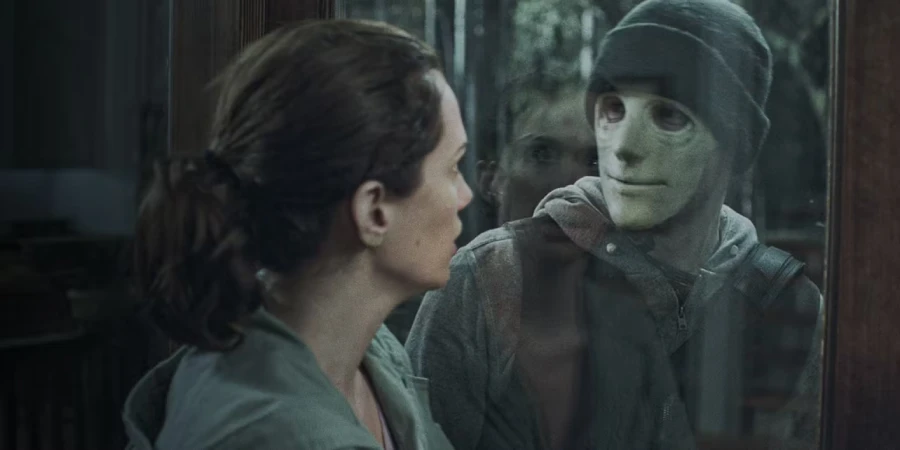
One night, a masked stranger appears outside Maddie’s house. At first, his presence feels almost voyeuristic. He watches, tests boundaries, and quickly realizes Maddie cannot hear him. This realization shifts the dynamic completely: the intruder no longer needs stealth—he has total control of sound.
Psychological Warfare Begins
Instead of breaking in immediately, the killer begins a cruel game. He uses Maddie’s deafness against her, appearing suddenly, disappearing just as fast, and deliberately making noise she cannot hear. When Maddie finally realizes someone is outside, panic sets in—but she cannot call for help, and her phone is useless.
Survival Over Fear
As the tension escalates, Maddie shifts from prey to strategist. She uses her intelligence, surroundings, and inner strength to fight back. The film spends a significant amount of time inside her head, literally visualizing her thoughts and plans, which creates a rare psychological intimacy in a slasher-style movie.

Movie Ending
The final act is brutal, intimate, and deeply personal. Maddie is badly injured, exhausted, and bleeding, while the killer grows increasingly frustrated. In a pivotal moment, the killer removes his mask, revealing a completely ordinary face. This choice reinforces the film’s message: there is no supernatural evil here—just a man who chose cruelty.
The killer taunts Maddie, believing she is too weak to survive. But Maddie has already accepted that this fight will end only one way. Drawing strength from her inner monologue and memories, she launches a final, desperate counterattack inside the house.
The climax is raw and violent. Maddie ultimately kills the intruder using her own ingenuity and sheer willpower. As dawn breaks, she staggers outside, wounded but alive. Police sirens approach in the distance.
The film ends not with triumph, but with quiet survival. Maddie sits alone, injured yet victorious, having reclaimed control of her life. The silence returns—this time, not as a weakness, but as a symbol of resilience.
Are There Post-Credits Scenes?
No. Hush does not include any post-credits or mid-credits scenes. Once the story ends, it ends completely—no sequel bait, no extra shock moments.
Type of Movie
Hush is a home-invasion thriller with strong horror elements, relying more on tension, psychology, and character vulnerability than gore or jump scares.
Cast
- Kate Siegel as Maddie Young
- John Gallagher Jr. as The Man
- Michael Trucco as John
- Samantha Sloyan as Sarah
Film Music and Composer
The score was composed by The Newton Brothers, frequent collaborators of Mike Flanagan. The music is deliberately restrained, often absent, allowing silence to function as a narrative tool. When music does appear, it emphasizes dread rather than action.
Filming Locations
The movie was filmed almost entirely in Alabama, USA, using a single primary house location.
The importance of this setting cannot be overstated:
- The isolation removes any realistic chance of rescue
- The surrounding forest becomes both a trap and a hiding place
- The limited space intensifies the cat-and-mouse tension
Awards and Nominations
While not a major awards contender, Hush received:
- Strong recognition at genre film festivals
- Critical praise for sound design and performance
- Cult status among modern horror fans and critics
Behind the Scenes Insights
- Mike Flanagan and Kate Siegel co-wrote the screenplay
- Kate Siegel learned American Sign Language for authenticity
- The killer’s face was intentionally revealed to avoid cliché slasher mystique
- The film was shot in under three weeks
- Many scenes were rehearsed extensively due to long, dialogue-free takes
Inspirations and References
- Classic home-invasion films like Wait Until Dark (1967)
- Slasher tropes deconstructed and minimized
- Real-life fears surrounding isolation and disability
- Alfred Hitchcock–style suspense rather than modern jump-scare horror
Alternate Endings and Deleted Scenes
- Early drafts included a more ambiguous ending, which was scrapped for clarity
- Some scenes showing the killer’s backstory were removed to keep him anonymous
- Flanagan chose not to explain the killer’s motives, emphasizing randomness of violence
Book Adaptations and Differences
Hush is not based on a book, but interestingly, Maddie’s in-film novel shares the same title. This meta-detail acts as a thematic mirror rather than an adaptation.
Memorable Scenes and Quotes
Key Scenes
- The moment Maddie realizes someone is outside—without sound
- The masked man tapping on the glass inches from her face
- The internal monologue sequence where Maddie plans her survival
- The unmasking scene that strips the killer of mystique
Iconic Quotes
- “You can’t scream. You can’t run. You can’t call for help.”
- “I have to win. This ends tonight.”
Easter Eggs and Hidden Details
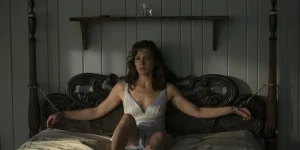
- Maddie’s book appears later in Gerald’s Game (2017), also directed by Flanagan
- The killer hums at one point—a sound Maddie will never hear
- Visual framing often removes escape routes subtly from the background
- Reflections are used repeatedly to show Maddie’s limited perception
Trivia
- The film contains very little spoken dialogue
- Sound drops out entirely during key moments to match Maddie’s perspective
- Stephen King publicly praised the movie
- The killer’s name is never revealed
Why Watch?
If you enjoy smart horror, stripped-down storytelling, and tension that never lets you breathe, Hush is essential viewing. It’s proof that horror doesn’t need monsters—just vulnerability, intelligence, and silence.
Director’s Other Works (Mike Flanagan)
- Oculus (2013)
- Before I Wake (2016)
- Gerald’s Game (2017)
- Doctor Sleep (2019)
Recommended Films for Fans
- The Strangers (2008)
- You’re Next (2011)
- Don’t Breathe (2016)
- Wait Until Dark (1967)
- Funny Games (1997)