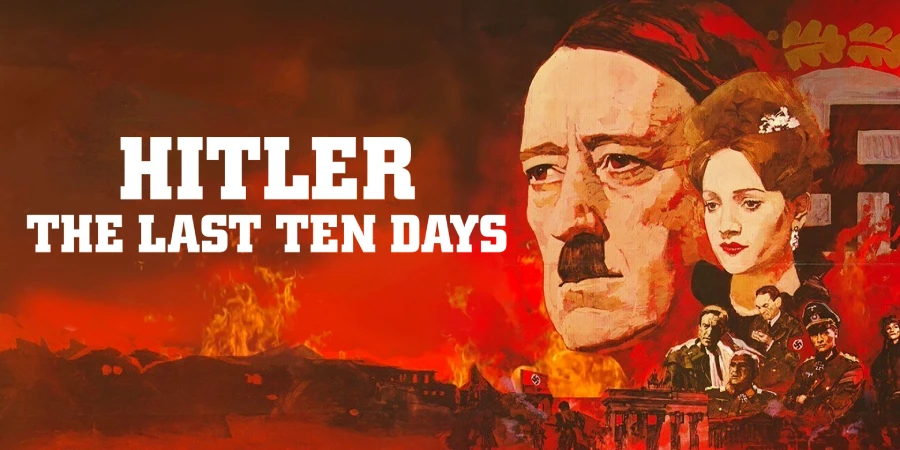

Hitler: The Last Ten Days (1973) is a historical war drama that focuses on the final collapse of Nazi Germany through the confined, claustrophobic world of Adolf Hitler’s underground bunker. Rather than depicting large-scale battles, the film chooses a psychological and human-centered approach, portraying fear, denial, fanaticism, and moral decay during the final days of the Third Reich.
This is not a war movie about victory or strategy. It is a film about inevitable defeat and the people who refused to accept it.
Detailed Summary
The Crumbling Reich
The film opens in April 1945, as Soviet forces close in on Berlin. Hitler has retreated into the Führerbunker beneath the city. Bombings shake the walls constantly, and news from the front grows worse by the hour.
Despite the obvious collapse, Hitler remains convinced that a miraculous military turnaround is still possible. Generals bring him reports of destroyed divisions, but he either dismisses them or accuses officers of betrayal.
From the beginning, the film emphasizes detachment from reality as one of its central themes.
Life Inside the Bunker
Inside the bunker, daily life continues in disturbing normalcy. Secretaries type orders that will never be executed. Officers argue over maps that no longer reflect reality. Eva Braun attempts to maintain cheerfulness through social gatherings and small celebrations.
The contrast is stark:
above ground, Berlin is burning.
below ground, people drink wine and play music.
This section of the film is crucial because it shows how ideology and denial can persist even when destruction is unavoidable.
Hitler’s Mental and Physical Decline
As the days pass, Hitler’s health deteriorates rapidly. He suffers from tremors, paranoia, emotional instability, and uncontrollable rage. Bruno Ganz portrays him not as a caricature, but as a man consumed by bitterness and obsession.
He lashes out at generals, refuses evacuation plans, and repeatedly insists that Germany must either win or perish entirely.
One of the film’s strongest elements is its refusal to portray Hitler as heroic or monstrous alone, but rather as dangerously delusional.
Loyalty, Fear, and Fanaticism
Several bunker residents face moral crossroads. Some officers consider escape. Others remain loyal to the end. Joseph Goebbels and his wife Magda choose fanatic devotion over survival, believing life without National Socialism has no meaning.
As Soviet artillery draws closer, executions for desertion continue even while the government collapses.
The film quietly but powerfully shows how authoritarian systems persist through fear, even when authority itself is dying.
The Final Days Approach
By late April, communications with the outside world are mostly lost. Hitler finally acknowledges that defeat is inevitable, but he refuses capture under any circumstances.
He dictates his political testament, marries Eva Braun in a brief ceremony, and gives farewell messages to bunker staff. These scenes are deliberately restrained, avoiding melodrama and instead emphasizing the hollow emptiness of the moment.
The bunker becomes less a command center and more a tomb.
Movie Ending
The final act of the film portrays the end of Hitler and the total psychological collapse of his inner circle in full, unflinching detail.
Hitler and Eva Braun commit suicide together in their private quarters. The film depicts this moment without sensationalism. The door closes, a gunshot is heard, and silence follows. Their bodies are carried outside into the ruined garden of the Reich Chancellery, where they are burned according to Hitler’s instructions.
As this occurs, Soviet shells fall nearby, emphasizing how insignificant these final rituals have become.
Inside the bunker, despair spreads. Joseph and Magda Goebbels poison their six children before taking their own lives. This is one of the most disturbing moments of the film, shown with emotional restraint rather than graphic imagery, making it even more haunting.
Remaining officers attempt escape through Berlin’s destroyed streets. Some are killed by Soviet troops. Others disappear into the chaos.
The final images show the bunker abandoned, littered with papers, maps, and personal belongings. The regime that claimed it would last a thousand years ends not with triumph or glory, but with silence, rubble, and death.
The film closes on the idea that ideology collapsed not in a battlefield, but in a basement.
Are There Post-Credits Scenes?
No. The film ends definitively with no post-credits or mid-credits scenes.
Type of Movie
Hitler: The Last Ten Days is a historical drama with strong biographical and war elements. It prioritizes psychological realism over action and focuses on political collapse rather than combat.
Cast
- Alec Guinness as Adolf Hitler
- Simon Ward as Captain Hoffmann
- Adolph Hitler portrayed with restrained intensity by Guinness
- Diane Cilento as Eva Braun
- James Maxwell as Joseph Goebbels
- Barbara Jefford as Magda Goebbels
Alec Guinness’s performance is widely regarded as the film’s strongest element.
Film Music and Composer
The score was composed by Carl Davis, whose music avoids patriotic or dramatic excess. Instead, it uses minimal orchestration to enhance tension and emotional emptiness, reinforcing the bunker’s oppressive atmosphere.

Filming Locations
The film was primarily shot in:
- Shepperton Studios, England – bunker interiors were meticulously recreated here.
- Exterior war scenes were limited, emphasizing confinement rather than spectacle.
The choice to focus almost entirely on interior locations reinforces the film’s central metaphor: a regime trapped by its own ideology.
Awards and Nominations
- Nominated for several British Academy Television and film awards
- Alec Guinness received strong critical recognition for his portrayal, though the film did not receive major international awards
Its legacy is more academic and historical than commercial.
Behind the Scenes Insights
- Alec Guinness reportedly studied extensive archival footage of Hitler’s final days.
- The production deliberately avoided exaggerated mannerisms to maintain realism.
- The bunker set was built to feel increasingly smaller as filming progressed, intensifying claustrophobia.
- Many actors described the shoot as emotionally exhausting due to the subject matter.
- The director insisted on subdued lighting to reflect the psychological darkness of the story.
Inspirations and References
The film is based on:
- The book Hitler: The Last Ten Days by Gerhard Boldt, who was present in the bunker.
- Firsthand survivor testimonies.
- Official wartime documents and transcripts.
The film aims for historical accuracy rather than reinterpretation.
Alternate Endings and Deleted Scenes
There are no known alternate endings.
Some scenes depicting wider destruction in Berlin were scripted but removed to keep the narrative strictly within the bunker environment. This decision strengthened the film’s thematic focus.
Book Adaptations and Differences
While closely following Boldt’s book, the film:
- Condenses timelines for narrative flow
- Simplifies secondary historical figures
- Focuses more heavily on Hitler’s psychology than the book, which is more documentary in tone
Overall, it remains one of the more faithful cinematic adaptations of bunker accounts.


Memorable Scenes and Quotes
Key Scenes
- Hitler shouting at generals over nonexistent divisions
- Eva Braun’s quiet celebration during bombardment
- The marriage ceremony in the bunker
- The Goebbels children’s final moments
- The burning of Hitler’s body outside the bunker
Iconic Quotes
- “If the German people are weak, they deserve to perish.”
- “History will absolve me.”
- “There will be no surrender.”
These lines encapsulate the ideology-driven blindness at the heart of the film.
Easter Eggs and Hidden Details
- Maps in the bunker accurately reflect real 1945 German troop positions.
- Hitler’s tremors match medical reports from his personal physician.
- The bunker layout closely mirrors original architectural blueprints.
- The film avoids showing swastikas excessively, emphasizing decay rather than propaganda.
Trivia
- Alec Guinness initially hesitated to accept the role due to moral concerns.
- The actor reportedly remained in character between takes.
- The film influenced later portrayals, including Downfall (2004).
- Runtime is intentionally tight to mirror the countdown toward death.
- It was one of the earliest English-language films to focus exclusively on Hitler’s final days.
Why Watch?
You should watch this film if you are interested in:
- Historically grounded portrayals of World War II
- Psychological studies of power and denial
- Films that avoid glorification and focus on consequence
- Understanding how totalitarian systems collapse internally
- Movies about Adolf Hitler
It is uncomfortable, restrained, and deeply human in its horror.
Director’s Other Works
Directed by Ennio De Concini, known primarily as a screenwriter:
- Divorce Italian Style (1961)
- The Red Tent (1969)
- Lady L (1965)
- Death Walks in High Heels (1971)
Recommended Films for Fans
- Downfall (2004)
- The Bunker (1981)
- Conspiracy (2001)
- Valkyrie (2008)
- The Grey Zone (2001)
- Das Boot (1981)