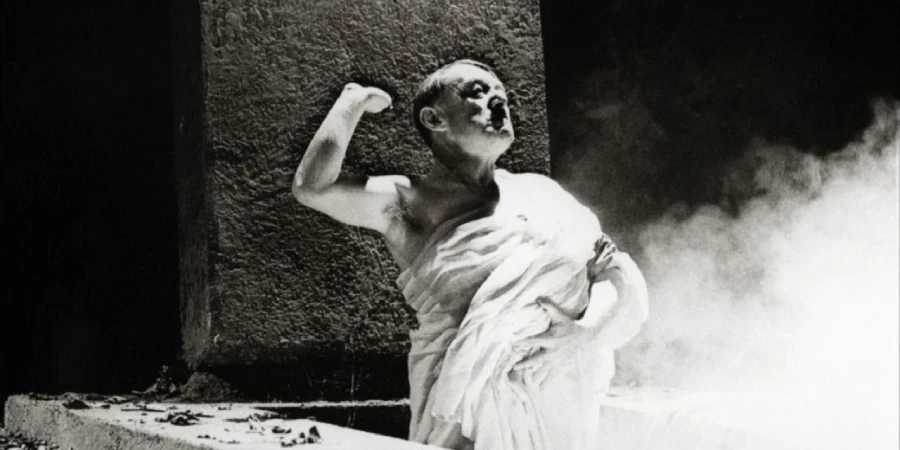

Hitler: A Film from Germany (original title: Hitler, ein Film aus Deutschland) is one of the most controversial and intellectually demanding films ever made about Adolf Hitler and the psychological collapse of Germany. Directed by Hans-Jürgen Syberberg, the film is not a conventional biography but a radical cinematic essay that blends history, philosophy, theater, and nightmare imagery.
This is not a film meant to entertain. It is meant to confront.
Detailed Summary
The Film’s Structure and Concept
The movie runs over seven hours and is divided into four major parts. Rather than portraying Hitler through realistic reenactments, Syberberg presents him as a mythological, symbolic, and psychological figure.
Actors frequently speak directly to the camera. Puppets, masks, projections, and stage props replace realism. The film treats Hitler not merely as a man, but as a reflection of German collective consciousness.
Part One: The Grail
The opening sections introduce Hitler as a product of German romanticism, Wagnerian fantasy, and unresolved national trauma after World War I. Historical facts blend with monologues, archival footage, and philosophical commentary.
Hitler is portrayed less as a dictator and more as a dark wish fulfilled by society itself.
Part Two: A German Dream
Here the film examines how nationalism, humiliation, propaganda, and mass psychology allowed Hitler to rise. Scenes move between reenactments and symbolic theater.
Key moments include:
- Hitler’s transformation from failed artist to messianic figure
- The manipulation of myth, spectacle, and language
- Germany’s longing for authority and meaning
Syberberg emphasizes that Hitler did not seize power alone; he was invited.
Part Three: The End of a Winter’s Tale
This section focuses on the internal collapse of the Nazi ideology. The dream begins to rot. Military defeat, moral emptiness, and madness dominate the visuals.
Characters speak as ghosts. Germany appears trapped inside its own delusion, unable to wake from catastrophe.
Part Four: We, Children of Hell
The final part moves beyond Hitler’s lifetime and into his afterlife in memory. The film argues that Hitler did not die in 1945; he survived as an idea.
Syberberg confronts the audience directly, asking whether modern civilization has truly learned anything.
Movie Ending
There is no dramatic suicide scene, no bunker recreation, and no conventional historical closure.
Instead, the film dissolves into long monologues, fading imagery, and ghostlike reflections. Hitler’s physical death becomes irrelevant. The final sequences suggest that:
- Hitler’s body may be gone, but his image remains alive in media, memory, and ideology
- Germany cannot escape him simply by condemning him
- Modern society continues to recycle authoritarian impulses
The film closes with the unsettling idea that Hitler exists not only in history but within culture itself, sustained by fascination, repression, denial, and spectacle.
The final images feel less like an ending and more like a warning:
History does not end. It waits.
Are There Post-Credits Scenes?
No. There are no post-credits scenes or additional material after the film concludes. The ending is intentionally final, leaving the viewer in silence and reflection.
Type of Movie
This film is best described as an experimental historical essay film that combines political cinema, avant-garde theater, philosophical documentary, and symbolic biography. It rejects realism entirely in favor of intellectual confrontation.
Cast
- Heinz Schubert as Adolf Hitler
- Magda Lena Schlott
- Hellmut Lange
- Peter Kern
- André Heller
The performances are intentionally stylized, often theatrical, and frequently detached from realism.
Film Music and Composer
The film uses an extensive range of pre-existing classical music, including:
Wagner’s presence is particularly important, reinforcing the connection between German romantic nationalism and Nazi ideology.
Filming Locations
The film was shot almost entirely on sound stages in Germany.
This was a deliberate artistic choice:
- No real-world locations
- No historical reconstructions
- No realism
The artificial environments emphasize that the film takes place inside the German imagination, not physical history.
Awards and Nominations
The film was widely discussed but rarely awarded due to its extreme length and unconventional style.
Notable recognition includes:
- Official Selection at international film festivals
- Strong academic and critical attention in film studies
Over time, it has become a cornerstone of modern European art cinema.
Behind the Scenes Insights
- The production took several years to complete
- Syberberg financed much of the film independently
- The script was partially rewritten during filming
- Many scenes were shot in long, uninterrupted takes
- Actors were encouraged to improvise philosophical monologues
- The director intentionally avoided realism to prevent emotional manipulation
Inspirations and References
- Friedrich Nietzsche’s philosophy
- Richard Wagner’s operas and mythic symbolism
- German Romantic literature
- Bertolt Brecht’s political theater
- Carl Jung’s ideas on collective unconscious
- Post-war German guilt discourse
Syberberg openly rejected Hollywood-style historical storytelling.
Alternate Endings and Deleted Scenes
There are no known alternate endings.
Some minor sequences were shortened for international screenings, but the film’s core structure remains intact. Syberberg considered the work a single continuous meditation rather than a traditionally edited film.
Book Adaptations and Differences
The film is not based on a single book, but rather on:
- Historical documents
- Political essays
- Philosophical texts
- German cultural mythology
It functions more as a cinematic thesis than an adaptation.
Memorable Scenes and Quotes
Key Scenes
- Hitler portrayed as a puppet controlled by invisible forces
- Long monologues delivered directly to the audience
- Archival Nazi footage projected onto theatrical backdrops
- The transformation of Hitler from man into symbol
- The final philosophical confrontation with post-war Germany
Iconic Quotes
- “Hitler is not a person. He is a condition.”
- “We wanted him.”
- “The dream did not die in 1945.”
Easter Eggs and Hidden Details
- Repeated use of mirrors symbolizing Germany’s self-reflection
- Toy soldiers representing the infantilization of militarism
- Wagnerian motifs tied to Nazi aesthetic obsession
- Shadows intentionally forming swastika-like shapes
- Projected ruins referencing both ancient myths and modern war
Trivia
- Total runtime exceeds 430 minutes
- Often screened over multiple days in cinemas
- Frequently studied in university film programs
- Susan Sontag famously defended the film against accusations of glorifying Nazism
- Considered one of the most intellectually demanding films ever made
Why Watch?
You should watch this film if you want:
- A deep psychological examination of fascism
- A film that refuses simple moral answers
- One of the boldest experiments in political cinema
- A confrontation with how societies create monsters
This is not entertainment. It is confrontation. One of the must-watch Hitler movies!
Director’s Other Works (Movies)
- Ludwig – Requiem for a Virgin King (1972)
- Karl May (1974)
- Parsifal (1982)
- Winifred Wagner (1975)
- The Night (1985)
Recommended Films for Fans
- Shoah (1985)
- The Act of Killing (2012)
- Downfall (2004)
- The White Ribbon (2009)
- Hitler: The Last Ten Days (1973)
- Lessons of Darkness (1992)
- Night and Fog (1956)