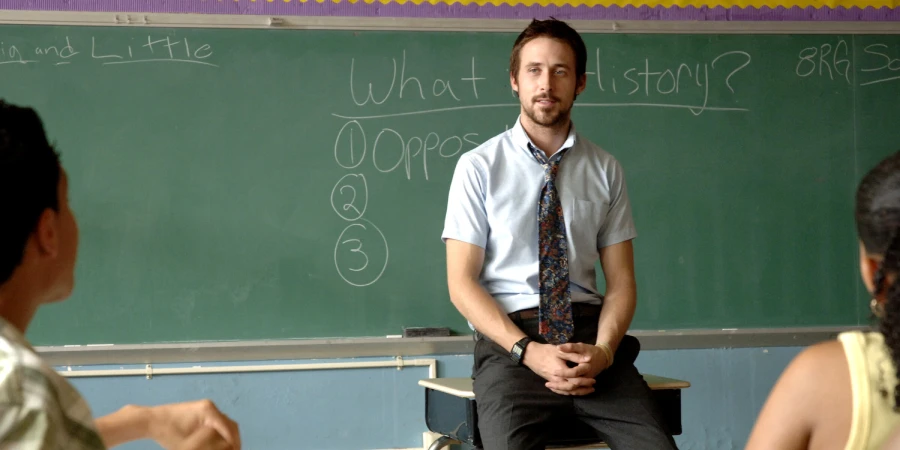

A teacher’s personal life unravels when a student discovers his dark secret. Half Nelson, however, is not a simple story of a savior and a victim. Instead, the film presents a raw, unflinching examination of two broken people. Consequently, they find an unlikely, fragile connection in the ruins of their lives.
Detailed Summary
Meeting Dan Dunne
We first meet Dan Dunne, a charismatic and brilliant middle school history teacher in a tough Brooklyn neighborhood. His students adore him. He teaches history using the Hegelian dialectic, encouraging them to see change as a clash of opposing forces. Outside the classroom, however, Dan leads a secret life. He is a high-functioning drug addict, using crack cocaine to numb a deep-seated pain.
Drey’s Discovery
The film’s pivotal moment arrives after a school basketball game. Dan, who also coaches the girls’ team, retreats to the locker room to get high. One of his quietest students, thirteen-year-old Drey, comes back to retrieve something and finds him semiconscious on the floor, a crack pipe beside him. Instead of panicking or judging, she simply helps him to a bench. Furthermore, this shared secret becomes the complicated foundation of their relationship.
An Unlikely Friendship
Following her discovery, a fragile bond forms between teacher and student. Dan begins driving Drey home from school. During these rides, we learn about Drey’s lonely home life. Her mother works long hours, her brother is in prison for selling drugs, and her father is absent. Similarly, Dan is profoundly lonely. As a result, they find a strange, unspoken comfort in each other’s company.
The Influence of Frank
A new complication emerges in the form of Frank, a local drug dealer played by Anthony Mackie. Frank was an associate of Drey’s incarcerated brother and now seeks to mentor her. In reality, he is grooming her to become a drug runner. Dan, in a misguided attempt to protect Drey, confronts Frank. This interaction, however, only escalates the tension and highlights Dan’s own hypocrisy, as he buys drugs from the very people he wants to protect Drey from.
The Downward Spiral
Dan’s life continues to spiral downward. His ex-girlfriend Rachel visits, dredging up a painful past. He also attempts to connect with his family during a dinner, but his self-destructive behavior alienates them. Later, high on cocaine, he shows up at the apartment of a fellow teacher, Isabel, whom he has been casually seeing. His erratic behavior ultimately leads her to reject him, pushing him further into isolation. Consequently, his addiction consumes him.
A Moment of Crisis
In a deeply flawed act of chivalry, Dan brings Drey along to confront Frank a second time. The tense car ride is a disaster. Frank skillfully manipulates the situation, exposing Dan’s weakness and making him look like a fool. Despite Dan’s failure, Drey makes a crucial choice. When Frank tells her to get out of Dan’s car, she refuses. She decides to stick with her broken teacher, at least for now.
Rock Bottom
The night ends in disaster for Dan. He attends another excruciating family dinner, which he flees to go on a crack binge. He finally returns to his apartment, completely strung out and defeated. The next morning, he sits in a stupor, having clearly hit rock bottom. The consequences of his actions have finally caught up with him in a profound way.

Movie Ending
The ending of Half Nelson is quiet, ambiguous, and deeply impactful. Sometime after his breakdown, Drey knocks on Dan’s apartment door. He answers, looking surprisingly different. He has cut his hair, shaved his beard, and is dressed in a clean suit. His apartment, moreover, is noticeably tidier. The two sit in his living room, not saying a word for a long time.
Ultimately, the silence is what matters most. It is not awkward; rather, it is full of mutual understanding and shared experience. To break the quiet, Dan tells a very simple knock-knock joke a student told him. Drey offers a small, genuine smile. The film ends on this fragile moment. It does not promise a full recovery for Dan or a perfect future for Drey. Instead, it offers a single, hopeful first step away from the abyss. The half nelson, a wrestling hold that’s tough but not impossible to escape, has perhaps loosened its grip.
Are There Post-Credits Scenes?
No, there are no post-credits, mid-credits, or any other scenes after the final credits begin to roll. Once the film ends, it is truly over.
Type of Movie
Half Nelson is a gritty independent drama. Its tone is overwhelmingly realistic and melancholic, capturing the oppressive atmosphere of addiction and poverty. The film functions as a powerful character study, focusing on the internal struggles of its two main characters. However, beneath the grim surface, there are persistent threads of hope and human connection that prevent it from being completely bleak.
Cast
- Ryan Gosling – Dan Dunne
- Shareeka Epps – Drey
- Anthony Mackie – Frank
- Monique Gabriela Curnen – Isabel
- Denis O’Hare – Jimbo
- Starla Benford – Principal Henderson
- Nathan Corbett – Terrance
- Tyra Kwao-Vovo – Stacy
- Jeff Lima – Roodly
- Karen Chilton – Karen
Film Music and Composer
The film’s score was composed and performed by the Canadian indie rock collective Broken Social Scene. Their music is absolutely integral to the movie’s atmosphere. Instead of a traditional orchestral score, the hazy, layered, and often melancholic rock tracks create an immersive soundscape. This music perfectly mirrors Dan’s disoriented and introspective state of mind. Notable tracks like “Shampoo Suicide” and “Da Da Dada” function less as background music and more as a direct extension of the film’s emotional core.


Filming Locations
Director Ryan Fleck and writer Anna Boden shot Half Nelson almost entirely on location in Brooklyn, New York. Specifically, they filmed in neighborhoods like Fort Greene, Clinton Hill, and Gowanus. This choice was crucial for the film’s authenticity. The gritty, lived-in urban environments ground the story in a tangible reality. Therefore, the city itself feels less like a backdrop and more like an active participant in the characters’ lives.
Awards and Nominations
Half Nelson received significant critical acclaim, particularly for its lead performances. Ryan Gosling earned an Academy Award nomination for Best Actor for his powerful and subtle portrayal of Dan Dunne. In addition, the film performed exceptionally well at the Independent Spirit Awards. It won for Best Male Lead (Gosling), Best Female Lead (Shareeka Epps), and Best First Screenplay (Anna Boden and Ryan Fleck). It was also nominated for the Grand Jury Prize at the Sundance Film Festival.
Behind the Scenes Insights
- The film is a feature-length adaptation of a 19-minute short film titled Gowanus, Brooklyn (2004), made by the same filmmakers and starring a different actor as Dan.
- To prepare for the role, Ryan Gosling moved to Brooklyn for a month before filming. He lived in a small apartment and shadowed an eighth-grade teacher to understand the classroom dynamic.
- Shareeka Epps, who plays Drey, had no prior professional acting experience. The directors discovered her during an open casting call in New York City.
- A significant amount of the classroom dialogue was improvised by Ryan Gosling and the young actors. This was done to foster a more authentic and spontaneous classroom environment.
Inspirations and References
The film’s central thematic framework is the Hegelian dialectic, which Dan teaches to his class: a thesis clashes with an antithesis to create a synthesis. This concept directly mirrors the conflicts within Dan (teacher vs. addict), between Dan and Drey, and in the larger social forces at play. In addition, Dan’s lessons about historical figures from the Civil Rights Movement, like Harvey Milk, serve as a constant parallel. These figures represent forces of change, a concept Dan understands intellectually but struggles to apply to his own life.
Alternate Endings and Deleted Scenes
There are no known alternate endings for Half Nelson. The filmmakers were committed to the quiet, ambiguous final scene. However, several scenes were cut from the final film for pacing. These included extended interactions with Dan’s family that provided more backstory on their dysfunctional relationships, as well as a more explicit scene of Dan purchasing drugs on the street. Ultimately, the filmmakers felt these scenes were redundant.
Book Adaptations and Differences
Half Nelson is not based on a book or any other pre-existing work. It is an original screenplay written by Anna Boden and Ryan Fleck. The story originated from their short film, Gowanus, Brooklyn.
Memorable Scenes and Quotes
Key Scenes
- The Locker Room: The tense, quiet moment when Drey finds Dan high after the basketball game. This scene establishes their entire relationship without a word of judgment.
- The Classroom: Any scene where Dan teaches is electric. His lecture connecting the dialectic to social change is a masterclass in showing, not telling, the film’s core theme.
- Confronting Frank: The chaotic car scene where Dan’s attempt to “save” Drey backfires spectacularly, exposing his impotence and hypocrisy.
Iconic Quotes
- “The only thing that’s the same is that everything is changing.”
- “One thing doesn’t make a man. Remember that.”
- “What’s the opposite of this? And what’s the opposite of that? And then you’re on your way to changing the world.”
- (Dan’s final joke) “Knock, knock.” “Who’s there?” “The penguin.” “The penguin who?” “…(long pause)…”
Easter Eggs and Hidden Details
- The title, Half Nelson, is a wrestling term for a hold that is difficult to escape. Consequently, it serves as a perfect metaphor for Dan’s addiction and the systemic traps facing Drey.
- In Dan’s classroom, the whiteboard is often filled with names and concepts related to struggle and opposition, directly reflecting the film’s dialectical themes.
- The books scattered around Dan’s apartment are not random props. They include works on history, philosophy, and social theory, hinting at the intellectual life he is actively destroying.
Trivia
- The film was shot on a very low budget of approximately $700,000 and filmed over just 23 days.
- Directors Anna Boden and Ryan Fleck met while studying film at New York University. Half Nelson was their debut feature film as a directing team.
- Anthony Mackie (Frank) and Ryan Gosling are close friends in real life. They found it challenging, yet rewarding, to portray such intense animosity on screen.
Why Watch?
This film is a raw, honest look at addiction and human connection that avoids every movie cliché. Ryan Gosling’s performance is a subtle masterpiece. As a result, the story leaves you with a fragile, earned sense of hope, not a clean resolution.
Director’s Other Movies
- Sugar (2008)
- It’s Kind of a Funny Story (2010)
- Mississippi Grind (2015)
- Captain Marvel (2019)