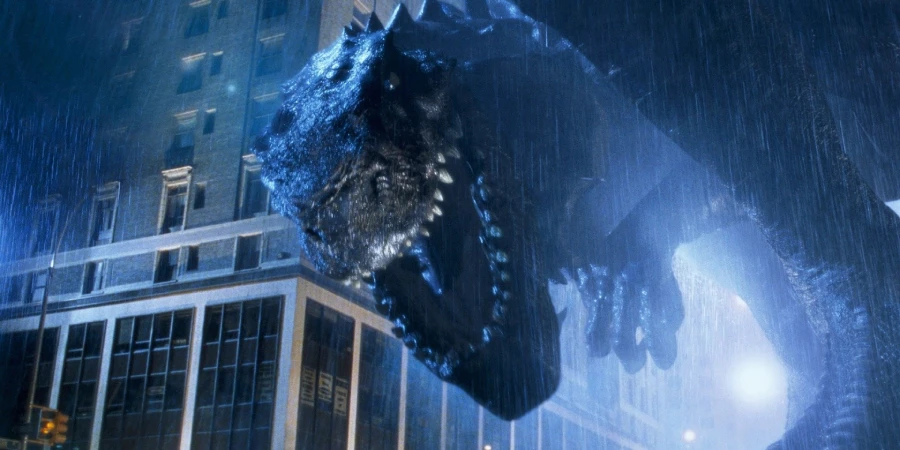

Released in 1998, Godzilla is Hollywood’s first major attempt to reimagine the legendary Japanese kaiju for Western audiences. Directed by Roland Emmerich, the film blends large-scale destruction, blockbuster action, and late-90s CGI spectacle into a modern monster disaster movie. While controversial among longtime fans, it has become a cult favorite over time.
Detailed Summary
Nuclear Origins and the Birth of a Monster
The film begins with French nuclear tests in the South Pacific. Radiation mutates local wildlife, and years later strange seismic events begin appearing across the globe. These disturbances hint that something enormous is moving beneath the ocean.
Dr. Nick Tatopoulos, a biologist specializing in radiation effects, is recruited by the U.S. military to investigate unusual animal footprints found in Panama. His analysis reveals something deeply unsettling: the creature responsible is still growing.
Arrival in New York City
The unidentified monster makes landfall in New York City, emerging from the Hudson River and causing massive destruction. Buildings collapse, streets are torn apart, and the city plunges into chaos. Media quickly dubs the creature “Godzilla.”
The military launches multiple attacks, but conventional weapons prove ineffective. Godzilla demonstrates extreme speed, intelligence, and an ability to evade radar, making it far more agile than expected.
Godzilla’s True Purpose
Nick soon realizes that Godzilla is not merely rampaging. The creature is nesting. Using Madison Square Garden as a massive incubation chamber, Godzilla lays hundreds of eggs that are rapidly hatching.
These offspring behave like hyper-aggressive predators, overwhelming soldiers and civilians alike. The threat escalates from one monster to potentially hundreds capable of overrunning the city.
Race Against Extinction
Nick teams up with reporter Audrey Timmonds, cameraman Victor “Animal” Palotti, and French secret agent Philippe Roaché, who reveals that the French government helped create the monster through nuclear testing.
Together, they uncover the nest and warn the military before the hatchlings spread beyond Manhattan.
Movie Ending
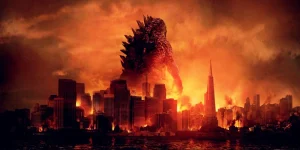
The film’s final act unfolds entirely in New York City and does not hold back on destruction or spectacle.
The U.S. military successfully destroys the nest inside Madison Square Garden using airstrikes, killing all visible baby Godzillas. However, the adult Godzilla survives and begins pursuing Nick and his allies through the city streets.
A dramatic chase sequence follows, with Godzilla running through Midtown Manhattan, smashing buildings and dodging attacks. Eventually, the military uses suspension cables on the Brooklyn Bridge to entangle the creature. Fighter jets fire missiles, killing Godzilla at last.
As the monster collapses, the city believes the nightmare is over.
But in the final moments inside the ruins of Madison Square Garden, one unhatched egg begins to crack. The screen fades to black as a baby Godzilla roars, strongly implying the species has survived and setting up a sequel that never materialized.
This ending reinforces one of the film’s central themes: humanity cannot fully control the consequences of its own destructive technologies.
Are There Post-Credits Scenes?
There is no post-credits scene after the credits finish rolling.
However, the final shot of the cracking egg functions as a sequel tease and effectively serves the same narrative purpose.
Type of Movie
Godzilla (1998) is a science-fiction disaster film that combines monster horror with large-scale action. It leans heavily into blockbuster spectacle rather than traditional kaiju mythology, focusing on survival, military response, and urban destruction.
Cast
- Matthew Broderick as Dr. Nick Tatopoulos
- Jean Reno as Philippe Roaché
- Maria Pitillo as Audrey Timmonds
- Hank Azaria as Victor “Animal” Palotti
- Kevin Dunn as Colonel Hicks
- Michael Lerner as Mayor Ebert
Film Music and Composer
The score was composed by David Arnold, known for his work on the James Bond series.
His soundtrack blends orchestral tension with heroic themes, emphasizing scale and urgency. The film also features a heavily marketed soundtrack album including artists such as Rage Against the Machine, Jamiroquai, and Foo Fighters.
Filming Locations
- New York City, USA
Exterior shots and city plates were filmed on location to capture authentic Manhattan geography. - Stage Studios, California
Most destruction scenes were recreated on massive soundstages using miniatures and CGI.
New York is not just a backdrop but a central character in the movie. Its dense architecture amplifies the scale of destruction and reinforces the monster’s overwhelming size.
Awards and Nominations
- Nominated for Best Visual Effects at several technical award shows
- Won a BMI Film Music Award for David Arnold’s score
- Nominated for multiple Saturn Awards
The film also infamously won several Golden Raspberry Awards, including Worst Picture and Worst Director, reflecting its divisive reception.
Behind the Scenes Insights
- Over 1,000 CGI shots were used, groundbreaking for 1998.
- Godzilla’s design was intentionally altered to move faster and behave more like an animal predator.
- Toho Studios allowed the American adaptation but later stated the monster should be considered a different creature entirely.
- Miniature city models were built alongside CGI to enhance realism.
- Roland Emmerich wanted Godzilla to behave like a force of nature rather than a superhero.
Inspirations and References
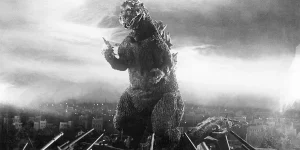
- Inspired by Toho’s original Godzilla (1954)
- Influenced by disaster films like Jurassic Park (1993) and Independence Day (1996)
- Themes drawn from Cold War nuclear anxiety and environmental consequences
Alternate Endings and Deleted Scenes
- A longer military confrontation sequence was cut for pacing.
- Early drafts featured Godzilla surviving and escaping back into the ocean.
- A fully planned sequel script existed but was canceled after box-office performance fell short of expectations.
Book Adaptations and Differences
The film is not based on a novel but received several novelizations and comic adaptations.
Major differences from traditional Godzilla lore include:
- Godzilla is a mutated iguana rather than an ancient creature.
- Atomic breath is replaced with powerful physical attacks.
- The monster behaves like a nesting animal instead of a symbol of divine punishment.
Memorable Scenes and Quotes
Key Scenes
- Godzilla’s first emergence from the Hudson River
- The taxi chase through Manhattan streets
- The baby Godzillas hunting humans in Madison Square Garden
- The Brooklyn Bridge finale
Iconic Quotes
- “That’s a lot of fish.”
- “We didn’t make it angry. We made it.”
- “This thing doesn’t want to fight. It wants to hide.”
Easter Eggs and Hidden Details
- Mayor Ebert and his aide are named after famous film critics Roger Ebert and Gene Siskel.
- The military call sign “G-98” references the production year.
- News footage contains subtle homages to classic Toho destruction shots.
- The baby Godzilla roar at the end closely resembles the original Japanese sound effect.
Trivia
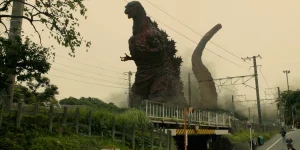
- The creature is officially called Zilla in later Toho canon.
- Godzilla’s roar was created using altered animal sounds mixed with machinery.
- The film grossed over $370 million worldwide.
- The animated sequel series continued the story and was far better received by fans.
- Toho later allowed Godzilla to defeat Zilla in Godzilla: Final Wars (2004).
Why Watch?
Godzilla (1998) is worth watching if you enjoy:
- Large-scale city destruction
- Late-90s blockbuster energy
- Practical effects mixed with early CGI
- Monster movies with fast pacing
While it may not satisfy purist fans, it remains an entertaining snapshot of its era and a fascinating reinterpretation of an iconic monster.
Director’s Other Works
- Independence Day (1996)
- The Patriot (2000)
- The Day After Tomorrow (2004)
- 2012 (2009)
- White House Down (2013)
Recommended Films for Fans
- Godzilla (1954)
- Godzilla vs. Destroyah (1995)
- Godzilla (2014)
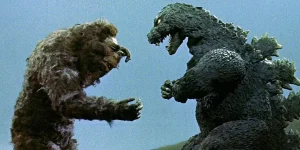
- Kong: Skull Island (2017)
- Cloverfield (2008)
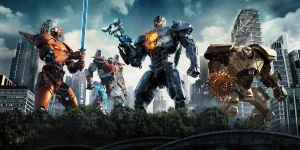
- Pacific Rim (2013)