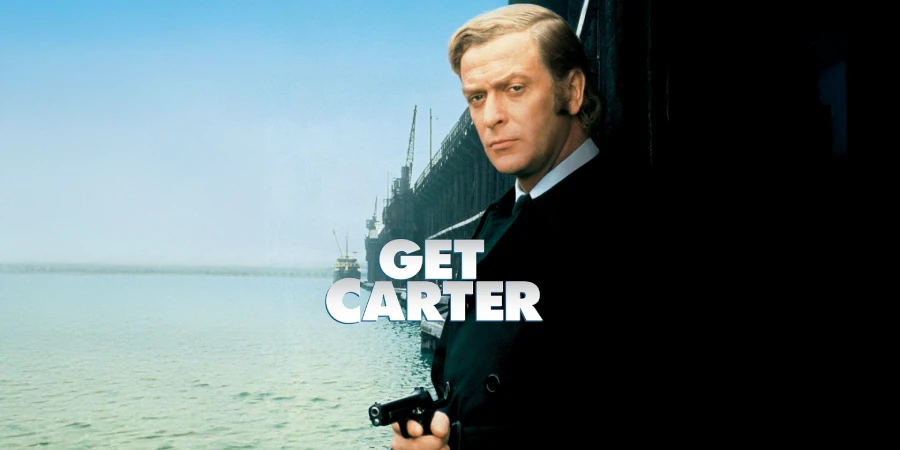

Get Carter (1971), directed by Mike Hodges, is one of the grittiest and most influential British crime films ever made. With Michael Caine delivering one of his most iconic performances, the film stands as a landmark in neo-noir storytelling, full of cold-blooded realism, moral decay, and unforgettable tension.
Detailed Summary
The Call That Starts Everything
Jack Carter, a London gangster, learns that his brother Frank has died in what authorities claim was a drunk-driving accident. Carter doesn’t buy it for a second. He travels to Newcastle, determined to uncover the truth. His reputation precedes him: people recognize him, fear him, but certainly don’t welcome him.
Carter vs. the Newcastle Underworld
As Carter starts asking questions, it’s clear someone wants him gone. He’s warned to leave town, stalked, and pressured by local gangsters who don’t want the truth dragged out. Carter’s methods are blunt: intimidation, manipulation, and an unwavering refusal to back down. He confronts Frank’s acquaintances, old friends, and enemies—each revealing pieces of a disturbing puzzle, especially involving Frank’s daughter Doreen.
The Discovery of the Pornographic Film
One of the most critical moments occurs when Carter watches a pornographic film featuring Doreen, Frank’s daughter. The implication is devastating: Doreen was exploited and Frank may have been killed for knowing too much. Carter’s face remains hard, but his rage quietly shifts into something more personal and unforgiving.
The Web of Betrayals
Carter discovers that local gangsters—including Kinnear and Brumby—were operating a pornography ring that ensnared Doreen. Frank’s death was not an accident but a carefully staged murder. As Carter closes in, loyalties crumble, betrayals pile up, and the violence escalates. Carter becomes a one-man reckoning.

Movie Ending
After uncovering the full extent of Frank’s murder and Doreen’s exploitation, Carter launches a vicious retaliation spree:
- He forces Brumby to confess his involvement and ultimately throws him from a multi-story parking structure.
- He tracks down the men involved in the porn ring, killing them methodically.
- He exacts his final revenge by confronting Eric Paice, the man directly responsible for Frank’s death. After a violent struggle on a remote beach, Carter kills Eric with a shotgun.
It seems Carter has finally completed his mission — but in classic noir fashion, justice does not equal salvation.
As he walks along the cold, empty beach, Carter is suddenly shot from a distance by a sniper hired earlier by crime boss Kinnear. The movie ends with Carter’s body collapsing in the sand as the waves crash around him. There is no last monologue, no redemption, no victory lap. Just the harsh reality that in the criminal world, revenge guarantees nothing except more violence.
This final scene is a defining moment of 1970s British cinema: bleak, merciless, and utterly unforgettable.
Are There Post-Credits Scenes?
No. Get Carter (1971) ends definitively with its final shot. There are no post-credits scenes, teasers, or additional content after the credits roll.
Type of Movie
Get Carter is a British neo-noir crime thriller with strong elements of gangster drama and social realism. It’s gritty, grounded, and unapologetically bleak.
Cast
- Michael Caine as Jack Carter
- Ian Hendry as Eric Paice
- Britt Ekland as Anna
- John Osborne as Cyril Kinnear
- Bryan Mosley as Cliff Brumby
- Dorothy White as Margaret
- Geraldine Moffat as Glenda
Film Music and Composer
The soundtrack was composed by Roy Budd, whose jazz-infused, minimalist score has become legendary. The opening theme—cool, rhythmic, and slightly sinister—perfectly sets the tone for the entire film. The music contributes substantially to the movie’s atmosphere, giving it a uniquely stylish yet grim feel.

Filming Locations and Their Importance
Filming took place primarily in Newcastle, Gateshead, and Northumberland, areas that were industrial, harsh, and bleak—exactly the tone the film needed.
- The Trinity Square Car Park (Gateshead): The brutalist structure became one of the film’s visual signatures and represents the cold, unforgiving environment Carter is navigating.
- Blackhall Beach: The location of the iconic and devastating final scene. Its desolate, rugged landscape intensifies the tragedy and inevitability of Carter’s fate.
- Newcastle streets, pubs, and estates: They are not polished film sets. The real-life grit adds authenticity, making the criminal underworld feel frighteningly real.
Awards and Nominations
Though not heavily decorated at the time of release, the film has grown in status and is now considered one of the greatest British films ever made. It has been included in numerous “best films” lists and received restored re-releases and retrospectives.
Behind the Scenes Insights
- Michael Caine insisted on playing Carter as emotionally cold, which enhanced the film’s noir tone.
- Director Mike Hodges had previously never made a feature film; Get Carter was his debut.
- The film initially divided critics due to its graphic violence, but audiences made it a cult favorite.
- Ian Hendry and Michael Caine allegedly had tension on set due to Hendry’s originally intended larger role.
- The infamous car park was demolished in 2010 despite public campaigns inspired partly by the film’s legacy.
Inspirations and References
- Based on the novel Jack’s Return Home by Ted Lewis.
- Influenced by classic American noir, especially Point Blank and The Maltese Falcon.
- Its bleak tone reflects the socio-economic decay of northern England during the late 1960s.
Alternate Endings and Deleted Scenes
No fully developed alternate ending was filmed. However, early script drafts had:
- A more ambiguous death scene where Carter’s fate was less clear.
- Additional scenes exploring corruption within Newcastle police, later removed to tighten the pacing.
Book Adaptations and Differences
The film is adapted from Jack’s Return Home, but there are notable differences:
- The novel portrays Carter as more introspective and reflective.
- The film simplifies some of the subplot politics to keep the focus on Carter’s revenge.
- The ending in the book is quieter, though still fatalistic.
- Several characters were combined or removed for cinematic clarity.


Memorable Scenes and Quotes
Key Scenes
- Carter’s cold arrival by train, paired with Roy Budd’s iconic theme.
- The discovery of the pornographic film involving Doreen.
- Carter throwing Brumby from the rooftop of the car park.
- The shocking beach finale.
Iconic Quotes
- “You’re a big man, but you’re in bad shape. With me, it’s a full-time job. Now behave yourself.”
- “I know you didn’t kill Frank… but you’re involved.”
- “You’re a crafty little fellow, aren’t you?”
Easter Eggs and Hidden Details
- The book Carter reads early in the film is a direct reference to the novel it’s based on.
- The car park’s architectural bleakness was deliberately chosen to symbolize Carter’s own moral emptiness.
- Many extras were real locals, adding raw authenticity to the environment.
Trivia
- Sylvester Stallone starred in a 2000 remake—but the original remains vastly superior.
- Michael Caine has said Carter is one of the coldest characters he ever played.
- The film’s poster became an iconic image of 1970s British cinema.
Why Watch?
Because Get Carter isn’t just a crime film—it’s a razor-sharp character study, a grim exploration of vengeance, and a masterclass in minimalist acting. If you appreciate understated but powerful filmmaking, gritty atmospheres, and morally complex antiheroes, this film is essential viewing.
Director’s Other Movies
- Pulp (1972)
- The Terminal Man (1974)
- Flash Gordon (1980)
- Croupier (1998)
- I’ll Sleep When I’m Dead (2003)
Recommended Films for Fans
- The Long Good Friday (1980)
- The French Connection (1971)
- Point Blank (1967)
- Mona Lisa (1986)
- The Departed (2006)