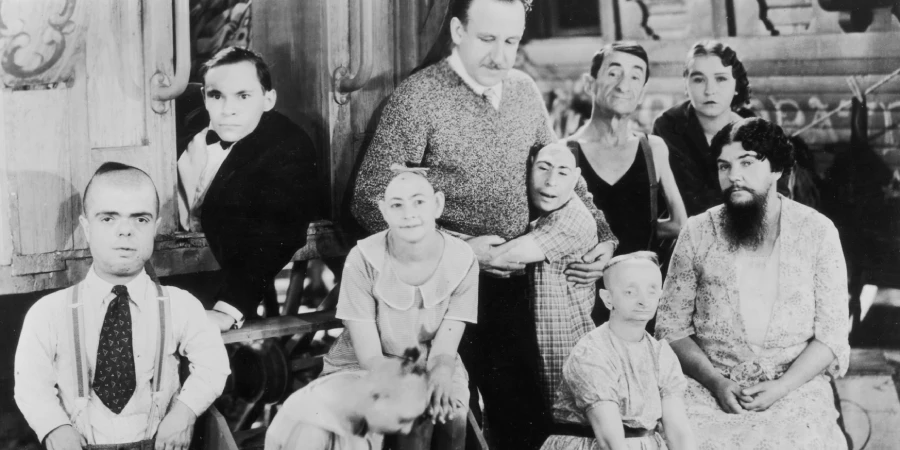

Tod Browning’s Freaks is more than a horror film; it is a celluloid wound that has refused to heal for nearly a century. The movie scandalized 1932 audiences by casting real carnival performers, whose humanity ultimately exposes the monstrosity of the so-called “normal” people. As a result, it remains one of the most controversial and empathetic pictures ever made.
Detailed Summary
A Circus Romance
The film introduces us to a French traveling circus. We meet its community of “freaks,” including the conjoined twins Violet and Daisy Hilton, Schlitzie (a man with microcephaly), and Prince Randian (the Living Torso).
The central story, however, focuses on Hans, a little person deeply infatuated with the beautiful, full-sized trapeze artist, Cleopatra. His fiancée, Frieda, also a little person, warns him that Cleopatra is just mocking him for his wealth and status.
A Sinister Plot
Cleopatra openly ridicules Hans behind his back. She carries on a brazen affair with the circus strongman, Hercules. When they learn Hans has inherited a large fortune, their mockery turns into a sinister scheme.
Consequently, Cleopatra agrees to marry Hans. She plans to poison him slowly after the wedding and then run away with Hercules and the inheritance. Hans, blinded by love, eagerly accepts her proposal, devastating Frieda.
The Wedding Feast
A bizarre wedding celebration takes place. The performers welcome Cleopatra into their family with a chilling chant: “Gooble-gobble, one of us! We accept her! One of us!” They pass around a large loving cup for everyone to drink from.
Cleopatra’s facade finally shatters. Repulsed, she screams at them, calling them “dirty, slimy freaks” and throws the wine in their faces. This moment of cruelty seals her fate, as she has irrevocably broken their code of acceptance.
Revenge of the Freaks
After the wedding, Hans falls gravely ill. Frieda discovers that Cleopatra is putting poison in his medicine. The other performers realize what is happening and band together to protect their friend.
During a violent thunderstorm, as the circus caravan moves to a new location, the performers enact their revenge. They emerge from the mud and shadows, armed with knives and clubs, crawling and creeping toward Cleopatra’s wagon. Hercules tries to intervene but is also targeted.
Movie Ending
The climax unfolds during a torrential downpour. The sideshow performers, moving with a terrifying, unified purpose, attack Hercules and Cleopatra. The camera focuses on their shadowy figures crawling through the mud beneath a wagon, their determined faces illuminated by flashes of lightning.
We see Cleopatra screaming in terror as they overwhelm her. The film then cuts away, leaving her ultimate fate ambiguous for a moment. Instead, the scene shifts to show Hercules’s comeuppance from an earlier deleted scene; other performers mention he now sings falsetto, implying he was castrated.
The final, horrifying reveal comes later. A barker introduces a new attraction: a squawking, feathered creature in a pen. This new “freak” is revealed to be Cleopatra, now horribly mutilated into a “human duck” with no legs, a tarred-and-feathered torso, and a broken, squawking voice. In an epilogue added by the studio, Hans is living a lonely life of luxury, but Frieda and two other friends visit to console him, showing that his true family has forgiven and accepted him back.
Are There Post-Credits Scenes?
No, there are no post-credits scenes in Freaks. The film ends after the brief epilogue with Frieda comforting Hans.
Type of Movie
Freaks is a pre-Code horror drama. While it contains chilling sequences that firmly place it in the horror genre, its core is a tragic melodrama. The film’s tone is unique, blending genuine empathy for its outcast characters with moments of shocking body horror and suspense. It defies simple categorization, existing as both a cautionary tale and a poignant character study.
Cast
- Wallace Ford – Phroso
- Leila Hyams – Venus
- Olga Baclanova – Cleopatra
- Roscoe Ates – Roscoe
- Harry Earles – Hans
- Daisy Earles – Frieda
- Rose Dione – Madame Tetrallini
- Daisy and Violet Hilton – The Siamese Twins
- Schlitzie – Himself
- Prince Randian – The Living Torso
- Johnny Eck – The Half-Boy
- Henry Victor – Hercules
Film Music and Composer
Freaks notably lacks a continuous, traditional musical score, a common trait in many early sound films. This absence of non-diegetic music makes the unsettling scenes feel more immediate and realistic. The primary music heard is diegetic, including circus fanfares, calliope tunes, and Roscoe’s stuttering rendition of “By the Light of the Silvery Moon.”
The opening and closing title themes were composed by Dr. William Axt, a prolific but often uncredited composer for MGM during that era. However, the film’s true soundscape is defined by the ambient noises of the circus and the characters’ own voices.
Filming Locations
Freaks was filmed entirely on the MGM studio lot in Culver City, California. The production team built detailed and convincing sets to replicate a muddy, rain-soaked European traveling circus. In addition, the confined and somewhat artificial environment of the studio lot helped amplify the film’s claustrophobic atmosphere.
Awards and Nominations
Upon its release, Freaks received no awards or nominations. The film was a critical and commercial disaster, reviled by the public and pulled from many theaters. Its modern acclaim is a result of decades of reappraisal by critics and film historians.
Behind the Scenes Insights
- Director Tod Browning had run away to join a circus as a teenager, giving him firsthand knowledge of the world he depicted. He treated the performers with respect on set.
- The use of actual carnival performers with physical disabilities was unprecedented and highly controversial. MGM executives were reportedly horrified by the daily rushes.
- During a test screening, one woman threatened to sue MGM, claiming the film caused her to have a miscarriage. This event contributed to the studio’s decision to cut the film.
- The original cut of Freaks was over 90 minutes long. After disastrous test screenings, MGM cut nearly 30 minutes of footage, most of which is now considered lost.
- The film was banned in the United Kingdom for over 30 years. Similarly, several U.S. states and other countries also prohibited its exhibition for decades.
Inspirations and References
The film is based on the 1923 magazine short story Spurs by Tod Robbins. Tod Browning acquired the rights and adapted the core concept for the screen. While the film follows the basic premise of a little person being exploited for his inheritance, it expands the world significantly by adding numerous other sideshow characters.
Alternate Endings and Deleted Scenes
The most famous deleted scene is the original ending. In it, the freaks were shown capturing Hercules and castrating him. A subsequent shot revealed him singing in a high-pitched falsetto voice, joining the circus’s cast of singers.
MGM removed this sequence, deeming it far too graphic and shocking for audiences. Only a single line remains in the final cut where a character mentions Hercules now “sings soprano.” Much of the excised footage focused on the violent details of the freaks’ revenge attack on both Hercules and Cleopatra.
Book Adaptations and Differences
The screenplay for Freaks is adapted from the short story Spurs, but it takes significant liberties. In the story, the main character is a little person named Jacques Courbé, who is a circus equestrian. He falls for a cruel bareback rider named Jeanne Marie.
The most significant difference lies in the revenge. In Spurs, Jacques’s friends, a group of fellow little people, abduct Jeanne Marie. Years later, Jacques is seen with a new “dog” on a leash—a shrunken, mutilated version of Jeanne Marie, forced to wear his old spurs. The film broadened the story to include a diverse community of “freaks” and made their revenge a collective act of justice.
Memorable Scenes and Quotes
Key Scenes
- The Wedding Feast: The iconic “Gooble-gobble, one of us!” scene is a masterclass in building tension. It shifts from a welcoming ceremony to a terrifying moment of rejection that solidifies Cleopatra’s doom.
- The Attack in the Rain: The climax where the performers crawl through the mud to exact their revenge is one of the most frightening sequences in horror history. Their silent, determined advance is pure nightmare fuel.
- Cleopatra’s Reveal: The final shot of Cleopatra as the “human duck” is a truly shocking and unforgettable image that has haunted audiences for decades.
Iconic Quotes
- “Gooble-gobble, one of us! We accept her! One of us!” – The Freaks
- “You’re a man, but I’m a woman. I’m a woman, Hans. You can’t make love to a lot of things… but you can to me.” – Cleopatra
- “Dirty! Slimy! Freaks! Freaks! Freaks! Get out of here!” – Cleopatra
- “Their code is a law unto themselves. Offend one, and you offend them all.” – Phroso
Easter Eggs and Hidden Details
- Throughout the film, the conjoined twins Daisy and Violet Hilton are shown having distinct personalities and romantic interests. This subtle detail reinforces the film’s theme of individuality and humanity beyond appearances.
- In the opening scenes, Madame Tetrallini lovingly refers to the performers as her “children,” establishing the found-family dynamic that becomes crucial to the plot.
- When Phroso the clown consoles Venus, a poster for a “Human Skeleton” attraction is visible behind them, subtly foreshadowing the physical dangers that lurk within the circus world.
Trivia
- Lon Chaney, Tod Browning’s frequent collaborator, was the original choice for the role of Hercules. Unfortunately, he passed away before production began.
- Author F. Scott Fitzgerald was working as a screenwriter at MGM during production. He reportedly attended a screening and declared it was so disturbing he had to leave to be sick.
- The film’s commercial failure effectively ended Tod Browning’s once-prestigious career. While he directed a few more films, he never regained the status he had after directing Dracula (1931).
- Harry Earles (Hans) and Daisy Earles (Frieda) were siblings and members of a German performing troupe known as “The Doll Family.”
Why Watch?
Watch Freaks to witness a film so daring it nearly destroyed its director’s career. It’s a powerful, empathetic, and truly unsettling masterpiece that challenges perceptions of normalcy and monstrosity. Its influence on horror and counter-culture is immeasurable.
Director’s Other Movies
- The Unholy Three (1925)
- The Unknown (1927)
- London After Midnight (1927)
- Dracula (1931)
- Mark of the Vampire (1935)
- The Devil-Doll (1936)
Recommended Films for Fans
- The Elephant Man (1980)
- Carnival of Souls (1962)
- Santa Sangre (1989)
- The Cabinet of Dr. Caligari (1920)
- Eyes Without a Face (1960)