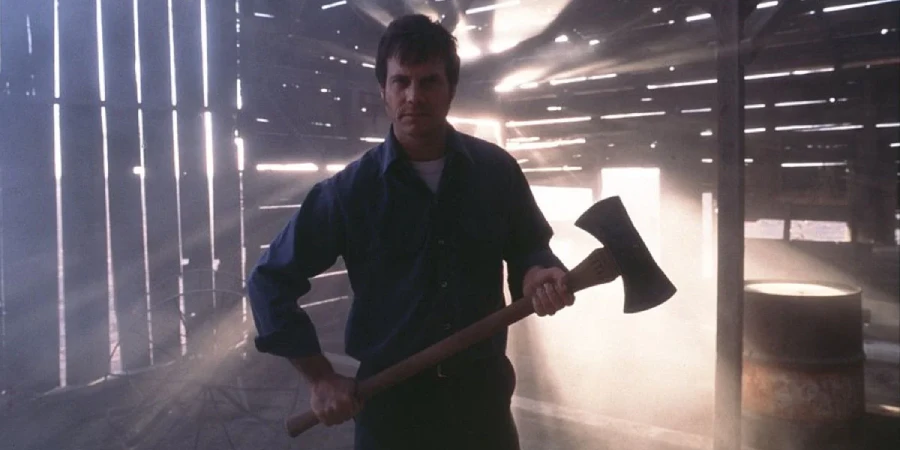

Frailty (2001) is one of those rare psychological thrillers that quietly sneaks under your skin and refuses to leave. Directed by and starring Bill Paxton, the film blends religious horror, crime mystery, and psychological drama into a disturbing story about faith, guilt, and the terrifying possibility that madness and divinity may look exactly the same.
Detailed Summary
A Disturbing Confession at the FBI Office
The film opens late at night when a nervous man named Fenton Meiks walks into an FBI office in Dallas. He claims to have information about a serial killer known as “God’s Hand,” who has murdered people across Texas.
Fenton insists that the killer is not only real, but is his own brother, Adam Meiks.
As FBI Agent Wesley Doyle listens, the movie shifts into flashback, forming the backbone of the story.
Childhood in a Deeply Religious Household
The flashbacks take us to the 1970s, where young brothers Fenton and Adam live with their widowed father in a small Texas town.
Their father is deeply religious but otherwise loving and normal until one night when everything changes.
He awakens his sons to deliver a shocking message:
God has spoken to him.
According to their father, God has chosen him to destroy demons disguised as humans. These “demons” look normal but are actually evil beings sent to corrupt the world.
Fenton immediately believes his father has lost his mind. Adam, however, accepts the message with disturbing calm.
This ideological split becomes the emotional core of the film.
The Tools from God
Their father claims that God has sent him three sacred tools:
- An axe for execution
- A pair of gloves that reveal a person’s sins when touched
- A list of names given through divine visions
When the father touches people while wearing the gloves, he describes horrific visions of murder, abuse, and evil acts.
To Fenton, this is clear insanity.
To Adam, it is proof of God’s will.
Escalation into Violence
The father abducts individuals he believes are demons and brings them to a hidden shed on the family property called the Rose Garden.
He insists the killings must be done in a specific order:
- The demon must confess
- The execution must be carried out with the axe
- The body must be buried in the Rose Garden
The murders escalate in brutality and emotional intensity. Fenton attempts to save victims and even tries to report his father to the police.
One of the film’s most disturbing moments occurs when the father locks Fenton in the cellar for days, claiming God told him to do it.
The family dynamic collapses completely.
The Father’s Death
Eventually, the father is killed during a confrontation with the police.
Before dying, he insists that God’s mission is not over and that one of his sons must continue the work.
The authorities believe the murders were the acts of a deranged man, and the case is officially closed.
Or so it seems.
Return to the Present Timeline
Back in the present, adult Fenton tells Agent Doyle that Adam continued the killings years later.
He claims Adam fully embraced their father’s beliefs and has become the true “God’s Hand” killer.
Fenton says he fears Adam is planning one final murder and begs the FBI to stop him.
Agent Doyle reluctantly agrees to accompany Fenton to the Rose Garden to uncover evidence.
Movie Ending
The ending of Frailty is where the film transforms from a psychological thriller into something far more chilling.
At the Rose Garden, Fenton digs up the bodies to prove Adam’s crimes. The remains confirm multiple murders, validating much of Fenton’s story.
However, during the process, Fenton suddenly kills Agent Doyle with the axe.
The truth is finally revealed.
Fenton was lying.
He is not Fenton at all.
He is Adam Meiks.
The man we believed was the innocent younger brother was actually the one chosen by God all along.
The real Fenton had grown up rejecting the mission and threatening to expose it. God then commanded Adam to kill his brother, identifying him as a demon.
The twist reframes the entire movie:
- The father was not delusional
- The gloves truly revealed sins
- The demons were real
- God’s mission was genuine
Even more disturbing, Agent Doyle himself is revealed to be a demon. When Adam touches him with the gloves, he receives visions confirming Doyle’s hidden crimes.
Adam completes the execution calmly and buries Doyle beneath the Rose Garden.
The film ends with Adam continuing his divinely ordained task, protected by God and completely beyond the reach of human law.
The final message is deeply unsettling: what if faith is not madness, but obedience is the real horror?
Are There Post-Credits Scenes?
No. Frailty does not include a post-credits or mid-credits scene. The story ends definitively with its final revelation, and the silence after the credits reinforces the film’s disturbing conclusion.
Type of Movie
Frailty is a psychological thriller that blends religious horror, crime mystery, and Southern gothic drama. It balances grounded realism with supernatural ambiguity until its final act removes all doubt.
Cast
- Bill Paxton as Dad
- Matthew McConaughey as Fenton Meiks
- Powers Boothe as Agent Wesley Doyle
- Matt O’Leary as young Fenton
- Jeremy Sumpter as young Adam
Film Music and Composer
The score was composed by Brian Tyler, whose restrained and atmospheric music avoids traditional horror cues. The soundtrack emphasizes tension, dread, and moral unease rather than jump scares.

Filming Locations
The movie was filmed primarily in Texas and California, using rural landscapes to reinforce isolation and religious intensity.
The small-town settings mirror the characters’ closed world view, while the Rose Garden location becomes a symbolic intersection of faith, violence, and secrecy.
Awards and Nominations
While not a major awards contender, Frailty gained significant critical praise and later achieved cult status.
It received nominations from:
- Saturn Awards (Best Horror Film)
- Fantasporto Film Festival
Its reputation has grown considerably since release.
Behind the Scenes Insights
- Bill Paxton made his directorial debut with this film.
- Paxton stated he wanted the violence to feel “solemn, not entertaining.”
- Matthew McConaughey accepted the role because of the script’s moral ambiguity.
- The child actors were intentionally shielded from understanding the full story during filming.
- Paxton directed himself while acting, relying heavily on preparation and rehearsal.
Inspirations and References
- Biblical stories of divine testing, particularly Abraham and Isaac
- Southern gothic literature
- Real-life cases of religious extremism
- Films like The Night of the Hunter (1955)
The story explores how faith can become indistinguishable from fanaticism.
Alternate Endings and Deleted Scenes
No alternate endings were officially filmed.
However, early drafts kept the supernatural element ambiguous, leaving open the possibility that everything was delusion. The final version deliberately confirms the divine truth to maximize discomfort.
Several deleted scenes expanded the brothers’ adult relationship but were removed to preserve pacing.
Book Adaptations and Differences
Frailty is not based on a book. It was written as an original screenplay by Brent Hanley, making its narrative twists even more impressive given the lack of source material.
Memorable Scenes and Quotes
Key Scenes
- The first appearance of the gloves
- The cellar imprisonment scene
- The father calmly explaining God’s command
- The revelation at the Rose Garden
- The final execution
Iconic Quotes
- “God told me to do it.”
- “You don’t understand. Demons walk among us.”
- “Only one of you was chosen.”
Easter Eggs and Hidden Details
- The Rose Garden visually resembles a cross from above.
- Adam is frequently framed in light, Fenton in shadow.
- The axe is shown before the visions begin, hinting at inevitability.
- The sheriff’s badge number appears repeatedly throughout the film.
- Biblical verses are subtly embedded in background props.
Trivia
- The film was shot in under 40 days.
- Bill Paxton never directed another movie afterward.
- The gloves were custom-made and fragile, limiting takes.
- Matthew McConaughey appears only in the framing narrative.
- The movie performed modestly at the box office but found success on home video.
Why Watch?
Because Frailty is a rare horror film that doesn’t rely on monsters or jump scares.
It asks terrifying questions:
- What if God truly speaks?
- What if obedience is more dangerous than disbelief?
- What if evil looks exactly like faith?
Its final twist redefines every scene before it and lingers long after the screen goes dark.
Director’s Other Works (Bill Paxton)
- The Greatest Game Ever Played (2005) as actor only
- Titanic (1997) as actor
- Aliens (1986) as actor
- Twister (1996) as actor
Frailty remains his only directing credit.