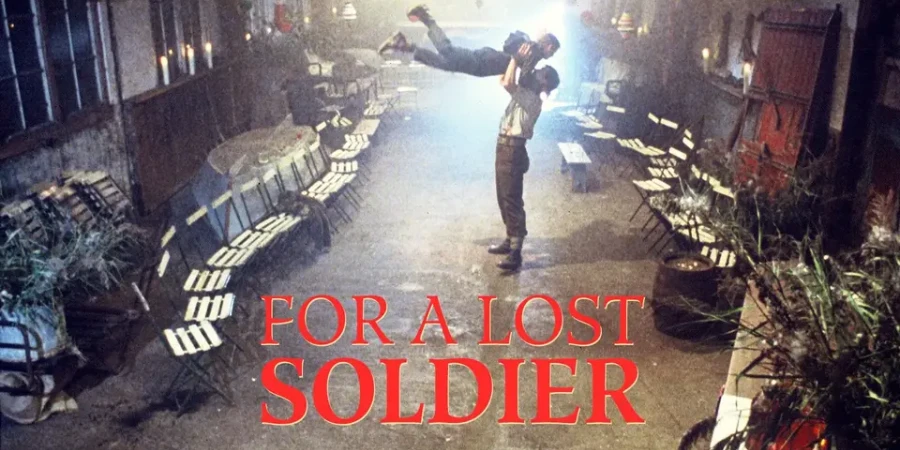

For a Lost Soldier (1992), directed by Roeland Kerbosch, is a delicate, contemplative Dutch drama based on Rudi van Dantzig’s autobiographical novel. The film explores memory, adolescence, longing, and the emotional confusion of first love during wartime.
Detailed Summary
The Evacuation and a New Life in the Countryside
The film opens during the closing months of World War II. Young Jeroen is evacuated from famine-stricken Amsterdam to Friesland, a rural area untouched by the worst of the war. There, he is placed with a foster family, who treat him warmly but remain emotionally distant. These early scenes establish the film’s central theme: a child trying to feel belonging during chaos.
Arrival of the Canadian Soldiers
When the Canadian forces liberate the region, Jeroen becomes fascinated by the soldiers, especially a young Canadian trooper named Walt. Their interactions begin innocently, rooted in admiration and the excitement of liberation. But the relationship slowly shifts into something more complex, tender, and confusing, as Walt becomes the first person to make Jeroen feel truly seen.
Jeroen and Walt’s Intensifying Bond
Walt serves as a symbol of freedom, masculinity, and affection for Jeroen. Their relationship deepens physically and emotionally, portrayed through the eyes of Jeroen’s later adult self, who is still trying to understand these memories. These scenes walk a careful line: they do not focus on explicit content, but rather on the emotional impact and the shaping of identity.
Walt’s Sudden Disappearance
Without warning, Walt’s unit is ordered to move on. He leaves a brief note, then disappears from Jeroen’s life entirely. Jeroen is devastated. The film captures the profound emotional fallout of abandonment, confusion, and the sudden ending of a relationship he did not fully comprehend.
Movie Ending
In the final act, the adult Jeroen reflects on his past as he creates a dance performance inspired by his memories of Walt. This retrospective framing reveals that Jeroen has spent his adulthood wrestling with the impact of that wartime relationship — its tenderness, its loss, and its unresolved emotional weight.
The ending shows Jeroen attempting to fill the void Walt created, not through bitterness, but through art. The film ends where the adult Jeroen finally accepts that the emotional imprint of Walt will always be part of him, even if the relationship was never properly understood or closed.
There is a quiet, almost haunting finality to this: no reunion, no answers, only memory and its echoes.
Are There Post-Credits Scenes?
No, there are no post-credits scenes in For a Lost Soldier.
Type of Movie
The film is a coming-of-age wartime drama with strong autobiographical tones. Its approach is quiet, introspective, and emotionally nuanced rather than sensational.
Cast
- Maarten Smit as Young Jeroen
- Jeroen Krabbé as Adult Jeroen
- Andrew Kelley as Walt
- Freark Smink as Jeroen’s foster father
- Elsie de Brauw as Jeroen’s foster mother
Film Music and Composer
The score was composed by Joop Stokkermans, whose soft, lyrical piano-based themes reinforce the film’s introspective and wistful tone.
Filming Locations
The film was primarily shot in the Netherlands, particularly in rural regions that visually mirror the setting of Friesland during WWII.
These locations are important because they reflect:
- The peacefulness Jeroen experiences compared to war-torn Amsterdam
- The isolation that intensifies his emotional attachment to Walt
- The nostalgic, dreamlike quality of his memories
Awards and Nominations
While not a major awards contender globally, the film received attention at several European festivals for its sensitive handling of difficult material and its cinematography. It remains a respected title in Dutch cinema.
Behind the Scenes Insights
- The film faced challenges in casting Jeroen due to the sensitive nature of the story.
- Kerbosch worked closely with author Rudi van Dantzig to maintain emotional authenticity.
- Many outdoor scenes were shot using natural light to preserve the nostalgic, memory-like aesthetic.
- The Canadian soldiers were played partly by local extras trained to mimic authentic 1940s military behavior.
Inspirations and References
The film is an adaptation of Rudi van Dantzig’s semi-autobiographical novel, Voor een Verloren Soldaat.
It draws inspiration from:
- Van Dantzig’s real childhood wartime experiences
- His lifelong reflections on identity, memory, and attachment
- Dutch resistance-era history and the “Hunger Winter” of 1944–45
Alternate Endings and Deleted Scenes
There are no widely known alternate endings. However:
- Some early scripts included extended scenes of adult Jeroen searching for information about Walt, later removed to keep the narrative focused on memory rather than literal closure.
- A few quieter interactions between young Jeroen and his foster parents were also cut for pacing.
Book Adaptations and Differences
Because the film is directly based on a novel, certain differences stand out:
- The book delves deeper into Jeroen’s adult psychological struggles.
- The relationship between Walt and Jeroen is portrayed with more introspection and ambiguity in the novel.
- The film simplifies some of the political and wartime context to focus on personal memory rather than historical detail.
Memorable Scenes and Quotes
Key Scenes
- Jeroen’s first encounter with Walt and the spark of admiration it ignites.
- The celebratory liberation scenes, filled with music, dancing, and joy.
- The moment Jeroen discovers Walt has left — a turning point of heartbreak.
- Adult Jeroen rehearsing his ballet performance inspired by his childhood memories.
Iconic Quotes
- “Memory is not about truth. It is about survival.”
- “He walked into my life, and just as quickly, walked out.”
- “Everything I remember is colored by the boy I was then.”
Easter Eggs and Hidden Details
- The adult Jeroen’s dance movements subtly reference gestures he saw Walt make — a visual link between past and present.
- The bicycle Walt gifts Jeroen symbolizes freedom and independence, themes strongly tied to the Dutch liberation.
- Several shots mimic the cover illustrations from the original novel.
Trivia
- The film sparked significant discussion in Europe due to its controversial subject matter, though it was praised for avoiding sensationalism.
- Jeroen Krabbé (adult Jeroen) is also a renowned painter; his artistic sensibilities influenced the film’s visual tone.
- The film remains frequently studied in academic discussions of LGBT cinema and memory studies.
Why Watch?
Because it is a rare film that handles memory, longing, identity, and the emotional complexity of youth with restraint, sensitivity, and poetic beauty. If you appreciate slow, atmospheric dramas that feel like leafing through an old journal, this is a deeply affecting experience.
Important themes such as emotional imprint, the scars of formative experiences, and the quiet tragedies of war are explored with maturity and subtlety.
Director’s Other Works (Movies)
- The Moving Truth (1994)
- Het Woeden der Gehele Wereld (2006)
(Kerbosch worked more frequently in television, but these films represent his feature work.)
Recommended Films for Fans
If you appreciate the tone, themes, or era of For a Lost Soldier, you might enjoy:
- Mädchen in Uniform (1931)
- Au Revoir les Enfants (1987)
- My Own Private Idaho (1991)
- Beautiful Thing (1996)
- Call Me by Your Name (2017)