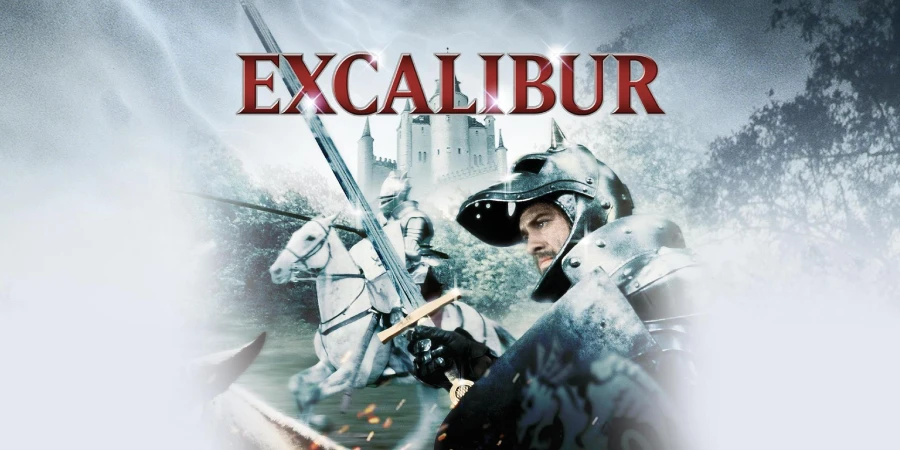

John Boorman’s Excalibur (1981) is one of the most ambitious, symbolic, and uncompromising adaptations of the King Arthur legend ever put on screen. Rather than a clean heroic fairy tale, the film embraces myth, blood, fate, and tragedy, presenting Camelot as a place born from magic and doomed by human weakness. This is Arthurian legend at its most operatic and brutal.
Detailed Summary
The Age of Chaos and Uther Pendragon
Britain is torn apart by endless war among rival lords. Uther Pendragon, aided by the wizard Merlin, seeks to unite the land. Merlin helps Uther deceive the Duke of Cornwall, allowing Uther to sleep with the Duke’s wife, Igraine. From this union, Arthur is conceived. Soon after, Uther dies in battle, plunging the kingdom back into chaos.
Before dying, Uther drives the magical sword Excalibur into stone, declaring that only the true king may draw it.
The Sword in the Stone
Years later, Britain remains divided. A young squire named Arthur, unaware of his royal lineage, accidentally pulls Excalibur from the stone while retrieving a sword for his foster brother. Merlin reveals Arthur’s true parentage, and after resistance from the lords, Arthur becomes king.
This moment establishes one of the film’s core themes: kingship is destiny, not ambition.
The Rise of Camelot
Arthur founds Camelot, creates the Round Table, and gathers noble knights such as Lancelot, Gawain, Percival, and Tristan. The land flourishes, and Arthur rules with justice. However, pride and passion begin to rot Camelot from within.
Arthur unknowingly fathers a son, Mordred, with his half-sister Morgana, who has been manipulating events using Merlin’s stolen magic.
Lancelot and Guinevere
The film’s emotional center is the forbidden love between Lancelot and Queen Guinevere. Their affair fractures Arthur’s spirit and breaks the sacred bond between king, land, and knights. As Arthur’s authority weakens, the land itself becomes barren.
This decline is shown visually through rusted armor, dying forests, and decaying castles, reinforcing the idea that the king and the land are one.
The Quest for the Holy Grail
Arthur, wounded and spiritually broken, sends his knights to find the Holy Grail, the only object capable of restoring the kingdom. Most fail. Percival, once a foolish boy, matures through suffering and eventually finds the Grail, returning it to Arthur.
Arthur drinks from the Grail and is healed. Camelot briefly rises again, but fate cannot be undone.
Movie Ending
In the final act, Mordred openly rebels, leading an army against Arthur. Merlin, long imprisoned by Morgana, fades from the world, his magic no longer able to change destiny. Morgana herself ages rapidly, consumed by her hatred and sorcery.
Arthur leads his remaining knights into a final, fog-covered battle against Mordred’s forces. One by one, the Knights of the Round Table fall. Arthur and Mordred confront each other directly, and Arthur kills his son—but not before Mordred fatally wounds him.
Mortally injured, Arthur commands Percival to return Excalibur to the Lady of the Lake. Percival hesitates, tempted by the sword’s power, but ultimately obeys. As Excalibur is thrown into the water, a mysterious hand rises and takes it beneath the surface.
Arthur is then placed on a boat and carried away toward Avalon, the mythical isle of rest and rebirth. Whether Arthur is dead or merely sleeping is left deliberately ambiguous, honoring the legend that the king may return when Britain needs him most.
The film closes not with triumph, but with mythic melancholy and acceptance of fate.
Are There Post-Credits Scenes?
No. Excalibur (1981) does not include any post-credits or mid-credits scenes. The story ends definitively with Arthur’s departure to Avalon.
Type of Movie
Excalibur is a dark fantasy epic rooted in mythological drama. It blends medieval warfare, mysticism, tragedy, and symbolic storytelling rather than traditional heroic adventure.
Cast
- Nigel Terry – King Arthur
- Helen Mirren – Morgana
- Nicholas Clay – Lancelot
- Cherie Lunghi – Queen Guinevere
- Nicol Williamson – Merlin
- Paul Geoffrey – Percival
- Robert Addie – Mordred
- Liam Neeson – Gawain (early role)
Film Music and Composer
The film uses a combination of classical compositions rather than an original score. Most notably:
- Richard Wagner’s Tristan und Isolde
- Carl Orff’s O Fortuna from Carmina Burana
These pieces give the film its grand, mythic, almost ritualistic tone, reinforcing the sense that the story exists outside normal time.
Filming Locations
- Ireland – Most of the film was shot in Irish forests, lakes, and hills
These natural locations give the film its misty, ancient atmosphere. The landscapes feel timeless and untouched, perfectly matching the mythic tone of the story. Ireland’s weather and terrain play a key role in the film’s visual symbolism, especially during Camelot’s rise and fall.
Awards and Nominations
- Nominated for Best Costume Design – Academy Awards (1982)
While it did not win major awards, Excalibur became a cult classic and is widely respected for its visual design and mythological ambition.
Behind the Scenes Insights
- Many actors wore real metal armor, making fight scenes physically exhausting.
- John Boorman insisted on minimal realism and maximum symbolism.
- Several cast members, including Liam Neeson, were at the very beginning of their careers.
- Weather delays were common, but Boorman embraced fog and rain as thematic elements.
- Helen Mirren has described the shoot as physically demanding but creatively liberating.
Inspirations and References
- Based primarily on Le Morte d’Arthur by Sir Thomas Malory
- Influenced by Celtic mythology and medieval romance literature
- Boorman aimed to capture the spiritual essence of the legend rather than historical accuracy
Alternate Endings and Deleted Scenes
There is no confirmed alternate ending. However, several character moments—particularly involving the knights—were trimmed to reduce runtime. Early drafts reportedly expanded Merlin’s role near the end, but Boorman chose a more myth-consistent disappearance instead.
Book Adaptations and Differences
While based on Le Morte d’Arthur, the film:
- Compresses multiple storylines into one continuous narrative
- Emphasizes myth and symbolism over chivalric detail
- Portrays Merlin as more ambiguous and morally complex
The result is less literary and more primal, focusing on fate rather than moral instruction.
Memorable Scenes and Quotes
Key Scenes
- Arthur pulling Excalibur from the stone
- Lancelot and Arthur’s duel, both wounded by pride
- The barren wasteland during Arthur’s decline
- The final fog-covered battle with Mordred
Iconic Quotes
- Merlin: “A dream to some. A nightmare to others.”
- Merlin: “Look at the land, and the land will look after you.”
- Arthur: “I was not born to be king, but I am king.”
Easter Eggs and Hidden Details
- Armor gradually becomes shinier or rusted to reflect Camelot’s moral state
- Merlin’s disappearance mirrors Celtic legends of fading magic
- Mordred’s armor design subtly echoes Arthur’s, reinforcing their bond
- Avalon is intentionally left visually vague to preserve mythic mystery
Trivia
- The film influenced later fantasy movies, including Braveheart and The Lord of the Rings
- Nicol Williamson’s Merlin performance remains one of cinema’s most unusual wizard portrayals
- The production reused armor designs later seen in other fantasy films
- Stanley Kubrick reportedly admired the film’s visual ambition
Why Watch?
Watch Excalibur if you want Arthurian legend without sugarcoating. It’s poetic, brutal, symbolic, and emotionally heavy. This is not a comfort fantasy—it’s a myth about power, desire, decay, and destiny.
Director’s Other Works (Movies)
- Deliverance (1972)
- Zardoz (1974)
- Exorcist II: The Heretic (1977)
- The Emerald Forest (1985)
- Hope and Glory (1987)