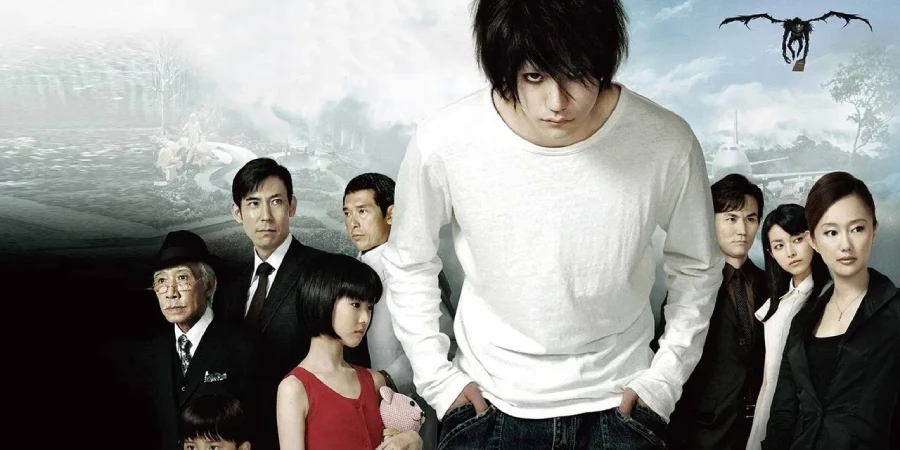

Death Note: L Change the World is a Japanese spin-off film set in the Death Note universe, focusing on the fan-favorite character L, the eccentric genius detective. Unlike the main Death Note films, this story is more intimate, emotional, and philosophical, asking what kind of legacy a brilliant mind leaves behind when time is running out.
Detailed Summary
A World After Kira
The film takes place shortly after the events of Death Note 2: The Last Name. Light Yagami is dead, Kira is gone, and L has written his own name in the Death Note, giving himself only 23 days to live. Despite knowing his death is inevitable, L continues working, driven not by justice alone but by responsibility.
The Emergence of a New Threat
A mysterious terrorist organization plans to unleash a deadly virus capable of wiping out humanity. The group believes the world deserves to be reset, echoing Kira’s ideology but without divine judgment. L becomes the only person capable of stopping them in time.
The Girl with the Virus
L encounters Maki, a young girl who unknowingly carries the virus within her body. Rather than exploiting her, L chooses to protect her, revealing his deeply human side. This decision is crucial, as it contrasts sharply with Kira’s philosophy of sacrificing individuals for a “greater good.”
A Child Named Near
L also meets a gifted boy named Near, hinting at the future of the Death Note universe. Near represents continuity, legacy, and hope beyond L’s death. Their interactions subtly mirror L’s past relationship with Light, but with far more compassion.
Racing Against Time
As L’s physical condition deteriorates, the film becomes a race against the clock. He investigates the virus’s origin, uncovers the terrorists’ plan, and works tirelessly despite collapsing multiple times. Every deduction costs him strength, making each scene heavier with inevitability.

Movie Ending
In the final act, L successfully prevents the virus from being released, saving humanity from extinction. He outsmarts the terrorists by manipulating their own logic and ensuring the virus is neutralized without mass casualties. Maki is cured, proving that compassion and intelligence can coexist.
After completing his mission, L quietly retreats, knowing his time is over. He spends his final moments writing, reflecting, and preparing the world for life without him. The film strongly implies his death soon after, but does not show it explicitly, allowing the moment to remain dignified and haunting.
The most emotionally powerful aspect of the ending is that L dies undefeated, not as a god or a martyr, but as a man who chose to save lives even when his own was already lost. His legacy lives on through Near and the people he protected.
Are There Post-Credits Scenes?
No, there are no post-credits or mid-credits scenes.
The film ends conclusively, reinforcing the finality of L’s journey and his acceptance of death.
Type of Movie
Death Note: L Change the World is a psychological thriller with strong crime, mystery, and drama elements. Compared to the main Death Note films, it leans more toward character study and moral reflection than mind-game spectacle.
Cast
- Kenichi Matsuyama as L
- Miho Kanazawa as Maki
- Hidetoshi Nakata as Dr. Kujo
- Magy as Near
- Shunji Fujimura as Watari
Kenichi Matsuyama’s portrayal of L is widely regarded as definitive, capturing both his oddness and emotional depth.
Film Music and Composer
The score was composed by Kenji Kawai, known for his atmospheric and minimalist style. The music emphasizes tension and melancholy rather than bombast, perfectly matching L’s fading presence and internal struggle.


Filming Locations
The film was shot primarily in Japan, using urban environments, laboratories, and secluded interiors. These locations reinforce the movie’s claustrophobic tone and the sense that time and space are closing in on L. The lack of flashy global settings keeps the focus on intellect rather than spectacle.
Awards and Nominations
While the film did not dominate major award ceremonies, it was praised domestically for:
- Kenichi Matsuyama’s performance
- Its respectful expansion of the Death Note mythology
- Strong box office performance in Japan
Behind the Scenes Insights
- The story is not based on a specific manga arc but was written as an original scenario.
- The manga creators Tsugumi Ohba and Takeshi Obata approved the concept, including L’s final characterization.
- Matsuyama reportedly stayed in character off-set to maintain L’s mindset.
- The film intentionally avoids Death Note usage to focus on human choice over supernatural power.
Inspirations and References
- The original Death Note manga
- Existential detective stories
- Post-apocalyptic bio-thriller concepts
- Philosophical debates on utilitarianism vs humanism
Alternate Endings and Deleted Scenes
There are no known alternate endings, but interviews suggest:
- An extended final monologue by L was cut to preserve subtlety.
- Additional scenes involving Near were shortened to avoid overshadowing L’s farewell.
Book Adaptations and Differences
Unlike the main Death Note films, this movie is not a direct adaptation of any manga volume. Major differences include:
- No Death Note usage
- L as the unquestioned protagonist
- A focus on saving life rather than punishing evil
- A more emotional and reflective tone


Memorable Scenes and Quotes
Key Scenes
- L washing Maki’s hair, symbolizing care and trust
- L collapsing while solving equations, refusing to stop
- The quiet final scene of L writing alone
Iconic Quotes
- “There are things that only humans should decide.”
- “Justice without compassion is meaningless.”
Easter Eggs and Hidden Details
- Near’s toys subtly resemble those seen in the manga
- L’s final writing echoes his earlier monologues from the main films
- The number 23 appears repeatedly, referencing L’s remaining days
Trivia
- This is the first Death Note film without Light Yagami
- L never uses the Death Note once in the movie
- The runtime mirrors L’s limited time thematically
Why Watch?
If you ever wondered who L really was beyond the mind games, this film answers that question. It’s slower, quieter, and far more emotional than expected, offering a rare respectful farewell to one of anime and manga’s most iconic characters.
Director’s Other Works
- K-20: Legend of the Mask (2008)
- Casshern (2004)
- Goemon (2009)
Recommended Films for Fans
- Death Note (2006)
- Death Note 2: The Last Name (2006)
- Death Note (2017)
- Se7en (1995)
- Children of Men (2006)