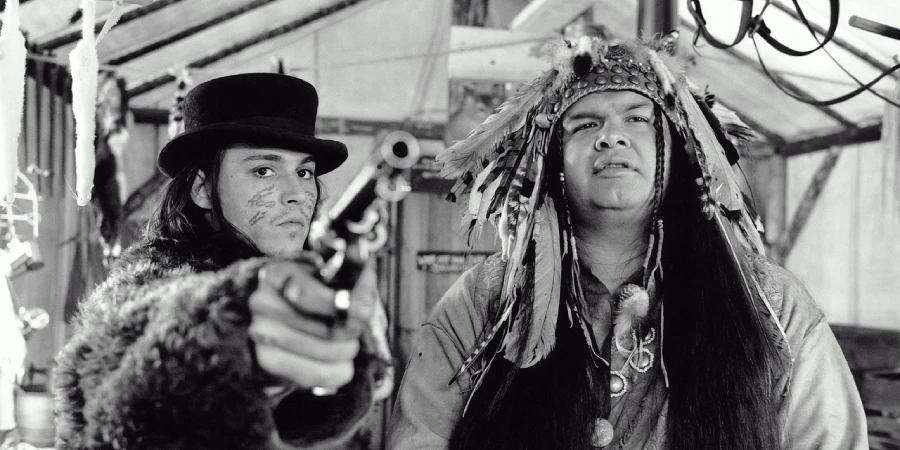

Jim Jarmusch’s Dead Man is not your typical Western. It is a black-and-white, dreamlike meditation on death, identity, colonial violence, and spiritual awakening. Starring Johnny Depp in one of his most restrained performances, the film transforms the American West into something ghostly and existential. This is a Western where the gunshots echo like philosophy.
Detailed Summary
The Journey West: William Blake Arrives in Machine
The film opens with accountant William Blake (Johnny Depp) traveling by train from Cleveland to the frontier town of Machine. The train ride itself feels like a passage from civilization into myth. As the landscape becomes darker and more industrial, so does the tone.
Machine is no welcoming frontier paradise. It is grimy, hostile, and dominated by industrialist John Dickinson (Robert Mitchum). When Blake arrives for his promised job, he discovers the position was filled weeks ago. Dickinson coldly dismisses him, and Blake is cast adrift in a town that feels predatory.
A Night of Misfortune
Blake meets Thel Russell (Mili Avital), and after a brief romantic encounter, everything spirals into violence. Thel’s former lover, Charlie Dickinson (the factory owner’s son), storms in and shoots Blake. Blake, wounded but not dead, fires back and kills Charlie. This single act seals his fate.
Now branded a fugitive, Blake flees into the wilderness. Dickinson places a bounty on his head and hires ruthless bounty hunters to track him down. The chase begins, but this is not a conventional action pursuit. It is slow, eerie, and inevitable.
Enter Nobody: The Spiritual Guide
Blake collapses in the woods and is rescued by a Native American named Nobody (Gary Farmer). Nobody believes Blake is the reincarnation of the English poet William Blake. From this point forward, the film drifts into spiritual territory.
Nobody becomes Blake’s guide, both physically and metaphysically. He teaches him to shoot properly, but more importantly, he reframes Blake’s journey as a passage into the spirit world. The bullet lodged near Blake’s heart ensures he is, in Nobody’s words, already “dead.”
The Bounty Hunters
Parallel to Blake’s journey, we follow the bounty hunters tracking him. They are grotesque and violent figures, embodying the corruption of the West. Their storyline becomes increasingly disturbing, culminating in betrayal and senseless brutality. Jarmusch uses them as a critique of frontier mythology—this West is not heroic but decaying.
Blake’s Transformation
As Blake continues westward with Nobody, he transforms from timid accountant to almost mythic outlaw figure. His notoriety grows; strangers recognize his name. He becomes a legend without understanding how or why.
What makes this arc fascinating is that Blake’s transformation is not empowering in a traditional sense. It feels like a shedding of identity. He loses fear, hesitation, and eventually attachment to life itself. The wilderness strips him down to something elemental.


Movie Ending
The final act unfolds near the Pacific Ocean. Nobody arranges for Blake to be placed in a ceremonial canoe, according to his tribe’s death ritual. The idea is clear: Blake must complete his journey to the spirit world.
Before this ritual can conclude peacefully, bounty hunters arrive and kill Nobody. In one of the film’s most emotionally powerful moments, Blake shoots the man responsible. It is not triumphant. It is quiet, final, and heavy.
Blake, gravely weakened from his wound and exhaustion, is placed in the canoe. Nobody’s tribe has vanished; colonial violence has erased them. Alone, Blake drifts out into the ocean.
The final images show him lying in the canoe, staring upward as the vessel floats toward the horizon. There is no dramatic confirmation of death. Instead, the film fades with ambiguity. Is he dying? Is this transcendence? Is it metaphor?
What makes the ending powerful is that the journey west—traditionally a symbol of expansion and conquest—becomes a journey into death and self-erasure. Blake never returns. There is no redemption arc, no last-minute rescue. Only the sea, silence, and acceptance.
Are There Post-Credits Scenes?
No. Dead Man does not include any mid-credits or post-credits scenes. Once the film fades to black, the story is complete.
Type of Movie
Dead Man is a philosophical revisionist Western blended with art-house drama. It deconstructs classic Western tropes and transforms them into a slow, poetic meditation on mortality and colonial America.
Cast
- Johnny Depp as William Blake
- Gary Farmer as Nobody
- Robert Mitchum as John Dickinson
- John Hurt as John Scholfield
- Iggy Pop as Salvatore “Sally” Jenko
- Lance Henriksen as Cole Wilson
Film Music and Composer
The haunting, improvised electric guitar score was composed by Neil Young. He recorded much of it while watching the film, creating an atmospheric soundscape in real time. The distorted guitar tones feel like wind across an empty desert—minimal, raw, and unforgettable.
Filming Locations and Their Importance
The film was shot primarily in Oregon, Washington State, and parts of Arizona. The dense forests of the Pacific Northwest give the film its dreamlike, almost otherworldly quality.
Unlike sun-drenched Westerns set in Monument Valley, Dead Man uses shadowy woods and misty rivers to create a liminal space. The geography reinforces the film’s themes: this is not a land to conquer but a threshold between worlds.
Awards and Nominations
The film received critical acclaim in art-house circles and was nominated for the Palme d’Or at the Cannes Film Festival. Over time, it has gained cult status and is often cited as one of the most significant revisionist Westerns of the 1990s.
Behind the Scenes Insights
- Jim Jarmusch insisted on shooting in black and white to strip the Western genre of romanticism.
- Neil Young improvised much of the score in a single studio session while watching the film projected on a screen.
- Robert Mitchum’s participation was symbolic—he was a legend of classic Hollywood Westerns appearing in a film that dismantles the genre.
- Johnny Depp has described this role as one of his personal favorites due to its introspective nature.
- The character Nobody speaks in poetic riddles, many inspired by actual Native American history and William Blake’s poetry.
Inspirations and References
The film draws inspiration from:
- The poetry of William Blake
- Existential philosophy
- Revisionist Western traditions
- The deconstruction of classic American frontier mythology
The name William Blake is not accidental. Jarmusch plays with the idea of mistaken identity and spiritual rebirth through poetry.
Alternate Endings and Deleted Scenes
There are no widely known alternate endings. Jarmusch reportedly maintained strong creative control and preserved his original vision. Some minor scenes were trimmed for pacing, but the core narrative and ambiguous ending remained intact from early cuts.
Book Adaptations and Differences
Dead Man is not based on a novel. It is an original screenplay by Jim Jarmusch. However, its narrative structure and spiritual themes echo literary influences, especially the poetry of William Blake.

Memorable Scenes and Quotes
Key Scenes
- The surreal train ride westward, which feels like a descent into the underworld.
- Nobody discovering Blake and declaring him already dead.
- Blake practicing shooting under Nobody’s guidance.
- The final canoe journey into the ocean.
Iconic Quotes
- Nobody: “Do you know my poetry?”
- Nobody: “It is preferable not to travel with a dead man.”
- Blake: “I’m an accountant.”
The dry humor embedded in these lines adds an ironic layer to the film’s darkness.
Easter Eggs and Hidden Details
- The factory town “Machine” symbolizes industrial death and mechanized America.
- The repeated references to William Blake’s poetry mirror the protagonist’s transformation.
- The use of black and white cinematography evokes early American photography and silent Westerns.
- Several cameos by musicians and counterculture figures reinforce the film’s outsider identity.
Trivia
- The film was initially divisive among critics but has since become a cult classic.
- Neil Young’s soundtrack album was released separately and is considered iconic.
- Johnny Depp learned to handle period-accurate firearms for authenticity.
- The film blends historical elements with deliberate anachronisms.
Why Watch?
If you want a Western that challenges everything you think the genre represents, this is essential viewing. Dead Man is meditative, haunting, and intellectually rich. It rewards patience and reflection.
Most importantly, it transforms a fugitive chase story into a spiritual odyssey about accepting mortality.
Director’s Other Works
- Stranger Than Paradise (1984)
- Down by Law (1986)
- Only Lovers Left Alive (2013)
- Paterson (2016)
- Broken Flowers (2005)