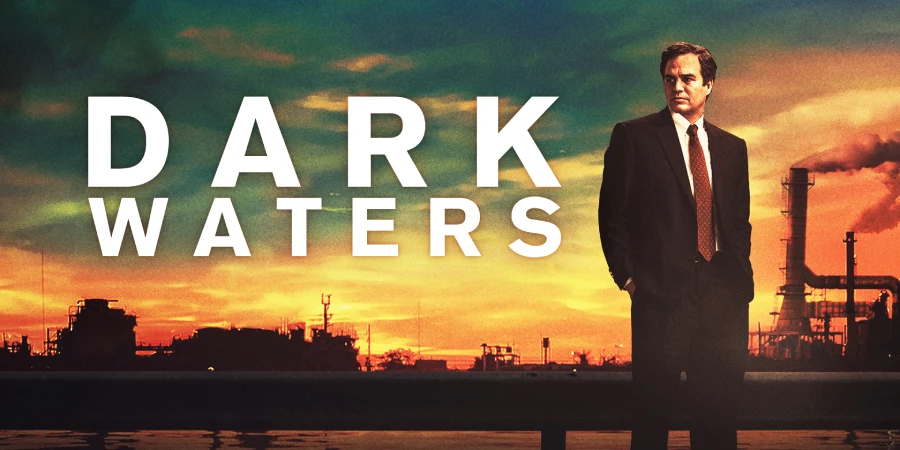

Dark Waters (2019), directed by Todd Haynes, is a slow-burn legal thriller based on the true story of attorney Robert Bilott and his decades-long fight against chemical giant DuPont. The film blends investigative drama with a haunting sense of realism, making it one of the most unsettling corporate-exposure films of the 21st century.
Detailed Summary
The Discovery: A Farmer’s Desperate Plea
The story begins when Wilbur Tennant, a West Virginia cattle farmer, approaches corporate defense attorney Robert Bilott (Mark Ruffalo) with a box of videotapes and documents. Tennant is convinced that DuPont is poisoning his land and killing his cattle. Although Bilott typically defends chemical companies, he agrees to help—partly because Tennant knows his grandmother, partly because something about the case doesn’t sit right with him.
Bilott Opens Pandora’s Box
Bilott digs into DuPont’s internal files through discovery requests and uncovers something far larger than dead cows: DuPont has been using a chemical called PFOA (Perfluorooctanoic Acid), known internally as C-8, in Teflon production for decades. The chemical is toxic, unregulated, and nearly indestructible. Even worse, DuPont knew it caused serious health problems in animals and humans and still released it into the environment.
The Fight Becomes Bilott’s Life
As Bilott pushes forward, DuPont stalls, threatens, and manipulates every step of the process. Years pass. Bilott’s health declines. His marriage is strained. But he keeps going, piecing together the scope of contamination: thousands of people unknowingly exposed through drinking water.
The Class Action and the Long Wait
Bilott finally wins a massive class action settlement. Yet DuPont requires that victims must be medically tested before compensation is paid. A panel of independent scientists is formed, and the wait begins—one that stretches across many years. During this time, DuPont continues to deny wrongdoing while quietly shifting production and protecting itself legally.


Movie Ending
The ending ties together the emotional and legal threads of Bilott’s decades-long struggle. After seven years, the scientific panel finally concludes that PFOA is “more likely than not” linked to several serious diseases, including kidney cancer, testicular cancer, thyroid disease, high cholesterol, and pregnancy-related hypertension. This ruling opens the door for individual lawsuits, which Bilott begins filing on behalf of victims.
In the final courtroom sequence, Bilott argues passionately for justice while facing DuPont’s lawyers, who continue treating the case as if it were a minor inconvenience. The court finds in favor of one of the victims, awarding damages—marking the beginning of a long line of similar cases.
The film closes with Bilott’s realization that he may never see the end of the fight. Yet he has achieved something monumental: the truth is exposed, DuPont is held accountable, and thousands of people finally have a path toward justice.
The film doesn’t give a neatly wrapped conclusion because the real story hasn’t ended; the contamination persists, lawsuits continue, and PFOA remains in human blood around the world. This unpolished ending is deliberate—reminding the audience that real-world justice is painfully slow, incomplete, and always contested.
Are There Post-Credits Scenes?
No. The film ends without any mid-credits or post-credits scenes.
Type of Movie
Dark Waters is a legal thriller with strong biographical and investigative drama elements, grounded in real events and built to expose a systemic environmental crisis rather than deliver flashy courtroom heroics.
Cast
- Mark Ruffalo as Robert Bilott
- Anne Hathaway as Sarah Bilott
- Tim Robbins as Tom Terp
- Bill Camp as Wilbur Tennant
- Victor Garber as Phil Donnelly
- Bill Pullman as Harry Dietzler
- Mare Winningham as Darlene Kiger
Film Music and Composer
The atmospheric, tension-laden score is composed by Marcelo Zarvos, who emphasizes subtle dread rather than melodrama. The music is restrained, matching the film’s grounded tone.

Filming Locations
Filming took place in:
- Cincinnati, Ohio – where Bilott actually worked
- Parkersburg, West Virginia – DuPont’s real plant location
- Hamilton, Ohio and surrounding rural areas – providing authentic Appalachian landscapes
These locations contribute to the film’s bleak realism. The rural communities are shown exactly as they are—isolated, industrial, and vulnerable to corporate negligence.
Awards and Nominations
While not heavily decorated, the film received recognition including:
- National Board of Review – Top Ten Films (2019)
- Various critics’ associations praised Mark Ruffalo’s performance
- Nominated for environmental and advocacy-driven awards due to its real-world impact
Behind the Scenes Insights
- Mark Ruffalo, an environmental activist, pursued the project personally.
- Todd Haynes insisted on using real locations connected to the actual events whenever possible.
- The real Robert Bilott appears briefly in the restaurant scene as a patron.
- Several locals in West Virginia played themselves or extras to maintain authenticity.
- The production consulted scientists involved in the actual C-8 investigation to ensure accuracy.
Inspirations and References
The film is adapted from the New York Times Magazine article “The Lawyer Who Became DuPont’s Worst Nightmare” by Nathaniel Rich. It also draws from Bilott’s real legal files, court transcripts, and years of environmental reporting.
Alternate Endings and Deleted Scenes
There are no widely released alternate endings, but early cuts reportedly contained more courtroom footage and extended sequences detailing the scientific panel’s work. These were trimmed to maintain pacing and keep the film focused on Bilott’s emotional journey.
Book Adaptations and Differences
The film is inspired by Bilott’s book “Exposure“ (2019).
Key differences:
- The movie compresses timelines that, in reality, span more than 20 years.
- The emotional toll on Bilott’s marriage is simplified for narrative clarity.
- Some characters are composites of several real people.

Memorable Scenes and Quotes
Key Scenes
- Tennant showing Bilott the horrifying videotapes of his dying cattle.
- Bilott discovering DuPont’s decades-old internal documents—an “I can’t unsee this” moment.
- The tense boardroom confrontation where Bilott exposes DuPont’s lies.
- The final courtroom victory, modest yet deeply significant.
Iconic Quotes
- “The system is rigged. They want us to think it’ll protect us. But it won’t.”
- “DuPont is knowingly poisoning 70,000 local residents.”
- “The truth doesn’t disappear just because you don’t want to see it.”
Easter Eggs and Hidden Details
- Real victims from the C-8 exposure appear in small roles, especially in medical testing scenes.
- Robert Bilott’s real office building is used for exterior shots.
- The film subtly references the broader PFAS contamination crisis through newspaper headlines in the background.
Trivia
- The Teflon chemical PFOA is now found in the blood of over 98% of humans worldwide.
- The film was produced by Participant Media, known for socially conscious movies like Spotlight and The Post.
- Mark Ruffalo prepared by shadowing Bilott at his actual law firm.
- Unlike many legal thrillers, almost all courtroom scenes were based on real transcripts.
Why Watch?
Because the film is unsettlingly real. It doesn’t rely on fictional exaggeration—its most disturbing moments are drawn directly from documented history. If you value journalism, environmental justice, or stories where ordinary people confront extraordinary corruption, this film deserves your attention. It’s a reminder that sometimes the most heroic battles are fought not with weapons, but with patience, documents, and stubborn moral courage.
Director’s Other Movies
- Carol (2015)
- Far from Heaven (2002)
- I’m Not There (2007)
- Wonderstruck (2017)
- Velvet Goldmine (1998)