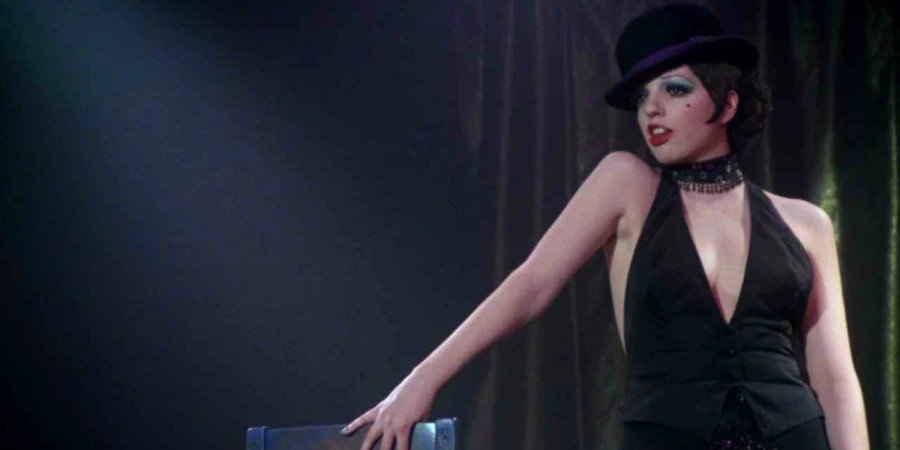

Cabaret (1972), directed by Bob Fosse, is one of the most influential musical dramas ever created. Set in 1931 Berlin, the film blends music, political awakening, and personal tragedy in a world on the brink of Nazi takeover. It is both dazzling and disturbing, reminding viewers how entertainment can mask the horrors underneath.
Detailed Summary
Arrival in Berlin and the Allure of the Kit Kat Club
The story begins with Brian Roberts, a quiet Englishman (Michael York), arriving in Berlin to study and work as a tutor. He soon meets the explosive and highly unconventional cabaret performer Sally Bowles (Liza Minnelli). Their bond develops as Brian becomes fascinated with Berlin’s nightlife, centered around the smoky, enticing, and morally ambiguous Kit Kat Club.
All performances at the club are hosted by the eerie, charismatic Emcee (Joel Grey), who subtly mirrors Germany’s sociopolitical collapse through provocative shows.
Love, Identity, and Seduction
Brian and Sally begin a complicated relationship. Their intimacy initially seems deep, but cracks appear when both grow attracted to the wealthy and aristocratic Maximilian von Heune. The film carefully explores themes of bisexuality, class, pleasure, and emotional denial. Berlin becomes a playground for experimentation, yet every “fun” moment is haunted by the rise of Nazism around them.
The Rising Threat of Fascism
Outside the nightclub, Germany changes rapidly. Violence worsens, propaganda spreads, and the film includes one of its most powerful sequences: a seemingly innocent youth singing “Tomorrow Belongs to Me.” As the crowd joins in, it becomes clear that nationalism is no longer an undercurrent; it is becoming the dominant force. The song marks the turning point where the carefree atmosphere of the film is finally broken.

Movie Ending
Sally becomes pregnant, unsure whether the father is Brian or Maximilian. Brian proposes they leave Berlin and raise the child together. For a brief moment, it seems possible that they might escape the darkness closing in. However, Sally decides to have an abortion without consulting Brian. She prioritizes her ambition to become a star over motherhood or emotional commitment, telling Brian that there is always “the cabaret.”
Brian leaves Berlin soon after, heartbroken but aware that Sally is trapped in a fantasy world. The final scene returns to the Kit Kat Club. Sally performs “Cabaret” in glamorous denial, choosing dreams over reality. But as the camera pans toward the audience, now filled with Nazi uniforms, the truth is unavoidable: the city’s decadence is collapsing under fascism.
The film ends on the chilling realization that the club, once a symbol of freedom, has become entertainment for those about to destroy it.
This ending underscores the film’s message: ignoring political reality does not stop it from consuming you.
Are There Post-Credits Scenes?
No, Cabaret (1972) does not contain any post-credits scenes. The ending shot is meant to linger and disturb, and the film intentionally offers no extra closure.
Type of Movie
Cabaret is a musical drama with strong political undertones. It is not a traditional “happy-ending” musical; instead, it uses song and performance to critique society, identity, and complacency during the rise of fascism.
Cast
- Liza Minnelli as Sally Bowles
- Michael York as Brian Roberts
- Joel Grey as The Emcee
- Helmut Griem as Baron Maximilian von Heune
- Marisa Berenson as Natalia Landauer
- Fritz Wepper as Fritz Wendel
Film Music and Composer
The soundtrack features music by John Kander with lyrics by Fred Ebb. Many numbers were adapted specifically for film and performed within the Kit Kat Club, making the music feel like commentary on the plot rather than part of the character dialogue. Songs like “Mein Herr,” “Maybe This Time,” and “Cabaret” are now iconic standards.


Filming Locations and Their Importance
Most of the film was shot on soundstages at Bavaria Studios in Munich, Germany.
Exteriors were filmed in Berlin, providing authenticity to the political atmosphere. The choice of Munich was practical yet symbolic: Germany itself becomes a supporting character, reflecting decay behind beauty. The artificiality of the studio-built Kit Kat Club highlights how entertainment served as escapism while real horrors grew outside.
Awards and Nominations
Cabaret won 8 Academy Awards, including:
- Best Director (Bob Fosse)
- Best Actress (Liza Minnelli)
- Best Supporting Actor (Joel Grey)
- Best Cinematography
- Best Editing
- Best Original Song Score / Adaptation
It famously beat The Godfather (1972) in all categories except Best Picture.
Behind the Scenes Insights
- Liza Minnelli’s look (short hair, dramatic lashes) helped define a new era of androgynous pop-culture style.
- Bob Fosse cut almost all non-diegetic music, transforming the musical genre forever.
- Joel Grey’s performance was so iconic that the role was not recast for decades in major productions.
- The film toned down Sally’s origin story compared to the original novel, making her more naive and sympathetic rather than aggressively scandalous.
Inspirations and References
- The film is based on Christopher Isherwood’s novels and the Broadway musical version of his Berlin stories.
- Isherwood’s experiences as a gay writer in pre-Nazi Berlin influenced Brian’s character, though heavily altered for Hollywood.
- The story reflects the real Weimar cabaret scene, where sexuality, satire, and political commentary collided in a time of danger.
Alternate Endings and Deleted Scenes
- A deleted scene involved a more direct romantic arc between Brian and Maximilian, which censors pressured to cut.
- The musical number “Don’t Tell Mama” was originally filmed but removed to streamline the storyline.
- An unused ending featured a more explicit depiction of Nazi violence around the club, rejected for being “too dark.”
Book Adaptations and Differences
Christopher Isherwood’s version of Sally Bowles is less talented and far more provocative, whereas the film makes her a star-in-the-making. Brian’s sexuality in the books is openly gay, while the film presents him as bisexual to navigate censorship. The novel is more cynical, while the film disguises tragedy beneath spectacle.


Memorable Scenes and Quotes
Key Scenes
- Sally singing “Maybe This Time” alone, revealing her fragile hope beneath reckless bravado.
- The youth choir performance of “Tomorrow Belongs to Me.”
- Brian and Sally arguing over her abortion, where political and personal collapse intertwine.
Iconic Quotes
- “Life is a cabaret, old chum!”
- “Screw Maximilian!”
“I did.”
“So did I.” - “In here, life is beautiful.”
Easter Eggs and Hidden Details
- The Emcee’s routines mirror political changes: his jokes grow harsher as the Nazis rise.
- The costuming gradually shifts to deeper blacks and browns, echoing the color palette of Nazi uniforms.
- In early scenes, Nazis are excluded from the club; in the last scene, they dominate the audience.
Trivia
- Minnelli’s Oscar win made her part of the first mother-daughter Oscar pair (with Judy Garland).
- The Emcee’s striped costume inspired later fashion trends and pop performance aesthetics.
- Michael York initially rejected the role due to concern over the political themes.
Why Watch?
Cabaret is a masterclass in how cinema can enchant and disturb at the same time. It shows that ignoring politics does not make it disappear; it makes it stronger. The film is stylish, historical, heartbreaking, and uniquely honest. Few musicals dare to be this truthful.
Director’s Other Works
- Sweet Charity (1969)
- Lenny (1974)
- All That Jazz (1979)
- Star 80 (1983)
Recommended Films for Fans
- All That Jazz (1979)
- The Godfather (1972)
- Chicago (2002)
- The Pianist (2002)
- Berlin Alexanderplatz (1980)