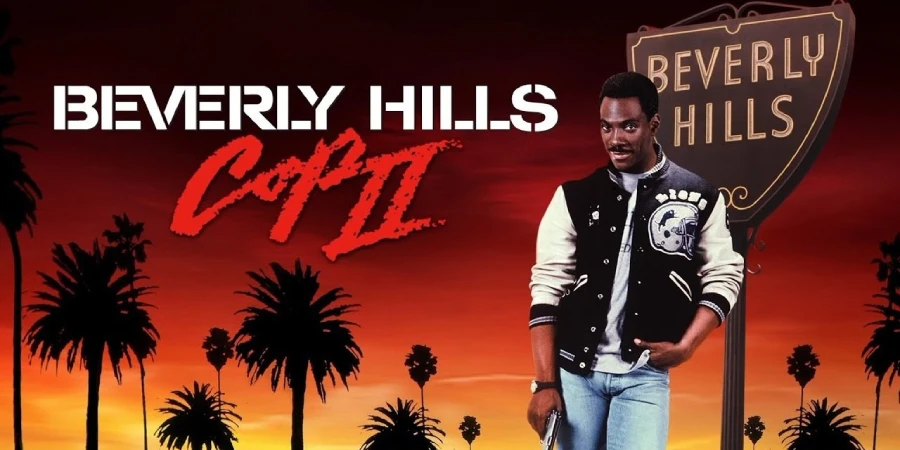

Beverly Hills Cop II (1987) is the high-octane sequel to the 1984 hit that cemented Eddie Murphy as a global superstar. Directed by action maestro Tony Scott, the film takes the slick Beverly Hills formula and injects it with more explosions, sharper suits, and bigger stakes. It’s louder, faster, and shinier than the original—very much a product of late-80s blockbuster cinema.
Detailed Summary
Axel Returns to Beverly Hills
Detroit cop Axel Foley (Eddie Murphy) is back to his old tricks—bending rules, annoying superiors, and improvising his way through chaos. When Captain Andrew Bogomil (Ronny Cox) is nearly killed in a shooting connected to a string of robberies in Beverly Hills, Axel heads back to California without permission.
The robberies are carried out by a group called the “Alphabet Crimes” syndicate, who leave letters at the scene of each crime. Bogomil had been investigating them before he was shot, and Axel believes the case is tied directly to the attempted murder.
Reuniting the Trio
Axel reunites with detectives Billy Rosewood (Judge Reinhold) and John Taggart (John Ashton). This trio dynamic remains the heart of the franchise—Axel’s chaotic brilliance balancing Billy’s enthusiasm and Taggart’s gruff skepticism.
But things have changed. Beverly Hills Police Chief Harold Lutz (Allen Garfield) is determined to shut Axel down, viewing him as a reckless liability. Meanwhile, Bogomil is hospitalized and unable to continue his investigation.
The Mastermind: Karla Fry
The trio uncovers that the crimes are orchestrated by Karla Fry (Brigitte Nielsen), a cool and calculating criminal working with Maxwell Dent (Jürgen Prochnow), a wealthy businessman secretly funding the operation.
The gang’s robberies are a smokescreen. The real objective is far more ambitious: Dent wants to acquire land at rock-bottom prices after the Alphabet Crimes drive down property values. It’s corporate corruption disguised as random violence.
Escalation and Chaos
The investigation leads to shootouts, surveillance operations, and several classic Axel Foley improvisational stunts—including manipulating suspects with absurd lies delivered so confidently that people just roll with it.
One of the film’s most memorable sequences involves a mansion shootout. The movie leans heavily into Tony Scott’s glossy action style—stylized lighting, dramatic slow-motion, and high-caliber gun battles. This is where the sequel clearly raises the action bar compared to the first film.
Movie Ending
The climax unfolds at the racetrack, where Dent plans to finalize his land acquisition scheme. Axel, Billy, and Taggart connect the dots: Dent orchestrated the entire crime spree to destabilize the market.
The confrontation escalates quickly. Dent attempts to flee, while Karla provides armed backup. A major shootout breaks out between the police and Dent’s men.
Karla, portrayed as the film’s most physically dangerous antagonist, faces Axel directly. She shoots at him repeatedly, wounding him in the arm. In a tense final standoff, Axel fires back and kills her. The moment is significant because it strips away the comedic tone—Axel is no longer joking; he’s fully committed to stopping her.
Dent attempts to escape but is cornered. In a moment of desperation, he reaches for a hidden gun. Axel reacts instantly and shoots him dead. The corporate mastermind’s downfall mirrors the corruption at the heart of the case—he wasn’t just a white-collar criminal; he was willing to kill to protect his scheme.
Bogomil recovers, and Chief Lutz is publicly embarrassed and removed from power after his obstruction and incompetence are exposed. Axel, as always, skirts consequences. Though technically operating outside his jurisdiction, his results speak for themselves.
The film ends on a triumphant note: justice is served, the villains are dead, Bogomil survives, and Axel returns to Detroit—still a rule-breaker, but undeniably effective.
Are There Post-Credits Scenes?
No. There are no post-credits or mid-credits scenes in Beverly Hills Cop II. Once the film ends, it’s truly over—very typical of 1980s action films before franchise teasers became standard.
Type of Movie
Beverly Hills Cop II is an action-comedy with strong elements of crime thriller. Compared to the first film, this sequel leans more heavily into stylized action and large-scale shootouts while still preserving Axel Foley’s fast-talking humor.
Cast
- Eddie Murphy as Axel Foley
- Judge Reinhold as Billy Rosewood
- John Ashton as John Taggart
- Brigitte Nielsen as Karla Fry
- Jürgen Prochnow as Maxwell Dent
- Ronny Cox as Captain Andrew Bogomil
- Allen Garfield as Chief Harold Lutz
Film Music and Composer
The score was composed by Harold Faltermeyer, who also scored the first film. The soundtrack prominently features “Shakedown” by Bob Seger, which became a major hit. Faltermeyer’s synth-heavy sound reinforces the film’s slick 80s atmosphere, though it’s more polished and aggressive compared to the original’s lighter tone.
Filming Locations and Their Importance
The film was shot extensively in Beverly Hills, Los Angeles, and surrounding California areas.
Beverly Hills isn’t just a backdrop—it’s central to the franchise’s identity. The visual contrast between Axel’s gritty Detroit roots and Beverly Hills’ wealth and luxury drives much of the humor and tension. The racetrack climax and mansion shootouts emphasize this clash between elite privilege and street-smart justice.
Awards and Nominations
Although commercially successful, the film did not receive major Academy Award nominations. However, it was nominated at the Golden Raspberry Awards, including Worst Supporting Actress for Brigitte Nielsen. Despite mixed critical reception, it performed strongly at the box office.
Behind the Scenes Insights
- Director Tony Scott replaced Martin Brest, who directed the original film.
- The production emphasized bigger action set pieces, nearly doubling the budget of the first movie.
- Eddie Murphy reportedly had significant influence over dialogue improvisation.
- The mansion shootout sequence required extensive stunt coordination and was one of the film’s most expensive scenes.
- The tone shift toward heavier action was a deliberate choice to compete with rising 80s action franchises.
Inspirations and References
The sequel builds directly on the success of Beverly Hills Cop, but stylistically reflects Tony Scott’s growing influence in Hollywood action cinema, particularly his emphasis on stylized visuals and kinetic pacing that would later define films like Top Gun.
Alternate Endings and Deleted Scenes
There is no widely known alternate ending. However, several comedic improvisation moments from Eddie Murphy were trimmed to maintain pacing and emphasize action. Early drafts reportedly leaned more heavily into comedy before Tony Scott pushed the film toward a harder-edged action tone.
Book Adaptations and Differences
The film is not based on a novel but was later adapted into novelizations typical of 1980s blockbuster releases. These adaptations mostly expand character thoughts and internal motivations rather than altering the plot.

Memorable Scenes and Quotes
Key Scenes
- The mansion shootout, showcasing the film’s explosive escalation
- Axel’s interrogation bluff scenes, where he improvises elaborate lies
- The racetrack finale confrontation with Dent and Karla
Iconic Quotes
- “You’re gonna arrest me for what?”
- “I trust you. It’s him I don’t trust.”
- Axel’s rapid-fire fake backstories during undercover moments
Easter Eggs and Hidden Details
- Subtle visual callbacks to the first film in police station scenes
- Axel’s Detroit references reinforcing his outsider identity
- The escalating scale of weaponry subtly reflects the 80s action arms race
Trivia
- The film grossed over $300 million worldwide.
- It was one of the highest-grossing films of 1987.
- Brigitte Nielsen performed several of her own stunts.
- The sequel significantly increased the franchise’s global popularity.
Why Watch?
If you enjoy charismatic anti-heroes, slick 80s aesthetics, and action that feels unapologetically excessive, this film delivers. While it sacrifices some of the original’s grounded charm, it compensates with scale and intensity. Most importantly, Eddie Murphy’s performance remains effortlessly magnetic.