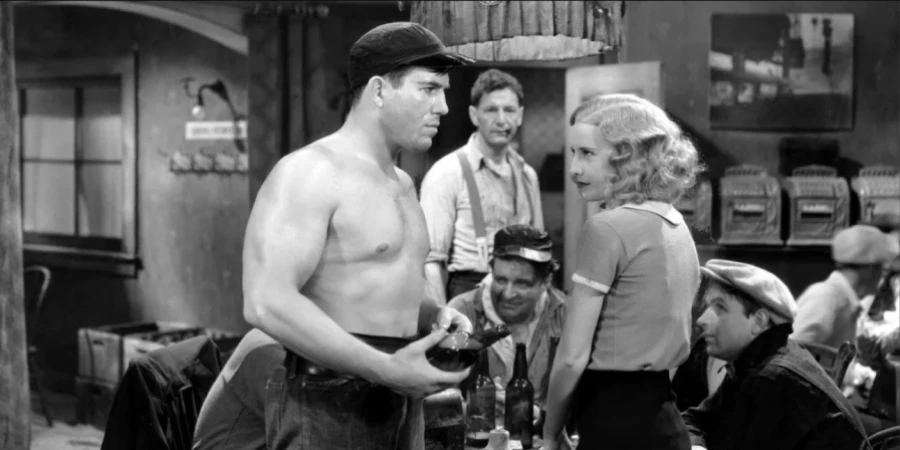

Barbara Stanwyck’s Lily Powers is not a victim. She is a predator. Baby Face (1933) hit audiences with a protagonist so ruthlessly ambitious, she used sex as a tool to climb the corporate ladder, floor by floor. This film remains a landmark of pre-Code Hollywood, a jaw-dropping story of power, greed, and female agency that censors later tried to erase.
Detailed Summary
From Erie Speakeasy to Big City Dreams
Lily Powers lives a grim existence in Erie, Pennsylvania. She works in her father’s sordid speakeasy, where he pimps her out to the local clientele. Consequently, her worldview is deeply cynical and devoid of sentiment.
Her only friend is a German cobbler named Cragg who lends her books by Nietzsche. He advises her to stop being a victim and use men to get what she wants. Following her father’s death in a still explosion, Lily and her friend Chico hop a freight train to New York City with this new philosophy as their guide.
Climbing the Corporate Ladder
In New York, Lily brazenly walks into the Gotham Trust Company building and secures a low-level job by seducing a clerk in the personnel department. This marks the beginning of her systematic ascent. The film famously visualizes her progress by panning up the skyscraper’s exterior with each new “conquest.”
She moves from clerk Jimmy McCoy Jr. to his boss, Brody. From there, she charms her way into the Filing Department, seducing its head, Mr. Stevens. Her actions result in firings and promotions, leaving a trail of discarded men as she moves ever upward.
Reaching the Top Floor
Eventually, Lily lands in the office of J.P. Carter, a junior executive. Their affair prompts Carter’s fiancée to call off their engagement. Desperate, Carter attempts suicide in his office.
This scandal brings Lily to the attention of the bank’s new president, Courtland Trenholm. Rather than fire her, Trenholm finds himself intrigued by her audacity. He moves her to the Paris branch, effectively an exile, but her ambition cannot be contained. She follows him back to New York and ultimately succeeds in making him fall for her, leading to a marriage proposal.


Movie Ending
Courtland Trenholm lavishes Lily with a lavish townhouse, jewels, and cash. However, his world comes crashing down during the stock market collapse. The bank fails, and its board of directors indicts him for misappropriating funds, even though his actions were meant to save the institution.
Facing ruin and imprisonment, a desperate Trenholm goes to Lily, begging her to return the money and assets he gave her to help him. Now completely hardened by wealth, she callously refuses and plans to flee to London. She packs her jewels and furs, ready to abandon him to his fate.
In a rare moment of conscience, Lily has a change of heart at the train station. She rushes back to their townhouse only to find Trenholm has shot himself. Racing to the hospital in an ambulance, she tearfully confesses her love and promises to stay with him. The final scene shows a humbled Lily and a recovering Trenholm, now poor, on the deck of a steamer, ready to start a new life together.
Are There Post-Credits Scenes?
No, there are no post-credits scenes in Baby Face. The film ends immediately after the final shot of Lily and Courtland on the ship.
Type of Movie
Baby Face is a quintessential Pre-Code drama. Its tone is remarkably cynical, gritty, and unsentimental for its time. A film that openly depicts a woman using sex for social and economic advancement, it pushes the boundaries of 1930s cinema with its frank portrayal of ambition and sexuality.
Cast
- Barbara Stanwyck – Lily Powers
- George Brent – Courtland Trenholm
- Donald Cook – Ned Stevens
- Alphonse Ethier – Adolf Cragg
- Theresa Harris – Chico
- Douglass Dumbrille – Brody
- John Wayne – Jimmy McCoy Jr.
Film Music and Composer
The music for Baby Face was largely compiled and directed by Leo F. Forbstein, the head of Warner Bros.’ music department. There is no original, thematic score in the modern sense. Instead, the film uses source music and existing compositions to set the mood.
A notable piece of music is “St. Louis Blues,” which plays repeatedly. It underscores the film’s gritty, somewhat sordid atmosphere, especially during the early scenes in the Erie speakeasy.



Filming Locations
Baby Face was filmed almost entirely on the Warner Bros. studio backlot in Burbank, California. The production design effectively contrasts the two main settings of Lily’s life.
The Erie speakeasy is portrayed as dark, grimy, and oppressive, visually communicating her desperate circumstances. In contrast, the Gotham Trust building in New York is a sleek, modern, Art Deco marvel, symbolizing the glamour and power she craves.
Awards and Nominations
While Baby Face did not receive any major awards upon its 1933 release, its historical and cultural significance has since been recognized. In 2005, the United States Library of Congress selected the film for preservation in the National Film Registry. This honor is given to films deemed “culturally, historically, or aesthetically significant.”
Behind the Scenes Insights
- The film’s blatant disregard for moral conventions caused a massive uproar with censor boards, particularly the New York State Board of Censors. It became a key exhibit for why the Hays Production Code needed stricter enforcement, which began in earnest in 1934.
- A heavily censored version of the film was released theatrically, which included new scenes and altered dialogue to make Lily more repentant. The uncensored original version was considered lost for decades until a print was discovered at the Library of Congress in 2004.
- Look closely for a very young John Wayne in one of his earliest screen appearances. He plays one of the first men Lily discards on her way up the corporate ladder.
Inspirations and References
The film’s primary philosophical inspiration is the work of German philosopher Friedrich Nietzsche. This is made explicit in the dialogue of the cobbler, Cragg. He gives Lily a copy of a Nietzsche book and tells her, “You must be a master, not a slave. Use men, do not let them use you.” This line directly informs Lily’s entire character arc and her ruthless approach to life.
Alternate Endings and Deleted Scenes
The most significant difference between the original and censored cuts of Baby Face is the ending and the overall moral tone. Censors demanded changes to punish Lily for her immoral behavior. Consequently, the widely seen theatrical version from 1933 was a compromised film.
In the censored version, Cragg’s dialogue is altered to include moralizing warnings against Lily’s path. More importantly, the ending was reshot. In this version, Lily not only gives Trenholm the money, but she also loses her job and is forced to return to a life of poverty in her hometown. Only then does he find her, penniless and working a menial job, offering a more traditional “redemption through suffering” narrative.
Book Adaptations and Differences
Baby Face is not based on a book. It is an original story treatment written by producer Darryl F. Zanuck under the pseudonym Mark Canfield.



Memorable Scenes and Quotes
Key Scenes
- Cragg’s Advice: The pivotal scene where the old cobbler gives Lily a Nietzschean worldview, setting her on a path of ruthless ambition.
- Climbing the Tower: The iconic montage showing the camera panning up the exterior of the Gotham Trust building, dissolving between floors as Lily successfully seduces her way higher up.
- The Paris Confrontation: Lily’s cold refusal to help a ruined Courtland Trenholm, showcasing just how hardened she has become before her ultimate change of heart.
Iconic Quotes
- “A woman, young, beautiful like you, can get anything she wants in the world. There is a right way and a wrong way. Remember, the price of the wrong way is too great.” – Cragg (in the censored version)
- “You must use men, not let them use you. You must be a master, not a slave.” – Cragg (in the original version)
- “I’m not a bad girl. I’m just… I’m not a nice girl, that’s all.” – Lily Powers
Easter Eggs and Hidden Details
- The Panning Skyscraper: The most famous visual element is not exactly hidden, but its function as a “scorecard” of Lily’s sexual conquests was a remarkably clever and cynical cinematic device.
- Theresa Harris as Chico: The role of Lily’s friend and maid, Chico, played by Black actress Theresa Harris, is notable for the era. While still a supporting role, Chico is portrayed as a loyal and intelligent confidante, a more nuanced character than typical minority roles of the period.
Trivia
- The film was one of the first to be officially condemned by the newly formed Catholic Legion of Decency.
- Barbara Stanwyck’s performance as a woman who is completely unapologetic about her sexuality and ambition was groundbreaking and helped solidify her “tough broad” persona.
- Production on the film was reportedly rushed to get it released before the impending crackdown from the Hays Office, which many in Hollywood knew was coming.
Why Watch?
Watch Baby Face for a raw, unfiltered look at Hollywood before censorship neutered it. Barbara Stanwyck delivers a fearless, iconic performance as one of cinema’s greatest anti-heroines in a story that feels shockingly modern and audacious even today.
Director’s Other Movies
- The Jolson Story (1946)
- The Inspector General (1949)
- A Thousand and One Nights (1945)
- Dangerous (1935)
Recommended Films for Fans
- Red-Headed Woman (1932)
- Female (1933)
- Three on a Match (1932)
- Night Nurse (1931)