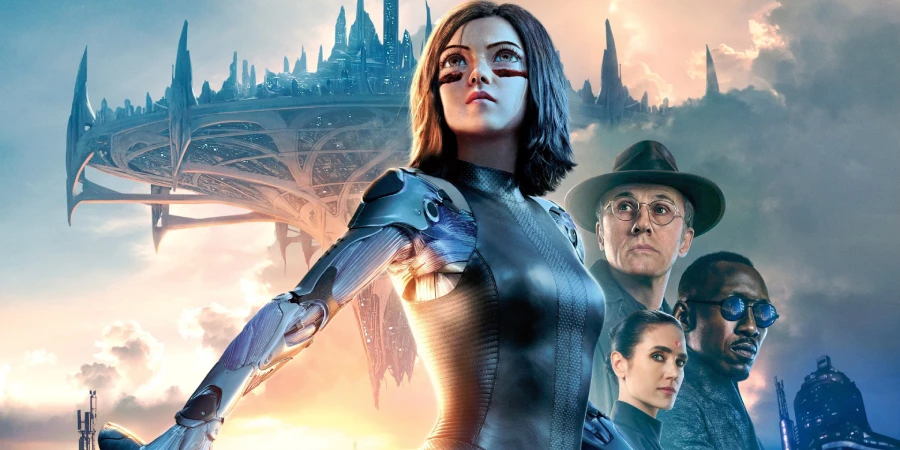

Alita: Battle Angel is a visually striking cyberpunk action film that blends anime-style emotion with Hollywood-scale spectacle. Produced by James Cameron and directed by Robert Rodriguez, the movie adapts a beloved manga into a big-screen origin story that is both intimate and explosive.
Detailed Summary
The World of Iron City
The story takes place in a dystopian future after a devastating war known as The Fall. Above the polluted, chaotic Iron City floats the elite sky city of Zalem, a symbol of untouchable power and privilege. Everything in Iron City exists to serve Zalem, even its people.
Discovery of Alita
Dr. Dyson Ido, a cybernetics doctor, discovers the discarded remains of a cyborg girl in a scrapyard. Remarkably, her brain is fully intact. He rebuilds her and names her Alita, though she wakes up with no memory of who she is or where she came from.
From the start, Alita shows unusual agility, curiosity, and kindness, paired with instinctive combat abilities she herself does not understand.
Learning to Be Human
As Alita explores Iron City, she forms a bond with Hugo, a young man obsessed with reaching Zalem. Through friendships, street life, and motorball fandom, Alita begins to experience human emotions such as joy, love, and fear. At the same time, fragments of her forgotten past surface in the form of combat reflexes and dreams.
The Hunter-Warrior Revelation
Alita learns that Iron City is ruled by Hunter-Warriors, bounty hunters licensed to kill criminals. When she faces deadly cyborg assassins, her fighting style reveals she once practiced Panzer Kunst, a lost and lethal martial art. This confirms that Alita is not an ordinary cyborg—she is a weapon from the past.
The Berserker Body
Ido reveals a powerful ancient cyborg body from the time of The Fall. After Alita risks her life to save others, he allows her to use it. The Berserker body dramatically amplifies her strength and agility, visually marking her transformation from innocent girl to unstoppable warrior.
Nova’s Shadow
Throughout the film, the mysterious figure Nova manipulates events from behind the scenes. Criminals like Vector serve him, while Alita slowly realizes that her true enemy is not in Iron City—but above it.



Movie Ending
The final act brings multiple storylines to a head. Hugo attempts to climb the massive supply tubes leading to Zalem after discovering the truth: no one from Iron City is ever allowed to enter. Nova betrays him, and Hugo is mortally wounded when security defenses sever his body.
Alita desperately tries to save Hugo by attaching his remaining brain and heart to a cyborg body, but the damage is too severe. Hugo dies in her arms, realizing too late that Zalem was always a lie designed to control people through hope.
Fueled by grief and anger, Alita confronts Vector and kills him, only to discover that Vector was merely a puppet. Nova briefly appears, revealing himself as the true ruler of Iron City and Zalem alike. He escapes without consequence, confirming that Alita’s real battle has not yet begun.
The movie ends with Alita standing victorious in the Motorball arena, now a famous and feared competitor. She raises her Damascus blade toward Zalem in a silent vow of vengeance. The ending is deliberately unresolved, positioning Alita as a revolutionary figure ready to challenge an entire system—not just a villain.
Are There Post-Credits Scenes?
No, Alita: Battle Angel does not include any mid-credits or post-credits scenes. The final shot serves as the movie’s thematic conclusion and sequel setup.
Type of Movie
Alita: Battle Angel is a science-fiction action film with strong cyberpunk and coming-of-age elements, blending emotional character development with high-intensity combat and dystopian world-building.
Cast
- Rosa Salazar as Alita
- Christoph Waltz as Dr. Dyson Ido
- Jennifer Connelly as Chiren
- Mahershala Ali as Vector
- Keean Johnson as Hugo
- Ed Skrein as Zapan
- Jackie Earle Haley as Grewishka
- Edward Norton as Nova (uncredited)
Film Music and Composer
The score was composed by Tom Holkenborg (Junkie XL). The music balances emotional themes with heavy industrial and electronic elements, reinforcing Alita’s dual identity as both human-hearted and machine-built.


Filming Locations and Their Importance
Most of the film was shot at Troublemaker Studios in Austin, Texas, using extensive motion-capture and CGI environments. This allowed Iron City and Zalem to be fully realized as exaggerated, vertical worlds—critical to emphasizing the class divide central to the story.
Awards and Nominations
- Nominated for Best Visual Effects at the Academy Awards
- Multiple nominations from the Visual Effects Society
While not a major awards contender, the film was widely praised for its groundbreaking facial animation technology.
Behind the Scenes Insights
- James Cameron spent over a decade developing the project before handing directing duties to Robert Rodriguez.
- Rosa Salazar performed the role using full performance capture, similar to Avatar.
- Alita’s eyes were intentionally designed larger than human eyes to preserve manga authenticity while maintaining emotional realism.
- Christoph Waltz reportedly approached the role as a “single father story set in a sci-fi world.”
Inspirations and References
- Based on the manga Gunnm (Battle Angel Alita) by Yukito Kishiro
- Influenced by classic cyberpunk works like Blade Runner
- Themes echo anime storytelling traditions, particularly identity and humanity in artificial beings
Alternate Endings and Deleted Scenes
No fully alternate ending has been released, but several deleted scenes explore:
- Hugo’s backstory in greater depth
- More political detail about Zalem’s governance
These were removed to improve pacing and maintain focus on Alita’s arc.
Book Adaptations and Differences
While the movie closely follows the early volumes of Gunnm, it softens some darker philosophical elements and violence. The manga delves deeper into existential themes and features a more brutal version of Iron City.



Memorable Scenes and Quotes
Key Scenes
- Alita’s first alleyway fight using Panzer Kunst
- The bar ambush where Alita declares herself a Hunter-Warrior
- Hugo’s tragic death near the Zalem tubes
- The final Motorball arena sequence
Iconic Quotes
- “I do not stand by in the presence of evil.” – Alita
- “For you, I’d do anything.” – Hugo
- “The world is a cruel place.” – Dr. Ido
Easter Eggs and Hidden Details
- Panzer Kunst movements are consistent across all fights, showing deliberate choreography
- Motorball designs reference multiple manga volumes
- Nova’s minimalist appearance mirrors his manga portrayal
- Zalem’s architecture subtly resembles a halo, symbolizing false divinity
Trivia
- The film uses more than 20,000 visual effects shots
- Alita’s face required new animation software to convey micro-emotions
- Robert Rodriguez edited the film himself
- The movie became a cult favorite despite modest U.S. box office performance
Why Watch?
If you enjoy strong female protagonists, emotional sci-fi, and visually ambitious worlds, Alita: Battle Angel is absolutely worth watching. Beneath the action lies a surprisingly heartfelt story about identity, freedom, and resistance.
Director’s Other Movies
- Sin City (2005)
- Desperado (1995)
- From Dusk Till Dawn (1996)
- Spy Kids (2001)
- Machete (2010)