
Detailed Summary
Prologue & Setup
The story picks up from its predecessor Alienoid (2022), where alien “prisoners” were locked in human hosts, and time-travel and ancient sorcery intertwined. In Return to the Future, we dive straight into the chaos: the “Divine Blade” (or “Divine Sword”) is now central, as are the time portals, and a looming alien threat called “Havaa” that can transform Earth’s atmosphere.
The Ancient Past & Present Collision
We see characters from the present day (e.g., Lee Ahn) sent back to the 14th century (Joseon era) where sorcerers and Taoist/monk characters (e.g., Mureuk) are trying to stop alien forces and retrieve the Divine Sword. The mix of mystical swords, time travel, alien tech and magical monks is full throttle.
The Alien Threat & Havaa Rising
The alien leader (sometimes called the “Controller”) sets in motion a plan: release “Havaa,” an alien atmospheric substance (a red-cloud-like threat) that will make Earth uninhabitable by humans and favor the aliens. The protagonists must track down the Blade, prevent the Havaa spread, and stop the aliens from achieving their terraforming objective.
Climax: Time Portal, Sacrifice & High Stakes
In the climax: Lee Ahn, Mureuk and their allies confront the aliens in a spectacular battle. The Divine Sword is used to pierce a spaceship, halting the Havaa spread. The alien leader tries to possess Mureuk’s body; Lee Ahn intervenes. One of the key characters (Thunder) sacrifices himself by exploding into space to ensure the alien threat is contained. The time portal opens and characters return to the present/future.
Resolution: Return to the Future
As the dust settles, the time link remains open permanently between past and present. Mureuk manages to step into the future via the portal after initially being stuck in the past. Lee Ahn and Mureuk’s paths converge. The alien threat is contained for now — but loose ends, especially around the future of the portal, remain.

Movie Ending
In full: after intense battles and magical/sci-fi collisions, Lee Ahn manages to locate the Divine Sword and uses it to stab through the alien mothership (or major alien vessel), stopping the Havaa from fully terraforming Earth. Meanwhile, the alien leader attempts to hijack Mureuk’s body, which leads to a direct confrontation: Lee Ahn intervenes in time to save Mureuk from possession, the alien is trapped inside a red crystal. However, Thunder warns the trap is temporary — it will eventually break free and threaten Earth again. Knowing this, Thunder sacrifices himself by blowing the crystal into space, taking the alien threat with him.
Then, the time portal that connects the past and future reopens. Mureuk, who had been stuck in the past, steps into the future and takes a taxi to reunite with Lee Ahn. The final scenes imply the permanent link between past and present. The alien threat is quelled but not completely eliminated — the portal remains open, suggesting further possibilities.
One key point for viewers: yes, the “big bad” is defeated for now, but the ending leaves ambiguous the longer-term fate of the portal, the red crystal trap, and the aliens’ ultimate return. The sacrifice of Thunder is emotionally central, and the convergence of Mureuk and Lee Ahn in the future provides closure for major character arcs — yet also the suggestion of “what’s next.”
If you were wondering: Will all plot threads be resolved? Mostly yes in terms of the main battle, but many threads remain purposely open (portal, lingering alien threat). If you like neat “all tied up” endings, you’ll get a lot of closure — but also seeds for more.
Are There Post-Credits Scenes?
No. According to several sources that waited through the credits, there is no additional mid- or post-credits scene in this film. So once the credits begin, you’re done — no surprise epilogue or “hint at sequel” clip after the music.
Type of Movie
This is a science fiction / fantasy / action film with substantial time-travel, alien invasion, martial arts/sorcery, and period-piece elements (historical Korea). The mix of genres is significant: aliens + Taoist magic + time portals + modern day thriller.
Cast
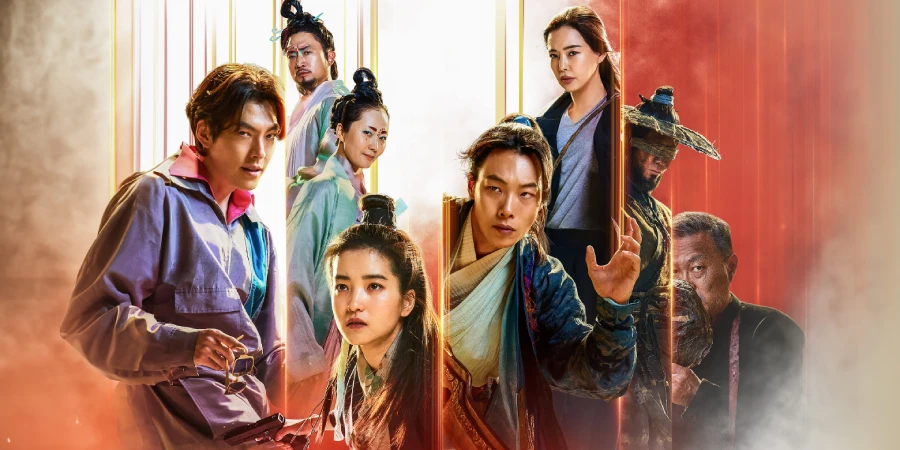
- Ryu Jun‑yeol as Mureuk
- Kim Tae‑ri as Lee Ahn
- Kim Woo‑bin as Thunder
- Lee Hanee as Min Gae-in
- Yum Jung‑ah as Heug-seol (mage)
- Jo Woo‑jin as Cheong-woon (mage)
- Kim Eui‑sung as Ja-jang (masked man, alien/antagonist)
- Jin Seon‑kyu as Neung-pa (blind swordsman)
Film Music and Composer
The music for the film was composed by Jang Young‑gyu. The original soundtrack includes 16 songs (see Spotify listing) and includes pieces that combine orchestral, electronic, and rock elements — suited to the high-octane sci-fi/magic mash-up tone.
Filming Locations
While detailed shot-by-shot filming locations are less widely published, we know the film intercuts ancient Korean settings (Joseon era) with modern Seoul and various futuristic/alien settings. The contrast in locations underscores the film’s time-travel premise: ancient Korea for the past sequences, modern city (Korea) for “present/future,” and alien/space-tech environments for the alien threat. The use of Korean historical locales gives the story a distinctive local flavour rather than generic sci-fi settings. Reviews note the blend of past and present being visually striking.
Awards and Nominations
Specific awards/nominations for this film are not widely listed in my sources (the Wikipedia page does not list awards yet). Given the scale of the production, recognitions in technical categories (visual effects, production design) may exist but I couldn’t locate a reliable comprehensive list.
Behind the Scenes Insights
Here are some interesting production/trivia bullets:
- Both Part 1 (Alienoid) and Part 2 were shot together: filming began March 2020 and concluded April 2021 (387 days) for both films.
- Director Choi Dong-hoon attempted a genre mash-up of sci-fi, fantasy, action, comedy and time-travel — intentionally ambitious and complex.
- The film’s budget is substantial (around 30 million+ USD equivalent) and the visual effects are noted as showing how far Korean blockbuster techniques have come.
- Some critics note that the sequel trims runtime (~2 hrs) compared to the first, making it more concise but still complex.
- The comedic fish-out-of-water moments (e.g., ancient characters encountering modern technology) were intentionally placed for levity amidst heavy action.
Inspirations and References
- The film draws on classic sci-fi tropes of alien invasion, body possession, time travel, and terraforming.
- It also incorporates elements of Korean historical sorcery and Taoist monk traditions (ancient setting, mystical swords).
- The combination of aliens + sorcery + time travel is somewhat reminiscent of genre-benders like Doctor Strange (time/magic) or classic Asian martial-arts/fantasy films, but remixed in a modern Korean blockbuster context.
- While not explicitly cited, the “aliens using human bodies as prisons” and the “terraforming Earth via an alien substance (Havaa)” echo sci-fi classics of body-horror and environmental takeover.
Alternate Endings and Deleted Scenes
There is no publicly detailed information about alternate endings or major deleted scenes for this film in my sources. I did not locate credible documentation of alternate endings. If you’re interested, I can attempt to dig deeper for production interviews or special-edition content.
Book Adaptations and Differences
This film is not based on a book (at least not that the sources link to). It’s an original screenplay by Choi Dong-hoon and thus there are no “book vs movie” differences to discuss.

Memorable Scenes and Quotes
Key Scenes
- The moment when Lee Ahn pierces the alien ship with the Divine Sword, stopping the Havaa spread.
- The time-portal sequence where characters from the past and the present collide and the future/past link is revealed.
- Thunder’s sacrifice: exploding the crystal into space, sealing the alien threat for now.
- The comedic sequence (mentioned in reviews) where ancient characters in modern times encounter treadmills (or other modern tech) as fish-out-of-water.
Iconic Quotes
Because the film is in Korean and the English-language sources do not quote many full lines, I cannot provide verbatim iconic quotes with full confidence. If you like, I can try locate original Korean quotes with translations.
Easter Eggs and Hidden Details
- The title itself (“Return to the Future”) plays on the iconic Back to the Future phrase, signalling the time-travel angle.
- The red crystal that contains the alien leader echoes classic “evil-in-a-box” sci-fi visuals (a nod to alien containment tropes).
- The film merchandise and posters tease time portals, multiple timelines — viewers familiar with time-travel films may catch structural echoes of earlier works (though not necessarily direct homages).
- The permanent link between past and present at the end suggests a subtle nod to “butterfly effect” time travel logic.
- The mix of ancient Korean sorcery with high-tech alien gear is itself a kind of mash-up easter-egg: two genres usually kept separate are intentionally jumbled.
Trivia
- The film runs about 122 minutes.
- It opened in South Korea on January 10, 2024 in IMAX, 4DX, ScreenX formats.
- The first 45 minutes (according to some reviews) are almost non-stop action before the deeper narrative kicks in.
- Critics have described the plot as “labyrinthine” and “sensory overload” due to its many time jumps, characters and genre shifts.
Why Watch?
If you’re someone who enjoys films that throw everything at you — aliens, magic, time travel, martial arts, modern day tech — this is a wild ride. The visuals are bold, the action scenes plentiful, and the concept fresh (at least compared to standard sci-fi fare). The mixing of Korean historical elements with futuristic alien invasion gives it a distinct flavour. Also: it wraps up (mostly) the story begun in the first film, so if you watched the first, you’ll see payoff.
Director’s Other Movies
- Alienoid (2022)
- The Thieves (2012)
- Assassination (2015)
- Tazza: The Hidden Card (2014)