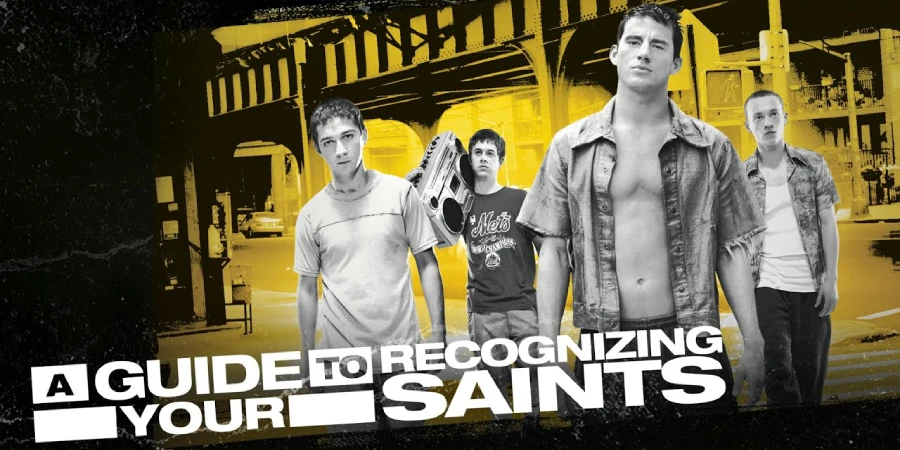

A Guide to Recognizing Your Saints is a deeply personal, semi-autobiographical coming-of-age drama that explores memory, regret, masculinity, and the quiet pain of growing up. Directed by Dito Montiel, the film is as much about what is remembered as what is lost, blending past and present into an emotionally raw portrait of family and identity.
Detailed Summary
Growing Up in Astoria, Queens
The film moves between 1980s Astoria, Queens and the present day. Young Dito grows up in a rough, tight-knit neighborhood defined by street violence, toxic masculinity, and limited horizons. His friends include volatile, troubled boys whose lives are shaped by anger, loyalty, and survival instincts rather than long-term dreams.
The environment is harsh but familiar, and the film avoids romanticizing it. Fights erupt suddenly, reputations matter, and weakness is punished. Dito is both part of this world and quietly detached from it, already feeling like an outsider.
Family Tensions and Emotional Distance
At home, Dito has a strained relationship with his father, a proud, emotionally rigid man who struggles to express affection. His mother acts as a mediator but cannot bridge the growing emotional distance between father and son. These scenes are grounded and painfully realistic, emphasizing how love can exist without being spoken.
Violence, Loss, and the Cost of Staying
As Dito’s friends become increasingly involved in violence, the consequences escalate. Several characters meet tragic ends through random acts of brutality or reckless choices. The film makes it clear that survival often feels like luck rather than virtue.
Young Dito begins to understand that staying in Astoria may mean sharing the same fate as his friends. Writing becomes his escape, and his decision to leave is portrayed as both necessary and guilt-inducing.
The Return Home
In the present day, adult Dito returns to Queens after learning that his father is dying. The neighborhood feels smaller, quieter, and haunted by absence. Old friends are gone, dead, or emotionally frozen in time. Dito’s success as a writer does not bring closure, only sharper awareness of what was sacrificed.
The film constantly contrasts who Dito was, who he became, and who he left behind.



Movie Ending
The final act centers on Dito’s reconciliation with his past rather than redemption in the traditional sense. His father’s health deteriorates, and despite years of emotional distance, Dito stays close during his final days. Their conversations are minimal, restrained, and painfully understated. There is no dramatic confession or cathartic release.
Dito’s father eventually dies, leaving behind unresolved tension but also a quiet understanding. Dito realizes that his father’s inability to express love was not absence of feeling, but inability to communicate it.
The film ends with Dito reflecting on the friends he lost and the life he escaped. There is no triumphant resolution, only acceptance. The title becomes clear: recognizing your saints means acknowledging the flawed, damaged people who shaped you, even if they could not save themselves. The ending is melancholic, grounded, and emotionally honest, emphasizing memory over closure.
Are There Post-Credits Scenes?
No. A Guide to Recognizing Your Saints does not include any post-credits or mid-credits scenes. The film ends definitively, reinforcing its reflective and grounded tone.
Type of Movie
This is a coming-of-age drama and semi-autobiographical character study focused on memory, identity, and working-class masculinity. It prioritizes emotional realism over plot-driven storytelling.
Cast
- Robert Downey Jr. as Adult Dito Montiel
- Shia LaBeouf as Young Dito
- Chazz Palminteri as Dito’s father
- Dianne Wiest as Dito’s mother
- Rosario Dawson as Laurie
- Eric Roberts as Antonio
- Channing Tatum as Antonio (young)
Film Music and Composer
The score was composed by Jonathan McHugh, using restrained, atmospheric music that supports the film’s reflective tone. The soundtrack also features punk and rock tracks from the 1970s and 1980s, grounding the story firmly in its era without overpowering the emotional core.

Filming Locations
The film was shot primarily in Astoria, Queens, New York, the real neighborhood where Dito Montiel grew up. This authenticity is crucial, as the streets, buildings, and interiors reflect lived experience rather than stylized nostalgia. The location functions almost as a character itself, shaping behavior, choices, and destiny.
Awards and Nominations
- Sundance Film Festival (2006)
- Won: Special Jury Prize for Best Ensemble Performance
- Nominated for multiple independent film awards recognizing performances and screenplay
Behind the Scenes Insights
- The film is based directly on Dito Montiel’s memoir, making many scenes emotionally autobiographical.
- Chazz Palminteri’s performance drew heavily from Montiel’s real father.
- Several cast members spent time in Astoria before filming to absorb the neighborhood’s atmosphere.
- Shia LaBeouf received critical praise for portraying restrained vulnerability rather than aggression.
- Robert Downey Jr. connected strongly with the story due to his own troubled past.
Inspirations and References
- Based on the memoir “A Guide to Recognizing Your Saints” by Dito Montiel
- Influenced by Italian-American family dramas and 1970s urban realism
- Thematically comparable to works like Mean Streets and This Boy’s Life
Alternate Endings and Deleted Scenes
There are no officially released alternate endings. Some deleted scenes reportedly expanded on Dito’s teenage friendships, but they were removed to maintain narrative focus and pacing. The final cut intentionally avoids over-explanation.
Book Adaptation and Differences
The film closely follows the memoir but streamlines events and characters for narrative clarity. The book is more episodic and reflective, while the film imposes a stronger emotional arc. Some secondary figures are combined or omitted, but the emotional truth remains faithful to the source.

Memorable Scenes and Quotes
Key Scenes
- Young Dito witnessing sudden street violence without warning
- Adult Dito silently sitting beside his dying father
- The moment Dito leaves Queens, knowing he may never truly return
- Friends laughing together, moments before their lives fall apart
Iconic Quotes
- “You think you’re better than us because you left.”
- “Some people stay. Some people survive.”
- “This is where we grew up. This is what it did to us.”
Easter Eggs and Hidden Details
- Street names and businesses match real locations from Montiel’s childhood
- Several background characters are based on real people from the memoir
- Subtle wardrobe choices reflect character trajectories rather than fashion trends
Trivia
- This was one of Shia LaBeouf’s earliest critically acclaimed dramatic roles.
- Channing Tatum’s role is small but significant, predating his rise to stardom.
- Robert Downey Jr. took the role partly because he connected with its themes of escape and survival.
- The film was shot on a relatively low budget, enhancing its grounded realism.
Why Watch?
If you appreciate character-driven storytelling, emotional honesty, and films that explore masculinity without glamorizing violence, this movie is worth your time. It is not loud, fast, or comforting, but it is sincere and deeply human.
Director’s Other Works
- Fighting (2009)
- Boulevard (2014)
- Man Down (2015)
- Skin (2018)
Recommended Films for Fans
- Mean Streets (1973)
- This Boy’s Life (1993)
- Kids (1995)
- Once Were Warriors (1994)
- Blue Valentine (2010)