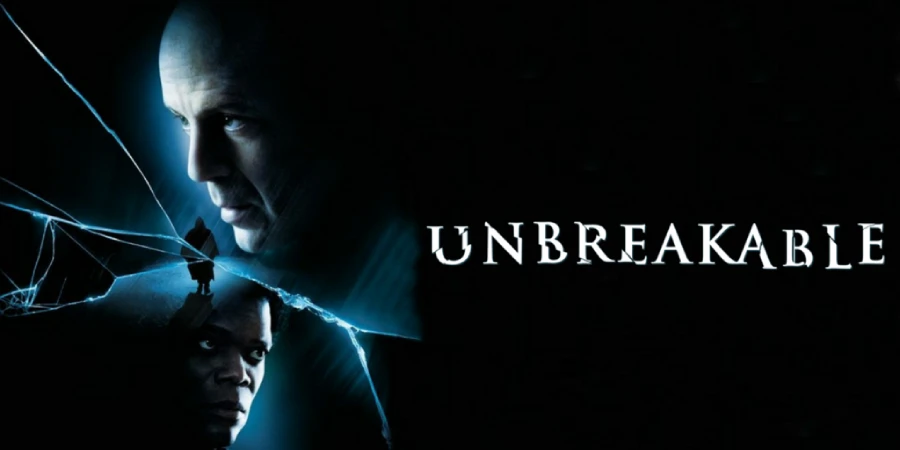

Unbreakable is not a typical superhero movie with capes, explosive battles, or world-ending threats. Instead, it is a slow-burn psychological mystery that asks a deceptively simple question: What if superheroes existed in the real world—and didn’t know it? Directed by M. Night Shyamalan, the film deconstructs the superhero genre years before it became mainstream.
Detailed Summary
The Train Crash That Changes Everything
The story begins with David Dunn, a quiet and emotionally distant security guard living in Philadelphia. His life feels stalled: a failing marriage, a strained relationship with his son, and a general sense of unfulfillment. Everything changes when a devastating train crash kills everyone onboard—except David. He walks away without a scratch, physically unharmed and deeply confused.
This incident is the film’s inciting mystery: how can one man survive something that kills dozens?
Enter Elijah Price: The Man Who Breaks
David is soon contacted by Elijah Price, a mysterious art dealer born with a rare condition that makes his bones extremely fragile. Elijah believes in a comic-book logic applied to reality: if there is someone who breaks easily, there must be someone who does not break at all.
Elijah becomes obsessed with David, convinced that David is superhuman, specifically possessing extreme strength and invulnerability. David, however, resists the idea, clinging to rational explanations and denying anything extraordinary about himself.
Signs, Doubts, and Discovery
As Elijah pushes David to examine his past, strange details emerge:
- David has never been seriously injured
- He has never been sick
- He exhibits abnormally strong physical abilities
- He experiences unsettling visions when touching people, sensing violent acts they have committed or will commit
These revelations slowly dismantle David’s skepticism. At the same time, his relationship with his son Joseph strengthens, as Joseph wholeheartedly believes his father is a hero.
The Weight of Responsibility
David realizes that his abilities are not just gifts but burdens. He struggles with the idea of responsibility—whether having power means he must act. The film deliberately avoids flashy heroics, focusing instead on David’s internal conflict and fear of embracing a role that will fundamentally change his life.
Movie Ending
In the final act, David finally accepts who he is. Following a disturbing vision triggered by physical contact, he tracks down a man responsible for a horrific crime involving a family. David confronts the criminal in his home, engaging in a tense, grounded struggle rather than a stylized fight. He saves the victims but nearly dies due to his one weakness: water, which neutralizes his strength.
This moment confirms David’s identity as a real-world superhero—powerful but vulnerable.
Afterward, David meets Elijah one last time. In what initially appears to be a moment of triumph and validation, David shakes Elijah’s hand. This contact triggers a horrifying vision: Elijah orchestrated multiple mass-casualty events, including the train crash, in his desperate attempt to find someone like David. Elijah reveals the truth calmly, even proudly—he believes his suffering had purpose because it led to the discovery of a hero.
The film ends with a title card revealing:
- David Dunn went on to become a vigilante
- Elijah Price was arrested and institutionalized
The ending reframes the entire story, revealing Elijah as the true villain—a man willing to sacrifice countless lives to justify his own existence. It is a quiet, devastating conclusion that transforms a story about self-discovery into one about obsession, moral absolutism, and the danger of mythmaking.
Are There Post-Credits Scenes?
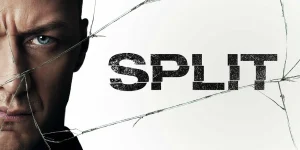
No. Unbreakable does not include any post-credits or mid-credits scenes. The film ends definitively, with its thematic weight carried by the final reveal rather than sequel bait. (Its continuation would not arrive until Split in 2016.)
Type of Movie
Unbreakable is best described as a psychological thriller with superhero elements, grounded firmly in realism. Rather than celebrating spectacle, it explores identity, belief, and destiny through a restrained, dramatic lens.
Cast
- Bruce Willis as David Dunn
- Samuel L. Jackson as Elijah Price / Mr. Glass
- Robin Wright as Audrey Dunn
- Spencer Treat Clark as Joseph Dunn
- Charlayne Woodard as Elijah’s mother
Film Music and Composer
The score was composed by James Newton Howard, whose music is central to the film’s tone. The orchestral themes are somber, restrained, and emotionally heavy, emphasizing introspection rather than action. The main theme has since become iconic within the genre.


Filming Locations
- Philadelphia, Pennsylvania – The city’s grounded, everyday atmosphere reinforces the film’s realism.
- Philadelphia 30th Street Station – Used to enhance the sense of scale and public vulnerability.
- Local neighborhoods and homes – Ordinary locations are crucial to the film’s theme that extraordinary things can exist within mundane settings.
The lack of exotic or stylized locations is intentional, grounding the story firmly in the real world.
Awards and Nominations
- Saturn Award nomination for Best Science Fiction Film
- Saturn Award nomination for Best Actor (Bruce Willis)
- Widely praised by critics for its originality, though it was divisive upon release due to its unconventional pacing
Behind the Scenes Insights
- M. Night Shyamalan intentionally framed many shots to resemble comic book panels
- Samuel L. Jackson based Elijah’s personality on tragic literary figures rather than comic villains
- Bruce Willis deliberately underplayed his performance to emphasize realism
- The film was originally marketed as a traditional thriller, not a superhero film
Inspirations and References
- Classic superhero comic books, especially origin stories
- The mythic structure of heroes and villains
- Existential philosophy and the idea of destiny
- Shyamalan’s interest in ordinary people confronting extraordinary truths
Alternate Endings and Deleted Scenes
- Early drafts explored more of Elijah’s crimes explicitly, but these were removed to preserve ambiguity
- Several scenes further explaining David’s vigilante future were cut to maintain subtlety
- No fully alternate ending was filmed, but the final revelation was refined extensively in editing
Book Adaptations and Differences
Unbreakable is not based on a book, but it functions as an original cinematic interpretation of comic book mythology. Unlike traditional comics, the film avoids exaggerated costumes, names, and action, choosing realism over stylization.


Memorable Scenes and Quotes
Key Scenes
- David realizing he has never been injured
- Elijah explaining comic-book logic in his gallery
- Joseph pointing a gun at David to prove his invulnerability
- The final handshake revelation
Iconic Quotes
- “They called me Mr. Glass.” – Elijah Price
- “Do you know what the scariest thing is? To not know your place in the world.”
- “Now that we know who you are, I know who I am.”
Easter Eggs and Hidden Details
- David’s green color palette contrasts with Elijah’s purple, symbolizing hero and villain
- Camera framing often boxes Elijah to emphasize fragility and confinement
- Newspaper headlines subtly foreshadow Elijah’s guilt
- The film avoids showing David lifting extreme weight directly, reinforcing ambiguity
Trivia
- The film was later revealed to be part of a trilogy (Unbreakable, Split, Glass)
- Samuel L. Jackson insisted Elijah remain physically vulnerable at all times
- The train crash is never shown directly, enhancing realism
- Shyamalan appears briefly as a drug dealer David encounters
Why Watch?
If you are tired of loud, overstuffed superhero movies, Unbreakable offers something rare: a thoughtful, character-driven exploration of what it truly means to be a hero. It rewards patience, attention, and emotional engagement.
Director’s Other Works
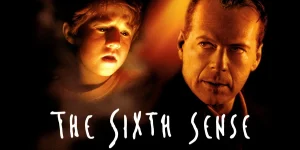
- The Sixth Sense (1999)
- Signs (2002)
- The Village (2004)
- Lady in the Water (2006)
- Split (2016)
- Glass (2019)