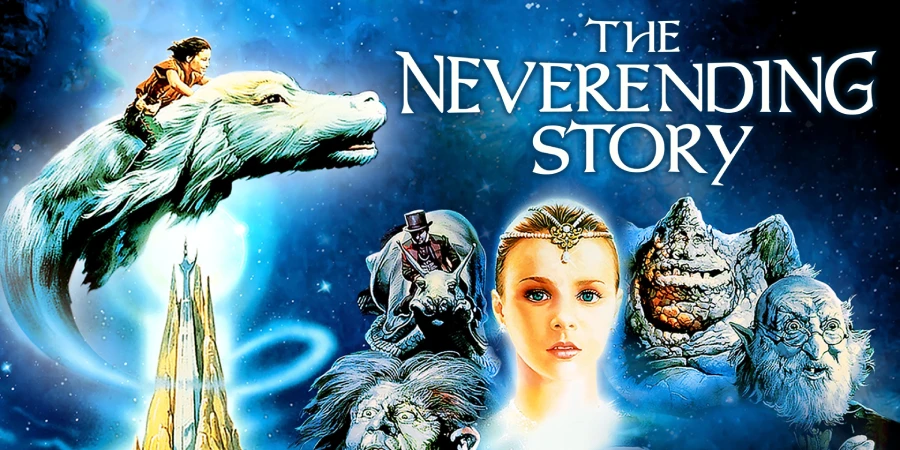
The NeverEnding Story (1984) is one of the most iconic fantasy films of the 1980s, a movie that shaped childhoods and continues to resonate with adults thanks to its emotional depth, imaginative world, and unforgettable imagery. Directed by Wolfgang Petersen and based on a beloved novel, it is far more philosophical than it first appears.
Detailed Summary
A Lonely Boy and a Mysterious Book
The story begins in the real world with Bastian Balthazar Bux, a shy, bullied boy struggling with the recent death of his mother. Feeling isolated and misunderstood, Bastian skips school and hides in an attic, where he begins reading a strange book titled The NeverEnding Story. From the very first pages, it becomes clear that this is not an ordinary fantasy tale.
Fantasia and the Spreading Nothing
The book tells the story of Fantasia, a magical land slowly being consumed by a force known as the Nothing. Entire regions are disappearing, and with them, the hope of Fantasia itself. The Childlike Empress, ruler of Fantasia, has fallen gravely ill, and only a hero can save her.
Atreyu’s Quest
The young warrior Atreyu is chosen to embark on a perilous quest to discover what can stop the Nothing. Along the way, he encounters iconic creatures such as Falkor the luckdragon, Morla the Ancient One, and the tragic Artax, whose fate becomes one of the most emotionally devastating moments in fantasy cinema.
Atreyu’s journey is not just physical but psychological. He must face fear, despair, and self-doubt, reflecting the deeper themes of loss and belief that run throughout the film.
The Reader Becomes Part of the Story
As Bastian continues reading, he begins to realize something unsettling: the book seems to be aware of him. Characters speak directly to the reader, blurring the boundary between Fantasia and the real world. The film slowly reveals that Fantasia’s survival depends not just on Atreyu, but on someone from outside the story.
Movie Ending
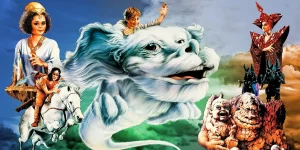
In the final act, Fantasia is nearly destroyed. Atreyu reaches the Childlike Empress only to learn that he has already failed. The Nothing continues to consume everything, and Atreyu is left floating in a void with Falkor as the last remnants of Fantasia vanish.
The crucial revelation comes when the Childlike Empress explains that Fantasia can only be saved by a human child who must give her a new name. This child is revealed to be Bastian himself. At first, Bastian refuses, afraid of being mocked or misunderstood in the real world. This hesitation mirrors his emotional paralysis after his mother’s death.
Eventually, pushed by the Empress’s plea, Bastian shouts a new name for her. In that moment, Fantasia is reborn. The land returns piece by piece, but in a smaller, fragile form. The Empress gives Bastian a single grain of sand, explaining that every wish he makes will rebuild Fantasia, but each wish also pulls him further away from the human world.
The film ends on a triumphant, dreamlike note as Bastian rides Falkor through Fantasia and then back into the real world, confronting his bullies with newfound confidence. The ending emphasizes that imagination and belief are not childish escapes, but essential tools for healing and self-discovery.
Are There Post-Credits Scenes?
No. The NeverEnding Story does not include any post-credits or mid-credits scenes. The film concludes definitively with its final fantasy sequence and credits roll.
Type of Movie
The NeverEnding Story is a fantasy adventure film with strong elements of coming-of-age drama and philosophical allegory, blending childlike wonder with surprisingly mature emotional themes.
Cast
- Barret Oliver as Bastian Balthazar Bux
- Noah Hathaway as Atreyu
- Tami Stronach as The Childlike Empress
- Alan Oppenheimer as Falkor / Rockbiter / Gmork (voice)
- Moses Gunn as Cairon
Film Music and Composer
The score was composed by Klaus Doldinger, with additional music by Giorgio Moroder for the international version. The theme song, “The NeverEnding Story”, became a global hit and remains one of the most recognizable movie themes of the 1980s.


Filming Locations
The film was primarily shot at Bavaria Studios in Munich, Germany, one of Europe’s largest and most advanced studios at the time. Massive practical sets were built for Fantasia, which gave the film a tactile, storybook quality that still holds up today. Some outdoor scenes were filmed in Spain, contributing to Fantasia’s timeless and otherworldly landscapes.
Awards and Nominations
- Nominated for Saturn Award for Best Fantasy Film
- Won multiple European film awards for production design and visual effects
While not heavily awarded in the U.S., the film gained massive cult status over time.
Behind the Scenes Insights
- The animatronic Falkor was notoriously difficult to operate and often malfunctioned.
- Author Michael Ende, who wrote the original novel, disliked the film adaptation and publicly distanced himself from it.
- The swamp scene with Artax was emotionally difficult for the young cast and crew to film.
- Over a year was spent designing and building practical creatures and sets.
Inspirations and References
The film is based on the novel The NeverEnding Story by Michael Ende. Philosophically, it draws inspiration from ideas about imagination, identity, grief, and the power of storytelling, echoing themes found in works by C.S. Lewis and J.R.R. Tolkien.
Alternate Endings and Deleted Scenes
Several scenes exploring Bastian’s wishes and their consequences were cut, many of which later inspired the sequel. The original novel continues far beyond where the 1984 film ends, meaning the movie only adapts roughly half of the book.
Book Adaptation and Differences
The novel is darker and more complex. In the book:
- Bastian becomes increasingly arrogant as he makes wishes.
- Fantasia’s rebirth is more morally ambiguous.
- The story focuses heavily on the cost of escapism.
The film softens these elements, aiming for a more hopeful and accessible ending.
Memorable Scenes and Quotes
Key Scenes
- Artax sinking into the Swamp of Sadness
- Atreyu facing the gate of the Sphinxes
- Bastian naming the Childlike Empress
Iconic Quotes
- “Fighting against sadness is the hardest fight of all.”
- “People who have no hopes are easy to control.”
Easter Eggs and Hidden Details
- The book Bastian reads has the Auryn symbol, which later appears throughout Fantasia.
- The Nothing represents loss of imagination, not evil in a traditional sense.
- Many creature designs subtly resemble medieval European folklore.
Trivia
- Falkor is technically a luckdragon, not a dragon.
- The film was the most expensive German production at the time.
- The U.S. version is shorter than the original German cut.
Why Watch?
Because it is not just a children’s fantasy film, but a deeply emotional story about grief, belief, and the necessity of imagination. It grows with you the older you get.
Director’s Other Movies
- Das Boot (1981)
- Enemy Mine (1985)
- In the Line of Fire (1993)
- Air Force One (1997)