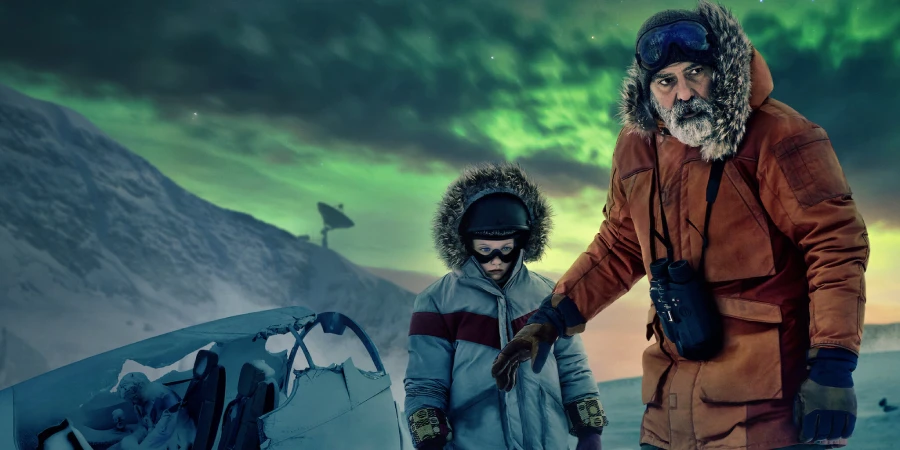

The Midnight Sky is a quiet, melancholic sci-fi drama directed by and starring George Clooney. Adapted from the novel Good Morning, Midnight, the film blends Arctic survival tension with deep-space isolation, asking a simple but devastating question: What if humanity’s last hope doesn’t know there’s nothing left to come home to?
Detailed Summary
A Dying Earth and a Man Who Stays Behind
The film opens in 2049. Earth has suffered an unspecified global catastrophe — radiation levels are rising, the air is toxic, and evacuation missions are underway. Most survivors are heading underground.
Augustine Lofthouse (George Clooney), a terminally ill Arctic scientist, chooses to remain behind at a remote research station in the Arctic Circle. He refuses evacuation not out of heroism, but regret. His life has been consumed by work, and he’s estranged from his daughter.
Soon after everyone leaves, Augustine discovers a young girl named Iris hiding in the station. She doesn’t speak. He assumes she’s been accidentally left behind, and despite his illness, he takes responsibility for her.
The Aether Crew in Deep Space
Parallel to Augustine’s isolation, we follow the crew of the spaceship Aether returning from a mission to K-23, a potentially habitable moon of Jupiter. The crew includes Sully (Felicity Jones), Adewole (David Oyelowo), Sanchez (Demián Bichir), Mitchell (Kyle Chandler), and Maya (Tiffany Boone).
They are unaware that Earth has collapsed. Communications have gone silent, but they assume it’s temporary.
The emotional core builds around Sully, who is pregnant and hopeful about returning home. The crew believes they’re bringing humanity its second chance.
Augustine’s Mission to Reach Them
Augustine discovers that a stronger communications array exists at a more distant Arctic base. He realizes the Aether crew must not return to Earth — the radiation would kill them.
Despite worsening health and brutal Arctic conditions, Augustine and Iris embark on a dangerous trek across the ice. Blizzards, thin ice, and limited oxygen create constant tension. Augustine grows attached to Iris, seeing in her the daughter he failed to connect with.
At one point, they fall through cracking ice — one of the film’s most harrowing sequences. Augustine barely survives.
Tragedy in Space
Meanwhile, the Aether crew suffers a catastrophic meteor strike while repairing an external communications system. Sanchez is killed during a spacewalk accident in one of the film’s most intense and visually striking scenes.
The damage compounds the crew’s vulnerability. Adewole is injured. Resources are limited. The realization that Earth may truly be gone begins to settle in.
The loneliness in space mirrors Augustine’s isolation on Earth.
The Emotional Revelation
Augustine finally manages to contact the Aether. He warns them not to return — Earth is uninhabitable.
In a pivotal emotional moment, he learns Sully’s full name: Iris Sullivan.
The young girl with him. The daughter he abandoned.
The child at the station is not real.
She is a hallucination — a manifestation of his regret and longing for reconciliation.
The film quietly reveals that Iris has not spoken because she is a projection of Augustine’s guilt and memory.

Movie Ending
The Aether crew now faces an impossible choice: drift endlessly in space with diminishing supplies, or attempt to colonize K-23 — the moon they just left.
Adewole chooses to stay aboard the Aether, accepting likely death in space. Sully and Adewole share an emotional farewell; he sacrifices himself so she and her unborn child may have a chance.
Sully decides to return to K-23 alone, believing it can sustain life. The crew reprograms the ship for her journey back toward Jupiter’s moon.
On Earth, Augustine remains at the Arctic station. He is weak, near death, and fully aware that he will not survive.
In his final communication with Sully, he confesses that he believes she is his daughter. Sully doesn’t confirm or deny it outright — but the emotional implication is clear.
Augustine accepts that humanity’s future no longer belongs to Earth. It belongs to Sully and her child on a distant world.
The film ends with:
- Sully heading back toward K-23, carrying the literal future of humanity
- Augustine alone in the Arctic, finally at peace
- The hallucinated Iris gone
There is no triumphant score. No celebration. Just quiet acceptance.
Humanity survives — but not here.
It’s a bittersweet ending, rooted in sacrifice, regret, and fragile hope.
Are There Post-Credits Scenes?
No. There are no post-credits or mid-credits scenes in The Midnight Sky. Once the credits roll, the story is complete.
Type of Movie
The Midnight Sky is a post-apocalyptic science fiction drama with strong psychological and survival elements. It focuses more on emotion and isolation than action, blending Arctic survival tension with space tragedy.
Cast
- George Clooney as Augustine Lofthouse
- Felicity Jones as Sully (Iris Sullivan)
- David Oyelowo as Adewole
- Kyle Chandler as Mitchell
- Demián Bichir as Sanchez
- Tiffany Boone as Maya
- Caoilinn Springall as Young Iris
Film Music and Composer
The score was composed by Alexandre Desplat. His music is restrained and melancholic, relying on soft strings and minimalistic motifs to emphasize emotional isolation rather than spectacle. The score plays a crucial role in making the silence of space feel heavy rather than empty.


Filming Locations and Their Importance
Filming took place in Iceland and at Shepperton Studios in England.
The Arctic exteriors were shot in Iceland, whose frozen landscapes authentically convey Earth’s abandonment and hostility. The harsh, endless white terrain reinforces Augustine’s isolation and the planet’s lifeless state.
The spacecraft interiors were filmed at Shepperton Studios, where detailed practical sets helped ground the space sequences in realism. The confined spaces contrast sharply with the vast Arctic emptiness.
Awards and Nominations
The film received nominations at the Academy Awards for Best Visual Effects. It was also nominated at the BAFTA Awards for Special Visual Effects and recognized by several critics’ associations for its technical achievements.
Behind the Scenes Insights
- George Clooney lost around 25 pounds for the role to physically portray Augustine’s illness.
- Clooney was hospitalized during production due to pancreatitis, reportedly brought on by rapid weight loss.
- The zero-gravity sequences were achieved through complex wire rigs and rotating set pieces rather than full CGI.
- Felicity Jones was pregnant during filming, which aligned with her character’s storyline.
- Clooney cited loneliness as the emotional anchor of the film rather than the apocalypse itself.
Inspirations and References
The film is based on the novel Good Morning, Midnight by Lily Brooks-Dalton.
Thematically, it draws comparisons to films like Gravity and Interstellar, but unlike those films, it avoids large-scale spectacle in favor of intimate emotional storytelling.
Alternate Endings and Deleted Scenes
There were no officially released alternate endings. However, early script drafts reportedly contained a more explicit confirmation that Sully was Augustine’s daughter. The final version intentionally leaves that connection emotionally implied rather than verbally confirmed.
Some deleted scenes expanded on Augustine’s past and his strained relationship with Iris’s mother, but these were removed to maintain narrative pacing.
Book Adaptation and Differences
The movie is adapted from Good Morning, Midnight, but there are significant differences:
- In the novel, the child’s identity and psychological dimension are treated differently.
- The film increases the emotional emphasis on the father-daughter connection.
- The ending in the book is more ambiguous regarding humanity’s long-term survival.
- The space crew storyline is expanded in the film for cinematic tension.
The adaptation leans more heavily into redemption and generational hope.


Memorable Scenes and Quotes
Key Scenes
- The meteor storm sequence in space
- Augustine and Iris falling through cracking Arctic ice
- The final communication between Augustine and Sully
- The silent reveal that Iris is not real
Iconic Quotes
- “We have to decide what kind of future we’re going to build.”
- “There is no going back.”
- “K-23 is our best chance.”
Easter Eggs and Hidden Details
- The name Iris appears both as the child and Sully’s real name, signaling the twist early.
- Augustine’s research papers in the station subtly reference his obsession with finding habitable worlds.
- The film uses minimal background radio chatter to emphasize societal collapse without showing it.
- The recurring imagery of Jupiter symbolizes unreachable hope.
Trivia
- This was George Clooney’s first sci-fi film as a director.
- The Arctic trek scenes were filmed in extreme sub-zero conditions.
- The Aether ship design was influenced by NASA deep-space exploration concepts.
- The film was released on Netflix during the COVID-19 pandemic, which amplified its themes of isolation.
Why Watch?
Watch this film if you appreciate slow-burn, emotionally reflective science fiction. It’s less about explosions and more about regret, sacrifice, and second chances. If you value atmosphere, performance, and quiet devastation, this one stays with you.
Director’s Other Works
Other films directed by George Clooney include:
- Confessions of a Dangerous Mind (2002)
- Good Night, and Good Luck (2005)
- The Ides of March (2011)
- The Monuments Men (2014)
- Suburbicon (2017)
Recommended Films for Fans
If you liked The Midnight Sky, you might enjoy: