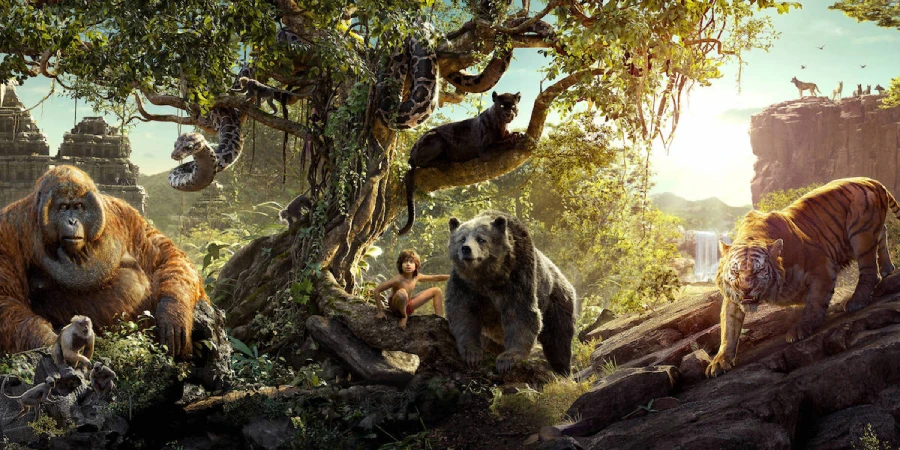

Disney’s 2016 live-action reimagining of The Jungle Book is a visually groundbreaking adaptation directed by Jon Favreau. Blending photorealistic CGI animals with a live child actor, the film reintroduces Rudyard Kipling’s timeless jungle tale to a modern audience while honoring the spirit of Disney’s 1967 animated classic.
It’s a film that feels nostalgic and innovative at the same time—warm, thrilling, occasionally dark, and surprisingly emotional.
Detailed Summary
The Man-Cub in the Wolf Pack
The story begins in the Indian jungle, where a young boy named Mowgli has been raised by wolves under the guidance of Raksha and the pack leader Akela. The stern but caring panther Bagheera watches over him, worried that the jungle is no place for a human child.
When the tiger Shere Khan returns and threatens the wolf pack, he demands that the man-cub be handed over. His hatred of humans stems from past scars inflicted by them. The jungle’s fragile peace shatters, and Mowgli is forced to leave the only family he has ever known.
The Journey Through the Jungle
Bagheera escorts Mowgli toward a nearby human village for his safety. Along the way, they encounter Kaa, the hypnotic python, whose eerie monologue introduces the film’s darker tone. Later, Mowgli meets Baloo, a carefree sloth bear who teaches him the joys of living in the moment.
The “Bare Necessities” sequence is a lighter interlude, but the threat of Shere Khan looms constantly in the background.
King Louie and the Red Flower
Captured by monkeys, Mowgli is brought before King Louie, a massive Gigantopithecus ruling over the ruins of an ancient temple. Louie wants the secret of “the red flower”—fire—believing it will give him dominance over the jungle.
This moment reinforces the movie’s central theme: fire represents both human innovation and destructive power.
Shere Khan’s Growing Dominance
Shere Khan systematically spreads fear among the animals. He manipulates the wolf pack, kills Akela, and intensifies the jungle’s divisions. Mowgli, wracked with guilt and anger, decides to confront the tiger rather than run from him.
The stage is set for a final, explosive showdown.
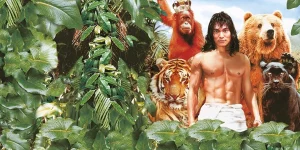

Movie Ending
The climax unfolds during a raging jungle fire, started accidentally by Mowgli while attempting to fight Shere Khan. The fire spreads rapidly through the ancient ruins, visually symbolizing the destructive potential of humanity’s tools.
Shere Khan pursues Mowgli across crumbling temple structures as flames engulf the jungle. In a tense sequence, Mowgli uses his intelligence—not brute strength—to outmaneuver the tiger. He climbs high onto a dead tree trunk extending over a fiery abyss.
Shere Khan attacks, but in his rage and arrogance, he loses balance and falls into the inferno below. His death is not triumphant but tragic—a culmination of hatred and obsession.
After the fire is extinguished by rain, balance slowly returns to the jungle. Mowgli is welcomed back into the wolf pack. In a powerful final moment, he chooses not to return to the human village. Instead, he embraces his identity as both human and jungle-dweller, running alongside the wolves.
The film closes with Mowgli confidently integrated into the jungle ecosystem—no longer torn between worlds, but part of both.
The ending emphasizes coexistence rather than exile.
Are There Post-Credits Scenes?
There are no additional narrative scenes after the credits. However, the credits feature stylized jungle artwork reminiscent of the 1967 animated film, serving as a nostalgic tribute rather than a teaser.
Type of Movie
The Jungle Book (2016) is a live-action/CGI hybrid adventure fantasy film with dramatic and family elements. It balances child-friendly storytelling with surprisingly intense and mature emotional beats.
Cast
- Neel Sethi as Mowgli
- Bill Murray as Baloo
- Ben Kingsley as Bagheera
- Idris Elba as Shere Khan
- Scarlett Johansson as Kaa
- Christopher Walken as King Louie
- Lupita Nyong’o as Raksha
- Giancarlo Esposito as Akela
Neel Sethi was the only actor physically present during filming—every other character was CGI.
Film Music and Composer
The score was composed by John Debney, who blended orchestral grandeur with thematic nods to Disney’s 1967 classic. Songs like “The Bare Necessities” and “I Wan’na Be Like You” were reinterpreted rather than replicated, giving them a more cinematic scale.

Filming Locations
Although the story is set in India, the movie was filmed almost entirely in Los Angeles, primarily at Walt Disney Studios using soundstages and blue-screen environments.
The jungle was created digitally by visual effects teams using advanced motion capture and CGI techniques. This approach allowed:
- Complete control over lighting and environment
- Hyper-realistic animal animation
- Seamless integration between the human actor and digital creatures
The artificial production method was essential in making the animals look photorealistic rather than cartoonish.
Awards and Nominations
The film was a major critical and commercial success.
Notably, it won:
- Academy Award for Best Visual Effects at the Academy Awards
- BAFTA Award for Best Special Visual Effects
It was widely praised for pushing CGI realism to new heights.
Behind the Scenes Insights
- Neel Sethi beat out thousands of children in a worldwide casting search.
- The jungle environments were inspired by real Indian landscapes but digitally enhanced for dramatic scale.
- Jon Favreau used virtual reality tools to “walk through” digital jungle sets before they were rendered.
- Idris Elba recorded his lines in a way that emphasized Shere Khan’s psychological menace rather than simple villainy.
- The film’s success directly influenced Disney’s decision to produce more live-action remakes.
Inspirations and References
The movie is based primarily on:
- The Jungle Book by Rudyard Kipling
- Disney’s The Jungle Book
However, the 2016 version leans more into Kipling’s darker tone than the animated adaptation did.
Book Adaptations and Differences
Compared to Kipling’s book:
- The film simplifies episodic stories into one cohesive narrative.
- King Louie does not exist in Kipling’s original work.
- Shere Khan is more psychologically complex in the film.
- Mowgli’s identity conflict is emphasized more strongly in the adaptation.
The movie also gives more emotional depth to the wolf pack dynamic than either the book or 1967 film.
Alternate Endings and Deleted Scenes
There are no publicly confirmed alternate endings. Some extended jungle sequences and character interactions were trimmed for pacing, particularly additional moments between Mowgli and the wolf pack. The final choice—Mowgli staying in the jungle—remained consistent throughout production.
Memorable Scenes and Quotes
Key Scenes
- The wolf council confrontation with Shere Khan
- Baloo floating down the river singing “The Bare Necessities”
- King Louie’s colossal entrance in the temple ruins
- The fire-lit final battle atop the crumbling structure
Iconic Quotes
- Shere Khan: “This is my jungle.”
- Baloo: “Kid, I got a pool with your name on it.”
- Bagheera: “You must go to the man-village.”
Easter Eggs and Hidden Details
- The end-credits artwork mirrors the 1967 animated film’s visual style.
- King Louie’s species (Gigantopithecus) is a prehistoric ape, adding realism.
- Certain camera movements subtly mimic documentary wildlife filmmaking.
- The wolf pack hierarchy follows real wolf behavioral research.
Trivia
- The film grossed nearly $1 billion worldwide.
- It was one of the first major films to use extensive virtual production techniques later adopted in projects like The Mandalorian.
- Jon Favreau previously revolutionized CGI integration in The Lion King (2019) after this film’s success.
- Neel Sethi performed many of his scenes reacting to tennis balls on sticks.
Why Watch?
Because it’s a rare remake that justifies its existence. The film combines cutting-edge visual effects, strong performances, emotional weight, and nostalgic charm. It’s darker than you might expect, visually richer than most family films, and surprisingly mature in theme.
If you enjoy adventure stories that balance spectacle with heart, this one delivers.
Director’s Other Works
Recommended Films for Fans
- The Lion King (1994)
- Life of Pi (2012)
- Avatar (2009)
- The Chronicles of Narnia: The Lion, the Witch and the Wardrobe (2005)
- Mowgli: Legend of the Jungle (2018)