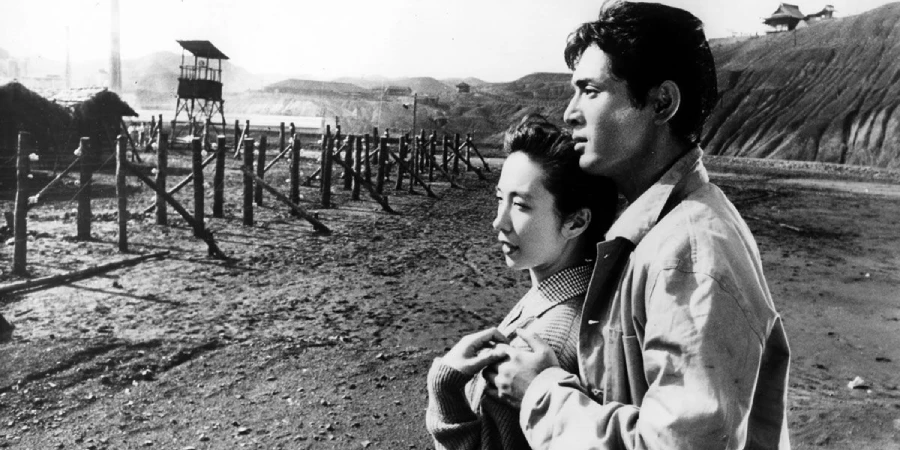

The Human Condition I: No Greater Love is the first chapter of Masaki Kobayashi’s monumental anti-war trilogy. Released in 1959, the film is not simply a war drama but a powerful moral examination of humanity under extreme oppression. It is widely regarded as one of the most important Japanese films ever made and one of cinema’s most uncompromising condemnations of militarism.
This first installment sets the philosophical, emotional, and ethical foundation for the two films that follow.
Detailed Summary
A Man Who Refuses to Become Cruel
The story follows Kaji, a young Japanese idealist married to Michiko. Unlike most men of his era, Kaji openly rejects violence, nationalism, and blind obedience. Because of his political beliefs, he attempts to avoid military conscription by accepting a civilian managerial job at a mining operation in Japanese-occupied Manchuria during World War II.
From the beginning, the film makes it clear that Kaji’s values are incompatible with the system he serves. He believes productivity can be achieved through humane treatment rather than brutality.
The Manchurian Labor Camp
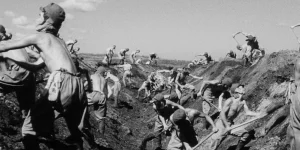
Kaji is placed in charge of supervising Chinese prisoners of war who are forced into slave labor. The conditions are horrific: starvation, beatings, executions, and routine humiliation. The camp guards treat cruelty as discipline, and compassion as weakness.
Kaji attempts to implement reforms. He improves food distribution, reduces violence, and insists on fair treatment. At first, productivity increases, proving his philosophy correct.
However, his actions isolate him. The military authorities see him as dangerous, the guards resent him, and the prisoners are initially suspicious of his kindness.
This section establishes one of the film’s central questions:
Can morality survive inside an immoral system?
The Cost of Compassion
Kaji’s humane approach quickly puts him in conflict with both the Kempeitai (military police) and the mine administrators. His refusal to participate in abuse marks him as politically unreliable.
When prisoners escape, the military responds with brutal interrogations and executions. Despite Kaji’s protests, collective punishment is enforced. He is powerless to stop it.
Here the film becomes increasingly bleak. Kaji’s moral stance does not change the system. Instead, the system begins to destroy him.
Corruption and Betrayal
The mine’s upper management is exposed as corrupt, selling supplies on the black market while blaming prisoners for shortages. Kaji attempts to report them, believing that justice still exists somewhere above him.
This proves to be a tragic miscalculation.
Rather than being rewarded, Kaji is punished. His reports attract unwanted attention from the military, who view him as a subversive intellectual rather than a loyal citizen.
His belief in institutional fairness collapses.
The Collapse of Idealism
As pressure increases, Kaji is forced to participate in acts he despises. Though he resists as much as possible, he becomes complicit simply by remaining in his position.
The prisoners suffer regardless of his intentions.
The film portrays this moral erosion with devastating realism. Kaji does not become cruel, but he becomes exhausted, disillusioned, and spiritually wounded.
His marriage also suffers as distance and fear separate him from Michiko.
From Civilian to Soldier
Ultimately, the military decides that Kaji is more dangerous as a thinker than as a fighter. His civilian exemption is revoked.
Despite all his efforts to avoid combat, he is forcibly conscripted into the Japanese army.
The transformation is symbolic. The man who tried to humanize oppression is now swallowed entirely by it.
The first film ends not with death, but with the destruction of hope.


Movie Ending
The film concludes with Kaji’s complete moral defeat by the system he tried to reform.
After exposing corruption and repeatedly challenging military brutality, he is arrested and interrogated by the military police. His ideological beliefs are labeled unpatriotic. The authorities determine that his presence as a civilian supervisor is destabilizing.
Kaji is stripped of his protected status and drafted into the Imperial Japanese Army.
The final moments show him leaving behind civilian life, his wife, and any illusion that ethical resistance can exist within authoritarian power. There is no heroic victory, no dramatic rebellion, and no redemption.
The true tragedy lies in what does not happen:
Kaji does not die.
He does not triumph.
He does not change the world.
Instead, he is absorbed into the machinery of war.
The ending deliberately denies emotional release, preparing the audience for the even darker journey ahead in Parts II and III.
Are There Post-Credits Scenes?
No. There are no post-credits scenes in The Human Condition I: No Greater Love. The film ends definitively and transitions directly into the next chapter of the trilogy.
Type of Movie
The film is a historical war drama deeply rooted in philosophical and political inquiry. Rather than focusing on combat, it explores ethics, authoritarianism, and the psychological cost of resisting dehumanization during wartime.
Cast
- Tatsuya Nakadai as Kaji
- Michiyo Aratama as Michiko
- Minoru Chiaki as Okishima
- Kô Mishima as Military Police Officer
- Kei Satō as Camp Guard
Tatsuya Nakadai’s performance is widely considered one of the greatest in Japanese cinema history.
Film Music and Composer
The score was composed by Toru Takemitsu, whose minimalist and emotionally restrained music reinforces the film’s oppressive atmosphere. Silence is used as powerfully as sound, emphasizing isolation and moral tension.
Filming Locations
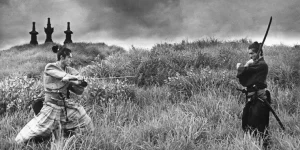
The film was shot primarily in Hokkaido, Japan, which served as a stand-in for Manchuria.
The harsh landscapes were essential to the film’s realism. The barren plains, extreme cold, and empty horizons visually reflect the emotional desolation of the characters and the merciless nature of the system they inhabit.
Awards and Nominations
Although not heavily awarded upon release, the trilogy later gained international recognition and is now frequently cited in:
- Sight & Sound Greatest Films polls
- British Film Institute retrospectives
- Cannes Film Festival historical screenings
Its reputation has grown significantly over time.
Behind the Scenes Insights
- Director Masaki Kobayashi was himself a former Japanese soldier who refused promotion during the war, directly influencing the film’s themes.
- The trilogy was filmed over nearly three years, an extraordinary commitment for its time.
- Tatsuya Nakadai aged physically and emotionally during production, mirroring Kaji’s deterioration.
- Many extras were actual war veterans.
- The film was controversial in Japan due to its direct criticism of wartime conduct.
Inspirations and References
- Based on the novel The Human Condition by Junpei Gomikawa
- Influenced by Kobayashi’s own wartime experiences
- Inspired by post-war existential philosophy
- Reflects themes similar to Dostoyevsky and Camus
- Acts as a direct counterpoint to propaganda war films of the 1940s
Alternate Endings and Deleted Scenes
There are no known alternate endings.
However, several scenes involving extended interrogations and labor camp punishments were shortened by the studio due to their extreme bleakness and length. Kobayashi later stated that his original cut was even more brutal.
Book Adaptation and Differences
The film closely follows Gomikawa’s novel but introduces several changes:
- Kaji is portrayed as more idealistic in the film
- The novel provides deeper political analysis, while the film emphasizes emotional suffering
- Some secondary characters are merged or removed
- The film softens certain ideological monologues to maintain cinematic pacing
Despite this, it remains one of the most faithful literary adaptations in Japanese cinema.



Memorable Scenes and Quotes
Key Scenes
- Kaji confronting guards over prisoner beatings
- The execution of escapees and collective punishment
- Kaji’s interrogation by the military police
- The final conscription order
- The silent farewell between Kaji and Michiko
Iconic Quotes
- “If kindness is a crime, then I accept the charge.”
- “Obedience without conscience is not loyalty.”
- “This system does not want good men. It wants useful ones.”
Easter Eggs and Hidden Details
- Prisoner numbers correspond to real wartime POW registries
- Military insignia subtly change as Kaji’s status deteriorates
- Repeated framing places Kaji behind bars or fences even when free
- The mine siren sound is reused later in the trilogy as a motif of oppression
Trivia
- At over three hours, this is only the first third of the complete story
- The full trilogy runs nearly ten hours
- The film was banned in several countries upon release
- Kobayashi considered this his most personal work
- Martin Scorsese has cited the trilogy as a major influence
Why Watch?
You should watch The Human Condition I if you want:
- A war film without glorification
- A deeply human moral struggle
- One of cinema’s strongest anti-authoritarian statements
- A performance of extraordinary emotional depth
- A story that respects the intelligence of its audience
This is not entertainment-first cinema. It is truth-first cinema.
Director’s Other Works (Movies)
- Harakiri (1962)
- Kwaidan (1964)
- Samurai Rebellion (1967)
- The Inheritance (1962)
- Black River (1957)
Recommended Films for Fans
- The Human Condition II: Road to Eternity (1959)
- The Human Condition III: A Soldier’s Prayer (1961)
- Come and See (1985)
- Fires on the Plain (1959)
- Paths of Glory (1957)
- Ivan’s Childhood (1962)
- Grave of the Fireflies (1988)
- The Pianist (2002)