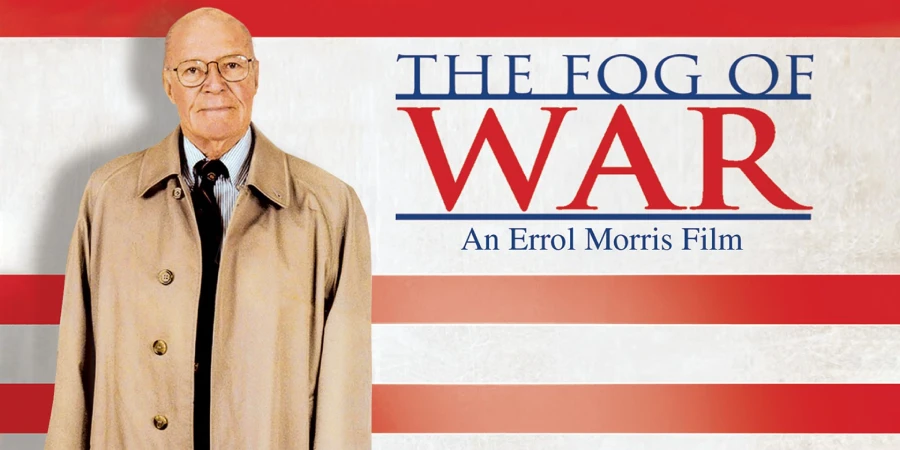

The Fog of War: Eleven Lessons from the Life of Robert S. McNamara is not a traditional documentary. Directed by Errol Morris, it is a haunting political memoir, a philosophical reflection on war, and a moral interrogation of American power in the 20th century. The film won widespread acclaim for transforming a long interview into one of the most gripping cinematic experiences ever made about modern warfare.
Detailed Summary
Who Is Robert S. McNamara?
The documentary centers on Robert S. McNamara, former U.S. Secretary of Defense under Presidents John F. Kennedy and Lyndon B. Johnson. Through extensive interviews, archival footage, audio recordings, and analytical editing, McNamara reflects on his role in major historical events including World War II, the Cuban Missile Crisis, and the Vietnam War.
Rather than following a strict chronological order, the film is structured around eleven “lessons” McNamara claims history has taught him.
Lesson 1–3: Rationality and Miscalculation
McNamara argues that rational leaders can still make catastrophic mistakes. He discusses how logic, data, and numbers were used to justify decisions that led to mass civilian deaths, especially during the firebombing of Japan in World War II.
He chillingly admits that had the Allies lost the war, these actions might have been considered war crimes.
Lesson 4–6: The Illusion of Control
The film dives into the Cuban Missile Crisis, revealing how close the world truly came to nuclear annihilation. Newly released recordings expose misunderstandings between the U.S. and the Soviet Union that nearly triggered global destruction.
One of the film’s strongest messages emerges here:
human survival sometimes depends not on intelligence, but on luck.
Lesson 7–9: Vietnam and Moral Blindness
The documentary becomes increasingly uncomfortable as McNamara reflects on Vietnam. He admits that U.S. leadership fundamentally misunderstood Vietnamese history, culture, and nationalism.
Despite massive data collection and strategic modeling, American policymakers failed to grasp the reality on the ground. Millions died as a result.
Morris never openly confronts McNamara, yet the editing subtly challenges his justifications, creating an ongoing moral tension between confession and avoidance.
Lesson 10–11: Unanswered Responsibility
In the final lessons, McNamara discusses accountability and ethics in war. He acknowledges mistakes but stops short of expressing full remorse. The film deliberately leaves the audience questioning whether reflection without accountability is enough.

Movie Ending
McNamara reflects on the idea that war defies human control. He emphasizes that even intelligent, well-intentioned people can create unimaginable destruction when operating inside systems driven by fear, ideology, and political pressure.
He openly states that the Vietnam War was a mistake and that the U.S. never truly understood its enemy. However, he avoids answering the question many viewers wait for: Should he have resigned? Should he have done more to stop it?
The final moments linger on his face as he speaks about morality in wartime, followed by haunting archival imagery and Philip Glass’s repetitive score. There is no emotional release, no clear redemption, and no definitive apology.
The film ends not with answers, but with a deeply unsettling realization:
history’s greatest disasters are often committed by intelligent people who believed they were doing the right thing.
Are There Post-Credits Scenes?
No. There are no post-credits scenes or additional material after the film ends. The closing silence is intentional and reinforces the documentary’s moral weight.
Type of Movie
The Fog of War is a documentary combining political history, biography, and philosophical inquiry, focusing on decision-making, ethics, and the psychology of power rather than traditional narration.
Cast
- Robert S. McNamara – Himself
- Archival appearances of:
- John F. Kennedy
- Lyndon B. Johnson
- Fidel Castro
- Curtis LeMay
The film contains no actors portraying roles; all appearances are real recordings or interviews.
Film Music and Composer
The score was composed by Philip Glass.
His minimalist music plays a crucial role in the film, creating tension, rhythm, and emotional unease. The repetitive structures mirror the cyclical nature of war and political failure.

Filming Locations
- United States (primarily Washington, D.C.)
- Interview segments filmed in controlled studio environments
The lack of physical locations is intentional. The focus is not geography, but memory, responsibility, and reflection. Archival footage supplies historical context rather than scenic realism.
Awards and Nominations
- Academy Award – Best Documentary Feature (Winner, 2004)
- BAFTA Nominee – Best Documentary
- Independent Spirit Award – Best Documentary
- National Board of Review – Best Documentary
The film is frequently listed among the greatest documentaries of all time.
Behind the Scenes Insights
- Errol Morris used his signature Interrotron, allowing McNamara to look directly into the camera while speaking.
- The interview sessions lasted over 20 hours, later shaped into the final narrative.
- Many audio recordings used in the film were declassified only shortly before production.
- Morris intentionally avoided narration to prevent moral guidance, forcing viewers to judge for themselves.
- McNamara reportedly struggled emotionally during certain interviews but insisted the footage remain unaltered.
Inspirations and References
- Real historical events from World War II through Vietnam
- U.S. Department of Defense archival recordings
- Political philosophy on ethics of war
- The concept of “fog of war” originally attributed to military theorist Carl von Clausewitz
Alternate Endings and Deleted Scenes
- No alternate ending exists.
- Several interview segments were removed, mainly involving World Bank discussions after McNamara’s Pentagon career.
- Morris stated that including these would dilute the film’s central moral focus on warfare.
Book Adaptations and Differences
The documentary is not directly adapted from a book, but it later inspired McNamara’s memoir:
The film differs significantly by:
- Offering less justification
- Emphasizing moral ambiguity
- Allowing silence and editing to challenge McNamara rather than defend him


Memorable Scenes and Quotes
Key Scenes
- The revelation of how close nuclear war came during the Cuban Missile Crisis
- McNamara admitting the firebombing of Tokyo killed more civilians than Hiroshima
- Playback of secret White House audio recordings
- The quiet moment where McNamara pauses, unable to fully answer a moral question
Iconic Quotes
- “Belief and seeing are both often wrong.”
- “Rationality will not save us.”
- “We were wrong, terribly wrong.”
- “Future generations will judge us.”
Easter Eggs and Hidden Details
- The number eleven repeatedly appears visually to reinforce the lesson structure.
- Editing rhythm mirrors Philip Glass’s musical tempo.
- Several pauses are intentionally left uncut to emphasize discomfort.
- The film never labels McNamara as hero or villain, an intentional moral vacuum.
Trivia
- The title refers to the uncertainty faced by decision-makers in war.
- The documentary influenced later political films like Inside Job.
- Used in military academies and ethics courses worldwide.
- Roger Ebert included it in his Great Movies list.
- The film was completed shortly before the Iraq War, giving it renewed relevance.
Why Watch?
Because it doesn’t tell you what to think.
The Fog of War challenges viewers to confront how intelligence, data, patriotism, and good intentions can still produce catastrophe. It is essential viewing for anyone interested in politics, history, leadership, or ethics.
This is not a film about the past. It is a warning about the future.
Director’s Other Works (Movies)
- Gates of Heaven (1978)
- The Thin Blue Line (1988)
- Fast, Cheap & Out of Control (1997)
- Standard Operating Procedure (2008)
- The Unknown Known (2013)
- American Dharma (2018)
Recommended Films for Fans
- Inside Job (2010)
- Hearts and Minds (1974)
- The Act of Killing (2012)
- The Last Party (1993)
- Restrepo (2010)
- Fahrenheit 9/11 (2004)
- Why We Fight (2005)
- Citizenfour (2014)