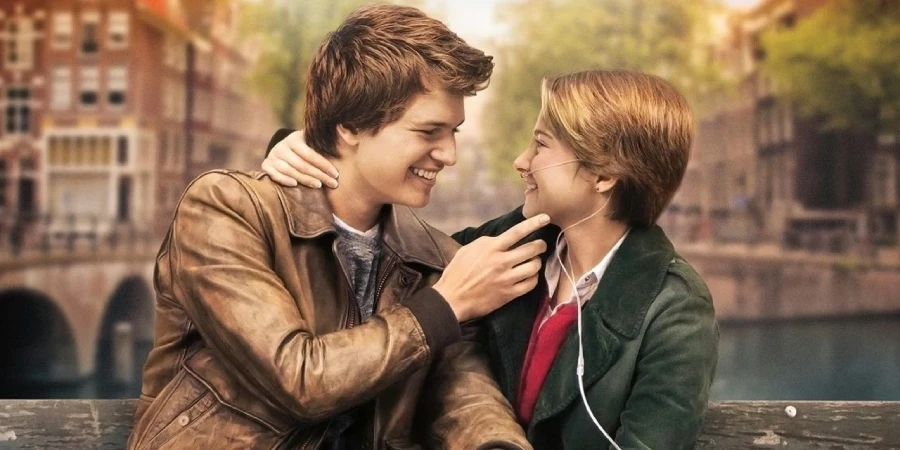

The Fault in Our Stars (2014), directed by Josh Boone, is one of the most emotionally impactful romantic dramas of the 2010s. Adapted from John Green’s bestselling novel, it explores love, illness, mortality, and meaning with sincerity and gentle humor.
Detailed Summary
Hazel’s World and the Weight She Carries
Hazel Grace Lancaster is a 16-year-old girl living with thyroid cancer that has spread to her lungs. Her world is small, shaped by oxygen tanks, doctor visits, and her parents’ constant fear of losing her. She reluctantly attends a support group, not because she wants to but because her mother insists “she needs to make friends.”
The Arrival of Augustus Waters
At support group, Hazel meets Augustus Waters, a charming, confident, former basketball player who lost a leg to osteosarcoma. Augustus instantly takes interest in Hazel, while Hazel tries to protect herself emotionally. Their chemistry is immediate yet tentative. They bond over books, particularly Hazel’s favorite novel, An Imperial Affliction, a story that ends abruptly mid-sentence.
The Search for Answers and the Journey to Amsterdam
Unsatisfied with the novel’s lack of closure, Hazel and Gus begin communicating with the book’s reclusive author, Peter Van Houten. When he finally invites them to Amsterdam, the opportunity feels like fate. Although Hazel’s health put the trip in doubt, doctors eventually allow her to travel on the condition of close supervision.
Amsterdam: Love, Disappointment, and Revelation
In Amsterdam, the two share a romantic dinner where Hazel realizes she is falling in love despite her fear of hurting others. Their meeting with Van Houten, however, is a disaster. Instead of offering answers, he insults Hazel and mocks her illness.
Despite the setback, the pair share a tender moment in the Anne Frank House, culminating in a kiss that symbolizes Hazel finally choosing life, love, and hope.
Gus’s Devastating News
After returning home, Gus reveals that his cancer has returned aggressively. The illness spreads quickly, and he deteriorates faster than Hazel expected. This becomes the emotional turning point of the film, shifting from young-love adventure to a poignant reflection on suffering and legacy.

Movie Ending
The final act is where the emotional impact reaches its peak.
As Gus’s condition worsens, Hazel stays by his side. In a heartbreaking scene, Gus asks Hazel and Isaac to read pre-written eulogies for him while he is still alive, wanting to hear how he will be remembered. Hazel’s speech is one of the most emotionally charged moments of the movie, emphasizing that love doesn’t need to be measured in time.
Gus dies shortly afterward.
Hazel is shattered but tries to continue living with the grace Gus always admired in her. Weeks later, Van Houten reappears with an apology and reveals that Gus had sent him a letter before he died. In it, Gus writes that he hopes Hazel will accept the love she deserves and recognize that their short time together meant something profound. This final message gives Hazel emotional closure.
The movie ends with Hazel lying on the grass, looking up at the sky, repeating Gus’s words: “Okay.” She smiles, not because the pain is gone, but because the love they shared continues to matter. The ending is bittersweet, reflective, and deeply faithful to the novel’s emotional tone.
Are There Post-Credits Scenes?
No, The Fault in Our Stars does not include any mid-credits or post-credits scenes. Once the ending fades out, the emotional conclusion of the film stands firmly on its own.
Type of Movie
The film is a romantic drama that balances youthful humor with heartbreaking realism. It focuses on emotional depth, character development, and intimate storytelling rather than spectacle.
Cast
- Shailene Woodley as Hazel Grace Lancaster
- Ansel Elgort as Augustus Waters
- Laura Dern as Frannie Lancaster
- Sam Trammell as Michael Lancaster
- Nat Wolff as Isaac
- Willem Dafoe as Peter Van Houten
Film Music and Composer
The score is composed by Mike Mogis and Nate Walcott, known for their emotionally rich and atmospheric soundscapes. The soundtrack features artists like Birdy, M83, and Ed Sheeran (“All of the Stars”), enhancing the film’s heartfelt tone.



Filming Locations and Their Importance
- Pittsburgh, Pennsylvania, USA – Served as the primary stand-in for Indianapolis, showcasing Hazel’s home life and support group scenes.
- Amsterdam, Netherlands – An essential part of the story. The canals, the Anne Frank House, and the city’s romantic atmosphere symbolize hope, escape, and emotional awakening. This location provides some of the film’s most memorable visuals and turning points.
Awards and Nominations
- Won: Teen Choice Awards (multiple categories)
- Won: MTV Movie Award for Best Kiss
- Nominated: People’s Choice Awards
- Won: Several critics’ awards for acting and adaptation
While not a major awards-season contender, the film was widely praised by audiences.
Behind the Scenes Insights
- Shailene Woodley cut her real hair for the role to mirror Hazel’s physical vulnerability.
- To authentically portray Augustus, Ansel Elgort met with young cancer survivors and amputees.
- The chemistry between Woodley and Elgort was immediate, likely helped by their previous collaboration in Divergent.
- The Amsterdam kiss scene drew a real crowd of cheering bystanders, and the production decided to keep their authentic reactions.
Inspirations and References
The movie is directly adapted from John Green’s 2012 novel, which itself was inspired by Green’s encounters with real teenagers who lived with cancer. Hazel’s character is partly inspired by Esther Earl, a friend of Green’s who passed away in 2010.
Alternate Endings and Deleted Scenes
While no major alternate ending was filmed, several deleted scenes exist, including extended conversations between Hazel and her parents, more footage of Augustus’s decline, and a slightly longer Amsterdam sequence. These scenes were cut for pacing but remain emotionally rich in bonus features.
Book Adaptations and Differences
- The film softens some darker, internal monologues from the book to maintain a more hopeful tone.
- Hazel’s philosophical reflections are reduced, focusing more on dialogue-driven emotion.
- Some minor characters and subplots were condensed or removed.
- Despite changes, the movie remains highly faithful in theme, structure, and iconic lines.


Memorable Scenes and Quotes
Key Scenes
- Hazel and Gus meeting in support group, with Isaac’s exaggerated crying in the background.
- The romantic dinner in Amsterdam.
- The Anne Frank House kiss.
- Gus’s living eulogy scene.
- Hazel reading Gus’s final letter.
Iconic Quotes
- “Okay?” — “Okay.”
- “You gave me a forever within the numbered days.”
- “Pain demands to be felt.”
- “Some infinities are bigger than other infinities.”
Easter Eggs and Hidden Details
- Hazel’s oxygen tube is subtly shaped to resemble a heart in some scenes.
- The book she reads in the airport subtly mirrors the plot’s themes about endings.
- The film includes a cameo of the real author, John Green, in a deleted scene.
- The number 17 appears repeatedly, referencing the characters’ ages and the theme of lost youth.
Trivia
- Woodley kept a small notebook on set documenting Hazel’s emotional states scene-by-scene.
- Ansel Elgort learned how to handle prosthetic limbs to portray Augustus realistically.
- The Anne Frank House allowed filming but only under strict historical preservation rules.
Why Watch?
Because it’s not just a love story; it’s a reflection on what it means to live fully, even with limited time. The film blends humor, heartbreak, philosophy, and tenderness in a way few romantic dramas manage. It’s emotionally resonant without being manipulative, and both leads deliver career-defining performances.
Director’s Other Movies
- Stuck in Love (2012)
- The New Mutants (2020)
- All Together Now (2020) – producer
Recommended Films for Fans
- Me Before You (2016)
- A Walk to Remember (2002)
- The Perks of Being a Wallflower (2012)
- Five Feet Apart (2019)
- Paper Towns (2015)