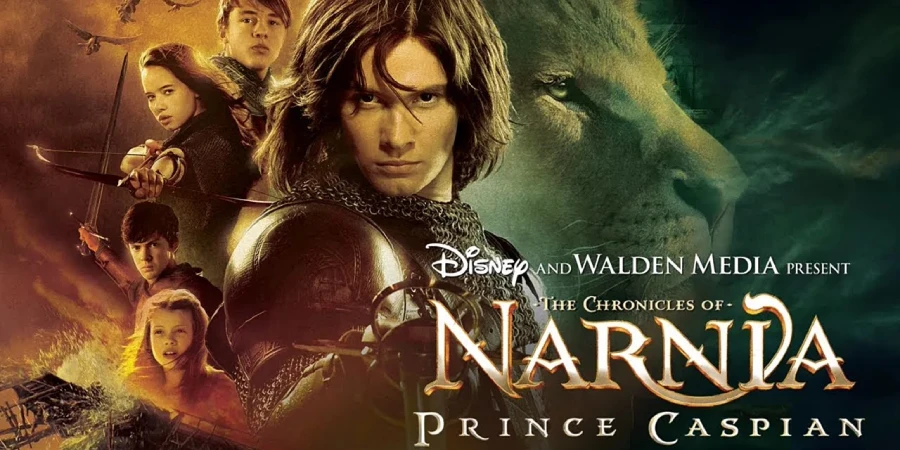
The Chronicles of Narnia: Prince Caspian (2008), directed by Andrew Adamson, continues C.S. Lewis’s legendary fantasy saga with a darker tone, higher stakes, and a more mature adventure for the Pevensie siblings.
Detailed Summary
The Return to Narnia
The Pevensies—Peter, Susan, Edmund, and Lucy—are living ordinary lives in WWII-era London when they are suddenly pulled back into Narnia. However, more than 1,300 years have passed in Narnian time, and the once-beautiful kingdom has fallen into ruin. Talking animals hide underground, and humans known as Telmarines rule with an iron fist.
Prince Caspian’s Flight
Prince Caspian, rightful heir to the Telmarine throne, escapes his uncle Miraz, who intends to kill him after the birth of Miraz’s own son. Horn in hand, Caspian summons aid from “Old Narnia” and unknowingly brings the Pevensies back into the world they once saved.
Reuniting Old and New Narnia
The Pevensies join forces with Caspian and the remaining Narnians. Political tensions arise as Peter tries to lead while Caspian struggles with self-doubt. Their alliance begins shakily—especially after a failed nighttime raid to capture Miraz, which results in heavy casualties and a growing sense of distrust.
The Battle for Narnia
As Aslan remains mysteriously absent, frustration builds. The Telmarines launch a massive assault, forcing the Narnians into a desperate final stand. With clever tactics (tree spirits, river gods, and a whole lot of “Narnian weirdness”), the old magic begins to shift the tide.
Movie Ending
The climax centers on a duel between Peter and Miraz, meant to avoid all-out war. Both leaders fight fiercely, and Peter eventually disarms Miraz. In true villain fashion, however, Miraz is treacherously stabbed in the back by his own commanders, who then frame the Narnians to ignite war.
A massive battle ensues at the river crossing. Just as the Telmarines gain the upper hand, Aslan finally appears, accompanied by Lucy. He summons the power of Narnia itself: trees come alive, the river god destroys the Telmarine army, and the battlefield transforms.
Prince Caspian is crowned King of Narnia, and rather than seeking revenge, he offers mercy and new beginnings. Aslan opens a portal back to Earth for the Telmarines who want a peaceful life—and it also becomes the gateway the Pevensies must use to return home.
At the emotional farewell:
- Aslan tells Susan and Peter they will not return to Narnia again because they have grown up and have moved beyond it.
- Edmund and Lucy may return someday.
- Susan shares a bittersweet goodbye kiss with Caspian.
- The Pevensies step through the portal and return to a London train station—mere moments after they had left—forever changed.
It’s a hopeful yet sorrowful ending, marked by maturity, sacrifice, and the theme of believing even when you cannot see.
Are There Post-Credits Scenes?
No, Prince Caspian does not include a post-credits scene. Once the credits begin rolling, the story has fully concluded.
Type of Movie
This film is a fantasy adventure drama with darker tones and more mature themes compared to The Lion, the Witch and the Wardrobe. It blends emotional character growth with large-scale battles and magical world-building.
Cast
- Ben Barnes as Prince Caspian
- Georgie Henley as Lucy Pevensie
- Skandar Keynes as Edmund Pevensie
- William Moseley as Peter Pevensie
- Anna Popplewell as Susan Pevensie
- Sergio Castellitto as King Miraz
- Peter Dinklage as Trumpkin
- Warwick Davis as Nikabrik
- Liam Neeson (voice) as Aslan
Film Music and Composer
The soundtrack was composed by Harry Gregson-Williams, who brought a deeper and more dramatic musical texture to match the film’s more mature story. Regina Spektor’s emotional song “The Call” plays during the ending and is widely considered one of the saga’s most memorable music moments.
Filming Locations
The film used several visually striking locations:
- New Zealand – lush forests and landscapes for outdoor Narnian scenes
- Slovenia – the Soča River region for the breathtaking final battle sequence
- Poland & Czech Republic – ancient castles and villages to give the film its medieval Telmarine aesthetic
These locations allowed the movie to feel more grounded and earthy, fitting the darker tone of the story.
Awards and Nominations
- Nominated for Best Fantasy Film (Saturn Awards)
- Won: Best Performance by a Younger Actor (Georgie Henley – Saturn Awards)
- Received numerous nominations for visual effects, sound, and costume design
Behind the Scenes Insights
- Ben Barnes had only a few weeks to master Caspian’s accent and swordplay.
- Many Telmarine sets were built full-scale, contributing to the film’s grounded tone.
- The Soča River battle was extremely difficult to shoot due to unpredictable weather.
- Andrew Adamson described the movie as “Narnia grows up”, reflecting the siblings’ emotional maturation.
- Warwick Davis, who played Reepicheep in the BBC version, returned decades later to play Nikabrik here.
Inspirations and References
- The film is based on C.S. Lewis’s novel “Prince Caspian” (1951).
- Narnia’s themes reflect Christian allegory, especially the idea of returning faith.
- The darker tone draws from medieval European history and themes of occupation and rebellion.
- The visual design was partly inspired by Mediterranean coastal kingdoms and classical Roman military aesthetics.
Alternate Endings and Deleted Scenes
- Additional character moments between the Pevensies were filmed but removed to tighten pacing.
- A longer goodbye scene between Susan and Caspian was scripted but cut.
- Several early drafts had a more extended Telmarine backstory.
No official alternate ending was produced.
Book Adaptations and Differences
The movie differs from the original book in several key ways:
- Much more action: The book is quieter and focuses more on nature and Aslan’s subtle presence.
- The Pevensies are more involved in the battles in the film.
- Susan and Caspian’s romantic subplot is not in the book at all.
- The Telmarines are depicted with a more distinctly Mediterranean cultural flavor.
The biggest change is that the film makes Peter’s and Caspian’s leadership tension more dramatic to raise emotional stakes.

Memorable Scenes and Quotes
Key Scenes
- The Pevensies’ return to a ruined, overgrown Cair Paravel.
- Caspian summoning the Narnians with Queen Susan’s horn.
- The failed castle raid, one of the darkest scenes in the franchise.
- Peter vs. Miraz duel—tense, emotional, and beautifully choreographed.
- Lucy walking into the forest to meet Aslan in a moment of pure faith.
- The river god wiping out the Telmarine army.
Iconic Quotes
- “I am Prince Caspian… and I call for your help.”
- “You have returned for a reason.” – Aslan
- “Things never happen the same way twice.” – Aslan
- “Perhaps we have grown up enough to know when to let go.” – Peter
Easter Eggs and Hidden Details
- Reepicheep’s design subtly nods to the original Pauline Baynes illustrations.
- The ruins of Cair Paravel contain objects from the first film if you look closely (throne carvings, weapons).
- The Telmarine symbols feature sea motifs—hinting at their origins as shipwrecked pirates (book lore).
- Peter’s fighting style mirrors his battle choreography from the first movie, showing consistency in his character’s growth.
Trivia
- Ben Barnes originally auditioned for a small role but was quickly recast as Caspian.
- The Telmarine accents were designed to sound like a blend of Spanish and Italian.
- Over 200 horses were used in production.
- Georgie Henley (Lucy) kept several props from the set, including her dagger.
Why Watch?
Because Prince Caspian offers a richer, more complex, and more emotional journey than the first film. The stakes are higher, the world is darker, and the characters face real moral dilemmas. It balances action, beauty, and heartfelt storytelling with an atmosphere of mythic grandeur.
Director’s Other Movies
- Shrek (2001)
- Shrek 2 (2004)
- The Chronicles of Narnia: The Lion, the Witch and the Wardrobe (2005)
- Cirque du Freak: The Vampire’s Assistant (2009)