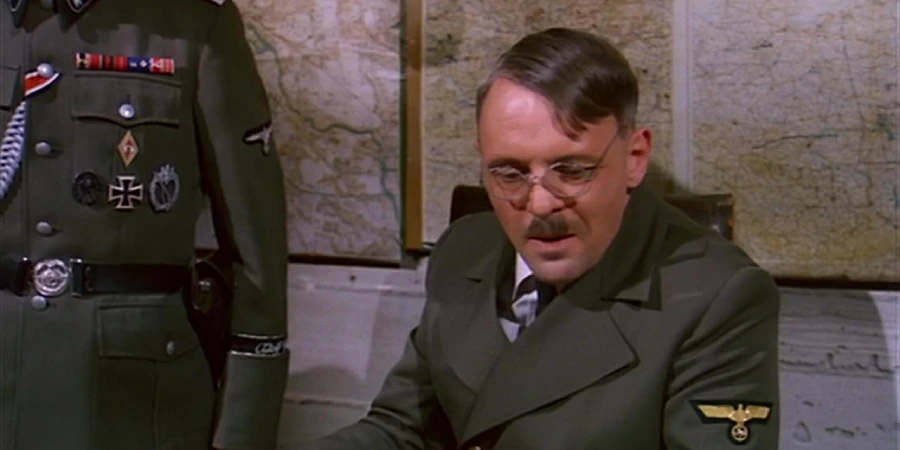

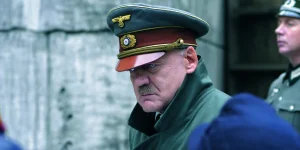
The Bunker (1981) is a dark, intense World War II drama that focuses on the final days of Adolf Hitler inside the Führerbunker in Berlin. Rather than portraying large-scale battles, the film locks the audience into a claustrophobic psychological collapse, showing how ideology, fear, and denial destroy those trapped underground as the Third Reich comes to an end.
Detailed Summary
Life Inside the Führerbunker
The film opens in April 1945, as Allied forces close in on Berlin. Hitler and his inner circle have retreated to the underground bunker beneath the Reich Chancellery. From the very beginning, the atmosphere is tense and suffocating. Food is limited, communication lines are failing, and artillery explosions shake the bunker walls daily.
Despite the obvious military defeat, Hitler refuses to accept reality. He continues issuing imaginary troop movements and orders to divisions that no longer exist. His generals and aides, fearful for their lives, play along while quietly realizing the war is lost.
The bunker becomes a symbolic prison, cut off from truth and sanity.
Hitler’s Mental and Physical Decline
As the days pass, Hitler’s health deteriorates rapidly. He suffers from tremors, paranoia, violent mood swings, and deep delusions. He lashes out at generals, accusing them of betrayal and cowardice.
One of the film’s strongest elements is how it portrays the gradual breakdown of leadership. Hitler is no longer a commanding dictator but a fragile, unstable man clinging to fantasies of miraculous counterattacks.
Several officers begin to consider escape, while others remain loyal out of fear or blind belief.
The Inner Circle Fractures
Inside the bunker, relationships unravel:
Eva Braun remains emotionally devoted to Hitler, insisting on staying by his side even as defeat becomes inevitable.
Joseph Goebbels and his wife Magda remain fiercely loyal, believing death is preferable to surrender.
Military officers quietly plan evacuation routes or negotiate their own survival.
The film carefully shows how morality collapses under pressure. Loyalty becomes self-preservation, and ideology replaces humanity.
As Soviet troops advance closer, the bunker grows increasingly crowded, darker, and more chaotic.
The Final Days
By the final act, Berlin is in ruins. Communication with the outside world is nearly impossible. Hitler finally acknowledges that Germany has lost the war, but he refuses to flee.
He announces his intention to die in the bunker rather than be captured.
This decision sends shockwaves through the remaining staff. Some attempt to escape. Others prepare for suicide. The bunker transforms from a military headquarters into a waiting room for death.
Movie Ending
Hitler marries Eva Braun in a brief, emotionless ceremony. The celebration feels hollow, surrounded by explosions and collapsing morale. Shortly afterward, Hitler dictates his final political testament, blaming Germany’s defeat on betrayal rather than his own decisions.
He then retreats to his private room with Eva Braun.
Both commit suicide: Eva by poison, Hitler by gunshot. Their bodies are carried outside by aides and burned in accordance with Hitler’s final orders, though Soviet shelling disrupts the process.
Inside the bunker, despair deepens.
Joseph and Magda Goebbels poison their six children while they sleep. This is one of the film’s most disturbing moments, presented quietly without sensationalism. Afterward, the Goebbels commit suicide themselves.
As Soviet forces enter Berlin, remaining personnel either flee through underground tunnels or surrender. The bunker is abandoned, filled with empty rooms, corpses, and paperwork of a regime that collapsed under its own delusions.
The final scenes emphasize the utter futility of fanaticism and the cost of blind obedience. No redemption is offered. The war ends not with glory, but silence.
Are There Post-Credits Scenes?
No. The Bunker (1981) has no post-credits scenes. The film ends definitively, reinforcing the historical finality of the Third Reich’s collapse.
Type of Movie
The Bunker is a historical war drama with strong psychological and biographical elements. It focuses less on combat and more on mental deterioration, power collapse, and moral decay during wartime.
Cast
- Anthony Hopkins as Adolf Hitler
- Richard Jordan as Colonel Vogel
- Cliff Gorman as Joseph Goebbels
- Piper Laurie as Magda Goebbels
- Eva Braun portrayed by Betsy Jones-Moreland
- Michael Lonsdale as Martin Bormann
Anthony Hopkins’ performance is often highlighted as one of the most chilling portrayals of Hitler due to its restraint and realism.
Film Music and Composer
The score was composed by Stanley Myers, whose minimalistic and somber music reinforces the sense of isolation. The soundtrack avoids heroism entirely, using low, oppressive tones that mirror the bunker’s psychological pressure.

Filming Locations
The film was primarily shot in:
- London, England
- Studio-built bunker sets
The bunker interiors were carefully reconstructed based on historical blueprints. The confined sets were essential to the film’s tone, creating a persistent sense of entrapment and decay. The lack of outdoor scenes strengthens the feeling that the characters are buried alive beneath history.
Awards and Nominations
- Emmy Award nomination for Outstanding Lead Actor (Anthony Hopkins)
- Multiple television film awards nominations in the early 1980s
Although not widely awarded, the film has gained long-term recognition for its performances and historical seriousness.
Behind the Scenes Insights
- Anthony Hopkins reportedly studied recorded speeches and newsreels extensively to avoid caricature.
- The production deliberately avoided dramatic lighting to maintain realism.
- Many scenes were shot in long takes to intensify emotional discomfort.
- The cast was encouraged to remain in character between takes.
- The bunker set was intentionally designed to feel smaller over time, reinforcing psychological claustrophobia.
Inspirations and References
- Based on historical records and eyewitness accounts from bunker survivors.
- Influenced by the book The Last Days of Hitler by Hugh Trevor-Roper.
- Shares thematic DNA with later films such as Downfall (2004).
Alternate Endings and Deleted Scenes
There are no known alternate endings. Some dialogue-heavy scenes involving military briefings were removed to reduce runtime, but the ending has remained unchanged since original broadcast.
Book Adaptations and Differences
The film is not a direct adaptation of a single book but draws heavily from multiple historical sources. Unlike many written accounts, the movie compresses timelines and merges minor figures for narrative clarity while maintaining historical accuracy.


Memorable Scenes and Quotes
Key Scenes
- Hitler screaming at generals over nonexistent armies
- The silent wedding ceremony under bombardment
- The poisoning of the Goebbels children
- Hitler’s final walk through the bunker corridors
- The empty bunker after Soviet arrival
Iconic Quotes
- “The war is lost… but I will not leave Berlin.”
- “If the German people have failed, they deserve to perish.”
- “Loyalty is everything, even now.”
Easter Eggs and Hidden Details
- Authentic Nazi documents are reproduced exactly in background props.
- Wall maps reflect historically accurate troop positions for April 1945.
- Hitler’s physical tremor worsens subtly in each scene.
- The bunker clock stops shortly before Hitler’s death.
- Some dialogue lines are taken directly from transcripts of bunker testimony.
Trivia
- Anthony Hopkins won an Emmy for this role before becoming globally famous.
- The film was originally produced for television.
- Several actors later appeared in major WWII films.
- The script was reviewed by military historians.
- Many German-language phrases are historically accurate, not invented.
Why Watch?
You should watch The Bunker (1981) if you are interested in:
- Psychological portrayals of power collapse
- Historically grounded war dramas
- One of the earliest serious depictions of Hitler on screen
- Films that explore how ideology dies when reality arrives
It is not entertaining in a traditional sense, but it is powerful, unsettling, and intellectually honest.
Director’s Other Works (Movies)
- George Schaefer
- The Crucible (1967)
- The Defector (1966)
- Papillon (1973) – TV version involvement
- Renaissance (1964)