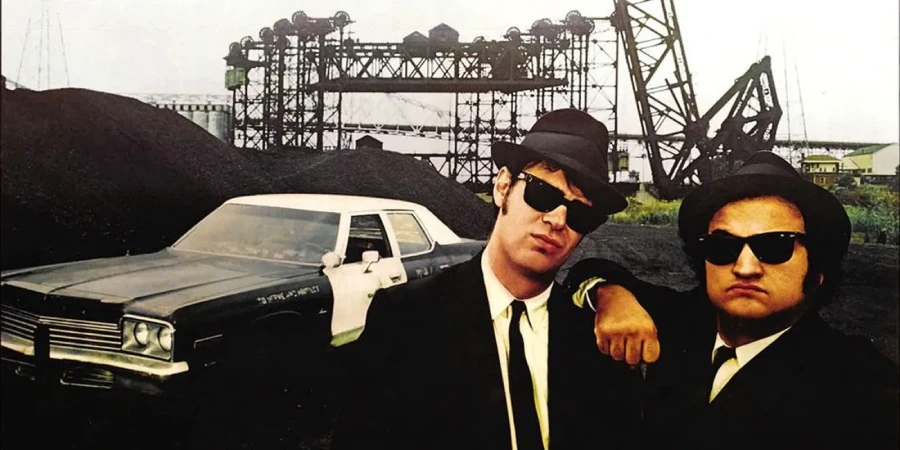

The Blues Brothers is one of those films that exists in its own cinematic universe: part musical, part comedy, part chaotic car-chase extravaganza. Directed by John Landis and built around the iconic SNL characters created by Dan Aykroyd and John Belushi, the movie is both a love letter to rhythm & blues and a slapstick masterpiece.
Detailed Summary
The Call from God: Jake’s Release from Prison
Jake Blues (John Belushi) is released from Joliet Prison and immediately reunited with his brother Elwood (Dan Aykroyd). The visit to their childhood orphanage reveals that it’s under threat of closure unless they can pay $5,000 in property taxes. And of course, they can’t do this the normal way. They must do it the Blues way.
“We’re Putting the Band Back Together”
Jake receives a divine revelation—literally, in a beam of gospel light—that they must reunite the Blues Brothers Band to earn the money. What follows is a tour of Chicago and surrounding areas, tracking down each former band member. Each reunion scene is a mini-comedy and musical highlight in its own right.
The Growing List of Enemies
As the brothers recruit the band, they unintentionally accumulate an impressive roster of enemies:
- A country-western band (The Good Ol’ Boys)
- Illinois Nazis
- A vengeful mystery woman (Carrie Fisher) armed with heavy weaponry
- The Chicago police
- The military
- Pretty much anyone who owns a car
The Palace Hotel Ballroom Performance
To raise the money, they stage a massive gig. The band performs for a packed crowd, delivering legendary musical numbers. Meanwhile, every enemy force in the Midwest closes in on them.
The Race to Chicago
After their show, the band escapes and begins what might be the most destructive car chase in cinema history. Police cruisers flip, pile up, and explode with such absurdity that the sequence became a hallmark of the film’s comedy style.
Movie Ending
The final stretch is a full spectacle of escalating insanity. Jake and Elwood flee the ballroom, speeding toward the Cook County Assessor’s Office in downtown Chicago with the $5,000 in hand. The chase becomes increasingly absurd as:
- Dozens of police cars crash in cartoonish fashion.
- The Illinois Nazis are forced off a bridge in a swooping, physics-defying fall.
- SWAT teams rappel from buildings and fire at them.
- The U.S. Army literally mobilizes.
When Jake and Elwood finally make it inside the building, they race up the stairs while police and soldiers break down every door and window behind them. The brothers hand over the envelope of money just in time.
The moment the clerk stamps the receipt, they’re immediately arrested by the overwhelming forces converging on them.
The film ends with the band in prison—performing “Jailhouse Rock”—suggesting that even incarceration can’t stop the Blues Brothers from putting on a show. It’s chaotic, ridiculous, and perfectly in tune with the film’s tone.
Are There Post-Credits Scenes?
No. The Blues Brothers has no post-credits scenes. Like many comedies of its era, it ends firmly before the credits roll.
Type of Movie
The film is a musical-comedy with action elements, blending deadpan humor, rhythm & blues performances, and over-the-top chase scenes. It straddles genres while remaining uniquely itself.
Cast
- John Belushi as Jake Blues
- Dan Aykroyd as Elwood Blues
- Carrie Fisher as the Mystery Woman
- James Brown as Reverend Cleophus James
- Aretha Franklin as Mrs. Murphy
- Ray Charles as Ray
- Cab Calloway as Curtis
- John Candy as Burton Mercer
Film Music and Composer
The film’s soundtrack is its beating heart. It features legendary artists performing their own songs, including:
- Aretha Franklin – Think
- James Brown – The Old Landmark
- Ray Charles – Shake a Tail Feather
- Cab Calloway – Minnie the Moocher
The score and musical arrangements were overseen by Ira Newborn, though the feature is best known for its rich lineup of R&B icons.
Filming Locations and Their Importance
The film was shot across Chicago, Illinois, and its suburbs, including:
- The Daley Center – final chase and tax office scene
- Maxwell Street Market – classic Chicago urban environment
- Joliet Prison – Jake’s release
- Wrigley Field – used humorously as a police stakeout
These locations give the movie an authentic Chicago flavor. The city is not merely a backdrop; it’s an essential character, capturing the grit and charm of late-1970s Chicago.
Awards and Nominations
While the film wasn’t a major awards contender, it has since earned cult classic status and is frequently cited in lists of top musicals and comedies.
Notable recognition includes:
- Ranked in AFI’s “100 Years…100 Laughs” list
- Praised widely for its soundtrack, which remains highly influential
Behind the Scenes Insights
- John Belushi was so beloved in Chicago that locals would bring him free food and drinks on set.
- The film destroyed over 100 cars, setting a record at the time.
- Dan Aykroyd’s first draft of the script was famously enormous—over 300 pages. John Landis had to trim it drastically.
- Carrie Fisher’s character was inspired partly by Aykroyd’s real-life relationship with her.
- Cab Calloway insisted on performing “Minnie the Moocher” in his original 1930s style, despite production’s push for a funkier version.
Inspirations and References
The film is directly inspired by:
- The Saturday Night Live sketch characters created by Aykroyd and Belushi
- Classic blues and R&B culture
- 1970s car-chase cinema
It draws heavily from musical traditions and slapstick comedy, combining them into a then-unprecedented hybrid.
Alternate Endings and Deleted Scenes
Several deleted scenes exist, including:
- Extended performances by the band
- Additional comedic bits from the country-western subplot
- Longer scenes involving Carrie Fisher’s character stalking Jake and Elwood
No significant alternate ending has been publicly released, but early scripts did toy with different outcomes for the brothers.
Book Adaptations and Differences
The film wasn’t based on a novel, but it did inspire novelizations, comic adaptations, and sequels. These works tend to expand on background details of Jake and Elwood or the history of the orphanage.
Memorable Scenes and Quotes
Key Scenes
- Jake’s transcendent “light of God” moment in the church
- Aretha Franklin delivering a fully choreographed “Think”
- The massive mall chase, where police cars rampage through stores
- The surreal Nazi confrontation on the bridge
- The climactic race to the tax office
Iconic Quotes
- “We’re on a mission from God.”
- “It’s 106 miles to Chicago, we’ve got a full tank of gas, half a pack of cigarettes; it’s dark, and we’re wearing sunglasses.” — “Hit it.”
- “Four fried chickens and a Coke.”
Easter Eggs and Hidden Details
- The license plate “BLUES” is a different color in different scenes due to continuity mix-ups.
- The mall chase was filmed in a real abandoned mall, which production decorated with real stores.
- The Illinois Nazis were based on a real group that paraded in Chicago in the late 1970s.
- Nearly every police officer in the movie has a last name referencing a Chicago suburb.
Trivia
- John Belushi performed many of his own stunts.
- The Bluesmobile was a 1974 Dodge Monaco, now a legendary movie car.
- This was one of the first films to feature a mostly African-American soundtrack promoted to mainstream white audiences.
- Dan Aykroyd, a real-life blues enthusiast, co-founded the House of Blues decades later.
Why Watch?
Because it’s a rare blend of music, comedy, and pure cinematic chaos. You get legendary live performances, some of the funniest deadpan humor ever put to screen, and car chases so ridiculous that modern films still struggle to top them. It’s a film that doesn’t just entertain—it celebrates music, culture, and absurdity.
Director’s Other Movies
- Animal House (1978)
- An American Werewolf in London (1981)
- Trading Places (1983)
- Coming to America (1988)
- Three Amigos! (1986)