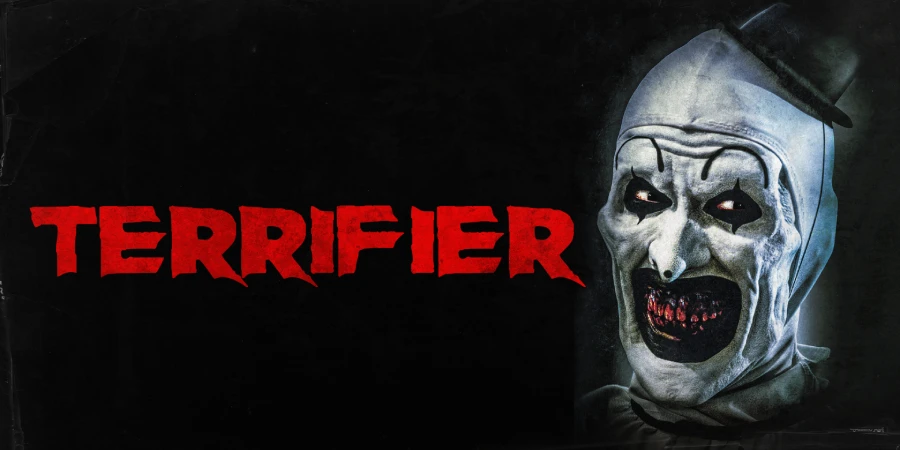

Terrifier (2016), directed by Damien Leone, is a brutal, low-budget slasher that helped cement Art the Clown as one of modern horror’s most disturbing villains.
Detailed Summary
Opening: A Survivor Speaks
The film begins with a television interview featuring a severely disfigured woman who claims to have survived an attack by Art the Clown. Her appearance is shocking, setting the tone for the extreme violence the movie is about to unleash. After the interview, Art brutally murders the host in one of the film’s early grotesque moments, immediately signaling that he survives whatever happened before and is still slaughtering.
Halloween Night: Tara and Dawn
Two friends, Tara and Dawn, are walking home drunk after partying. They encounter Art the Clown, who silently stalks them with the gleeful patience of someone who wants the night to last forever. The girls dismiss him as a creepy stranger until the situation escalates when they must hide in a rundown, mostly abandoned apartment building.
The Cat-and-Mouse Terror Begins
Inside the building, Art begins hunting the group one by one. Dawn is gruesomely murdered in one of the film’s most notorious scenes. Tara becomes Art’s next target, leading to a prolonged sequence of narrow escapes, dark hallways, and Art’s unpredictable bursts of violence.
Victoria Arrives
Tara’s sister Victoria arrives to pick her up, unaware of the horrors inside the building. What follows is a relentless chase in which Art uses knives, saws, chains, and psychological cruelty. The film’s structure stays loyal to classic slashers, but Art’s over-the-top brutality creates its own signature style.
Movie Ending
After Victoria is brutally attacked and left for dead, Art continues his assault by bringing her deeper into the complex. When police finally arrive on the scene, Art corners Victoria. In a horrifying twist, Art takes a gun and shoots himself in the head, seemingly ending his reign of terror.
His body is brought to the morgue. As the coroner examines Art’s corpse, the lights flicker and electronics malfunction. Suddenly, Art comes back to life, strangling the coroner and escaping the morgue.
The final reveal: the disfigured woman from the beginning of the movie is Victoria, the sole survivor of Art’s attack. The opening interview was actually taking place one year after the events of the film. This circular timeline clarifies the movie’s structure and emphasizes Art’s supernatural nature.
This ending sets up the continuity that would continue into Terrifier 2, confirming that Art is no ordinary killer—he may not even be human at all.
Are There Post-Credits Scenes?
No. Terrifier (2016) does not include a post-credits scene.
Type of Movie
Terrifier is a gritty, extreme slasher horror film with a strong emphasis on practical gore effects and an intentionally retro, grindhouse aesthetic.
Cast
- David Howard Thornton – Art the Clown
- Jenna Kanell – Tara
- Samantha Scaffidi – Victoria
- Catherine Corcoran – Dawn
- Matt McAllister – Mike the Exterminator
Film Music and Composer
The score was composed by Paul Wiley, who delivers an industrial, unsettling soundtrack that mirrors the film’s grimy tone. The music emphasizes tension rather than melody, enhancing Art’s unpredictable presence.
Filming Locations
- New York City, USA
Most of the movie was filmed in abandoned buildings and industrial areas in NYC. These real, deteriorating environments contribute to the film’s claustrophobic and dirty visual style. The apartment complex setting feels authentic because it is—a location with real crumbling walls, dim basements, and eerie hallways.
Using actual run-down locations helped keep the film’s low-budget production grounded and raw, giving scenes a sense of realism despite the supernatural elements.
Awards and Nominations
Though not a mainstream awards contender, Terrifier received recognition in horror circles, including festival screenings and cult-horror award nominations. It has since become one of the most discussed underground slashers of the 2010s.
Behind the Scenes Insights
- The character of Art first appeared in director Damien Leone’s short films and the anthology All Hallows’ Eve.
- Art was originally played by Mike Giannelli, but David Howard Thornton took over for Terrifier, offering a more exaggerated, mime-like performance.
- Leone handled much of the film’s practical gore effects himself, using old-school techniques reminiscent of early 80s slashers.
- The infamous hacksaw scene was shot over several long nights in freezing temperatures.
- Because of the limited budget, many props and sets were built by the crew themselves.
Inspirations and References
- Based on Damien Leone’s earlier works featuring Art the Clown.
- Influenced by 80s slashers such as Maniac (1980), The Prowler (1981), and Halloween (1978).
- The aesthetic pays homage to grindhouse cinema, with grainy textures and intentionally raw production quality.
- Art the Clown’s silent, expressive style draws inspiration from classic mime performers, twisted through a horror lens.
Alternate Endings and Deleted Scenes
There are no major alternate endings released, but Leone has discussed that early scripts were far more graphic in certain scenes. Some sequences were trimmed because they slowed pacing, not because they were too violent. The morgue resurrection was always planned, as it was crucial for establishing Art’s supernatural identity.
Book Adaptations and Differences
The film is not based on a book. Its origin lies in Damien Leone’s earlier short films and anthology projects. However, the movie expands Art’s mythology beyond previous appearances, giving him a more central and terrifying role.
Memorable Scenes and Quotes
Key Scenes
- Art staring silently at Tara and Dawn in the pizzeria, smiling in the most unsettling way imaginable.
- The hacksaw scene, arguably one of the most infamous kills in modern horror.
- Tara’s chase through the hallways, featuring some of the film’s strongest tension.
- The morgue resurrection, confirming Art’s supernatural nature.
Iconic Quotes
Since Art never speaks, the “quotes” come from his actions:
- Art smiling widely while holding a trash bag full of weapons.
- Art applying makeup in the mirror, as if preparing for a performance.
- Art waving joyfully at his victims right before attacking.
These silent moments become the character’s most chilling “lines.”
Easter Eggs and Hidden Details
- Art’s trash bag of weapons is a recurring prop across all his appearances.
- Several newspapers and background props reference events from All Hallows’ Eve.
- The film intentionally uses practical blood to mimic 80s horror textures.
- Art’s black-and-white design contrasts sharply with the film’s otherwise dirty color palette, making him pop visually in every frame.
Trivia
- The film’s budget was extremely low, estimated under $100,000.
- David Howard Thornton improvised many of Art’s gestures, adding to his cartoonish menace.
- Art’s grin became iconic because Thornton can naturally make exaggerated facial expressions without prosthetics.
- The director originally planned Terrifier as a stepping stone for a larger Art the Clown franchise.
Why Watch?
Watch Terrifier if you enjoy raw, unfiltered slasher horror with elaborate practical gore. It’s a film that embraces the brutality of classic slashers while introducing a modern horror icon. If you’re curious about the origins of one of the most talked-about killers of the 2010s and 2020s, this is essential viewing.
Director’s Other Works
- All Hallows’ Eve (2013)
- Terrifier 2 (2022)
- Terrifier 3 (2024)
- The 9th Circle (2008) – short
Recommended Films for Fans
- Maniac (2012)
- All Hallows’ Eve (2013)
- The Prowler (1981)
- Hatchet (2006)
- High Tension (2003)
- Inside (2007)