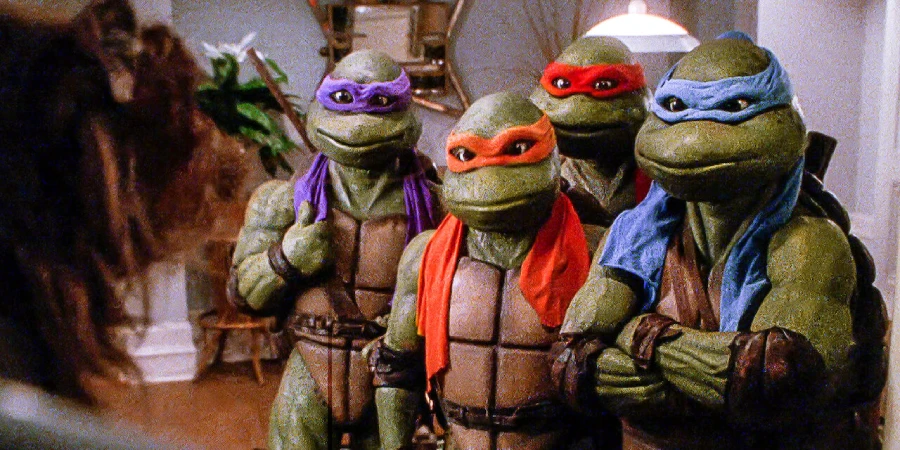
Released in 1991, Teenage Mutant Ninja Turtles II: The Secret of the Ooze is the goofier, brighter, and more kid-friendly sequel to the 1990 live-action hit. Directed by Michael Pressman, the film leans more heavily into comedy while expanding the mythology of the mysterious mutagenic substance that created our favorite pizza-loving heroes.
Detailed Summary
Opening: A Lighter, Goofier Tone
The sequel wastes no time establishing a tonal shift from the darker 1990 film. The Turtles — Leonardo, Michelangelo, Donatello, and Raphael — are now firmly pop-culture icons in-universe. April O’Neil (now played by Paige Turco) has moved to a new apartment after being fired for exposing the Foot Clan.
Meanwhile, the remnants of the Foot Clan are quietly regrouping.
The Return of Shredder
In one of the film’s early reveals, we learn that Shredder survived the garbage truck compactor from the first movie. Portrayed again by François Chau (with body performance by Kevin Nash), Shredder seeks revenge and a new path to power.
This is where the titular “Ooze” comes back into play.
The Secret of the Ooze
Through investigative reporting (and some good old-fashioned snooping), April and the Turtles discover that the mutagen responsible for their transformation was created by TGRI (Techno Global Research Industries). The ooze accidentally contaminated baby turtles and a rat — Splinter — years ago.
But here’s the twist: Shredder gets his hands on the remaining canister.
The Birth of Tokka and Rahzar
Instead of recreating intelligent warriors, Shredder mutates a snapping turtle and a wolf into Tokka and Rahzar, two enormous but dim-witted monsters. These creatures are visually intimidating but mentally childlike — a deliberate tonal shift that makes them less terrifying and more comedic.
Their rampage becomes the film’s central threat.
Keno Enters the Picture
A new character, Keno (played by Ernie Reyes Jr.), a pizza delivery guy with serious martial arts skills, becomes entangled in the Turtles’ battle against the Foot Clan. He even infiltrates Shredder’s headquarters to assist.
The Anti-Mutagen Plan
Donatello devises a plan to create a counter-mutagen to reverse Tokka and Rahzar’s transformation. This sets up the final confrontation at a nightclub concert featuring rap group Vanilla Ice — yes, really.
And yes, this is where “Ninja Rap” happens.
Movie Ending
The final act unfolds at a crowded dockside nightclub. Tokka and Rahzar storm the venue, causing chaos. The Turtles engage them in battle, trying to administer the anti-mutagen without harming innocent civilians.
After a wild fight sequence — including Vanilla Ice spontaneously creating a ninja-themed rap mid-crisis — Donatello successfully feeds the creatures the anti-mutagen. Tokka and Rahzar revert back into their original animal forms: a harmless snapping turtle and wolf.
But the conflict isn’t over.
Shredder, furious and desperate, drinks the remaining ooze himself. He transforms into a larger, more monstrous version of himself — often referred to by fans as “Super Shredder.” The transformation increases his strength but destabilizes the dock’s support beams.
In his rage, Super Shredder begins smashing the pier, ignoring the Turtles and focusing on brute destruction. The structural damage causes the dock to collapse. Massive beams and debris fall on him.
Despite the Turtles’ warning that he’s about to bring the whole structure down on himself, Shredder continues. The collapsing dock crushes him beneath tons of wreckage.
The Turtles escape the destruction, regroup, and return home victorious. The city is safe. The ooze threat appears neutralized. And the film ends with Splinter joining them in a celebratory dance — a much lighter closing moment compared to the darker tone of the first film.
It’s a definitive ending: Shredder is buried under a collapsed pier, Tokka and Rahzar are restored, and the Foot Clan is effectively dismantled.
Are There Post-Credits Scenes?
No. Teenage Mutant Ninja Turtles II: The Secret of the Ooze (1991) does not feature a post-credits or mid-credits scene. Once the credits roll, that’s it — very early-90s style.
Type of Movie
This is a family-friendly action-comedy with superhero and martial arts elements, leaning more heavily into slapstick and cartoon energy than its darker predecessor.
Cast
- Paige Turco as April O’Neil
- François Chau as Shredder
- Ernie Reyes Jr. as Keno
- Kevin Clash as Voice of Splinter
- David Warner as Professor Jordan Perry
Film Music and Composer
The score was composed by John Du Prez, who returned from the first film. The soundtrack reflects the lighter tone, incorporating hip-hop influences. The most famous musical contribution is undoubtedly “Ninja Rap” by Vanilla Ice, which became a pop-culture staple — for better or worse.
Filming Locations and Their Importance
The film was primarily shot in Wilmington, North Carolina at EUE/Screen Gems Studios. The city provided tax incentives and studio space that allowed for large practical sets, including sewer lairs and industrial docks.
The dock setting in the finale was crucial for staging large-scale practical destruction. Unlike many modern superhero films, the climactic collapse was achieved largely through physical set construction and practical effects, adding weight to the destruction.
Awards and Nominations
While not a major awards contender, the film received recognition in children’s entertainment categories and earned nominations at the Kids’ Choice Awards. It was more of a commercial success than a critical darling.
Behind the Scenes Insights
- The sequel was intentionally made more kid-friendly after parents complained that the 1990 film was too dark.
- The Turtles barely use their signature weapons onscreen to avoid promoting violence.
- Tokka and Rahzar replaced Bebop and Rocksteady because of rights and creative decisions.
- The animatronic suits were physically exhausting; actors inside them could barely see and endured extreme heat.
- Ernie Reyes Jr.’s martial arts background allowed for more dynamic human fight choreography.
Inspirations and References
The film is based on the Teenage Mutant Ninja Turtles comic by Kevin Eastman and Peter Laird, but tonally aligns more with the animated 1987 TV series than the darker original comics.
The mutagen concept continues the sci-fi origin introduced in the first film, though simplified for younger audiences.
Alternate Endings and Deleted Scenes
There are no widely released alternate endings. However, deleted scenes include extended Foot Clan training sequences and additional Keno material. Early drafts reportedly featured a darker Super Shredder battle, but this was shortened to keep the tone lighter.
Book Adaptations and Differences
The film is not directly adapted from a single comic storyline. While the “ooze” concept comes from earlier TMNT lore, the creation of Tokka and Rahzar was original to the film. The comics portray Shredder with far more menace and brutality compared to this more exaggerated cinematic version.

Memorable Scenes and Quotes
Key Scenes
- The reveal that Shredder survived the compactor.
- Tokka and Rahzar’s chaotic introduction.
- The nightclub fight with “Ninja Rap.”
- Super Shredder smashing the dock in blind rage.
Iconic Quotes
- “Go ninja, go ninja, go!”
- “The perimeter’s quiet.”
- Splinter’s calm philosophical guidance to the Turtles.
Easter Eggs and Hidden Details
- The canister design mirrors the first film’s prop exactly.
- Professor Perry subtly mirrors mad-scientist archetypes from classic 80s cartoons.
- Shredder’s helmet design is slightly modified from the first movie.
- The Foot Clan hideout includes visual nods to the animated series aesthetic.
Trivia
- The film grossed over $78 million worldwide.
- The suits weighed around 60 pounds each.
- The Turtles’ reduced weapon usage was a direct response to parental concerns.
- Vanilla Ice improvised parts of “Ninja Rap” on set.
Why Watch?
If you grew up in the early ’90s, this movie is pure nostalgic fuel. It’s brighter, sillier, and more accessible than its predecessor. While critics often prefer the darker 1990 film, this sequel fully embraces the Saturday morning cartoon energy — and sometimes that’s exactly what you want.
Director’s Other Works
- Doctor Detroit (1983)
- Boulevard (1994)
- Frank McKlusky, C.I. (2002)