
Released the same year as its legendary predecessor, Son of Kong (1933) is the direct sequel to King Kong. Produced quickly to capitalize on the massive success of the original, the film reunites audiences with filmmaker Carl Denham and takes us back to the mysterious Skull Island. Shorter, lighter in tone, and surprisingly emotional, it offers a very different flavor from its darker, tragic predecessor.
Detailed Summary
Aftermath of King Kong’s Fall
The film opens shortly after the events in New York. Carl Denham (Robert Armstrong) is facing lawsuits and public outrage over the destruction caused by Kong. Financially ruined and socially disgraced, Denham flees New York by ship to avoid creditors and legal consequences. Right away, the tone feels different: less operatic tragedy, more pulpy adventure.
On board, he reconnects with Captain Englehorn, who agrees to help him escape. Their journey leads them back into the Pacific, where they encounter a mysterious woman named Hilda Petersen.
Meeting Hilda and the Return to Skull Island
Hilda (Helen Mack) claims to have been stranded after her father’s treasure-hunting expedition went wrong. Denham, ever the opportunist, sees Skull Island not only as a place of past trauma but as a potential source of treasure rumored to lie hidden there.
They return to Skull Island, now eerily quieter and less populated than before. The atmosphere is still dangerous, but noticeably scaled down compared to the epic grandeur of the first film.
Encounter with “Little Kong”
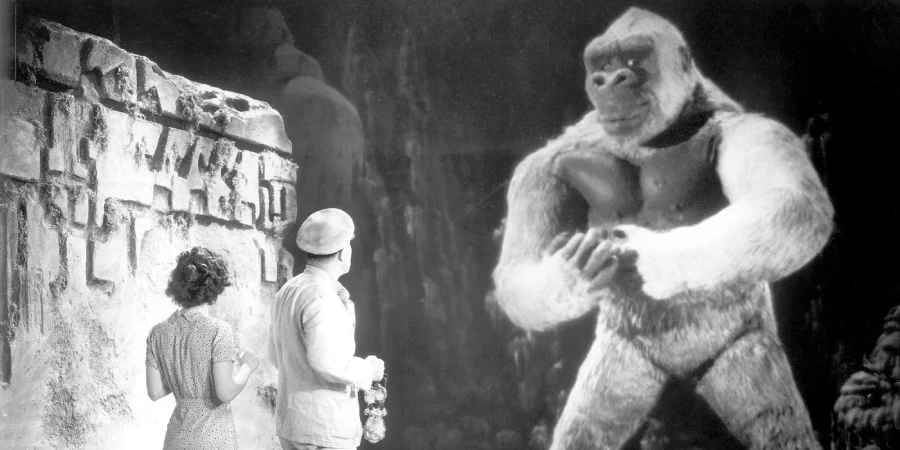
On the island, the group encounters a much smaller albino ape—Kong’s offspring, referred to by fans as “Little Kong.” Unlike his father, this creature is playful, clumsy, and surprisingly sympathetic. He displays childlike curiosity and even a sense of humor.
One of the film’s most charming elements is the bond that forms between Denham and Little Kong. In a subtle emotional arc, Denham—who once exploited Kong—begins to show compassion toward this creature.
The Treasure Hunt
Denham remains determined to find treasure rumored to be hidden on the island. With Little Kong’s help, they locate a cave containing gold. However, Skull Island itself becomes unstable, shaken by earthquakes and volcanic activity. Nature once again asserts its dominance over human greed.
Movie Ending
The climax unfolds as Skull Island begins to collapse into the sea due to violent earthquakes. The ground splits open, and the island starts sinking rapidly. This sequence is surprisingly intense for a 70-minute adventure film.
Denham and Hilda struggle to escape as the ocean engulfs the terrain. Little Kong, realizing the danger, sacrifices his own safety to help Denham reach higher ground. In a tragic yet quieter echo of his father’s fate, Little Kong becomes trapped as the island continues to sink.
In the film’s most emotional moment, Little Kong lifts Denham above the rising water, ensuring his survival. As the ocean swallows the island, Little Kong disappears beneath the waves. There is no last roar from airplanes this time—just nature reclaiming what was disturbed.
Denham and Hilda are rescued at sea. The ending leaves Denham financially ruined but emotionally changed. Unlike the ending of King Kong, which closes on a line about beauty killing the beast, this sequel ends on a more reflective note. Denham has learned something about responsibility and compassion, though the loss still lingers.
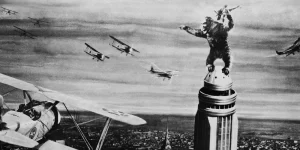
The final image emphasizes survival, not spectacle. It is a somber but less grandiose conclusion than the original film’s iconic finale atop the Empire State Building.
Are There Post-Credits Scenes?
No. Like most films of the 1930s, Son of Kong (1933) does not include any post-credits scenes. The film ends cleanly after the rescue, and the credits roll without additional material.
Type of Movie
Son of Kong is a fantasy adventure film with light monster-movie elements. Compared to its predecessor, it leans more toward whimsical adventure and character-driven storytelling than grand-scale horror spectacle.
Cast
- Robert Armstrong as Carl Denham
- Helen Mack as Hilda Petersen
- Frank Reicher as Captain Englehorn
- John Marston as Captain Nils Helstrom
Film Music and Composer
The score was composed by Max Steiner, who also composed the groundbreaking music for King Kong. His orchestral work once again elevates the emotional stakes, although the sequel’s lighter tone results in a somewhat less dramatic score.
Steiner’s music remains one of the early landmarks in film scoring, helping define how adventure and monster films would sound for decades.


Filming Locations and Production Context
The film was produced by RKO Radio Pictures and primarily shot on studio sets in Hollywood. Much of the Skull Island footage reused miniatures, sets, and stop-motion assets from the first film.
This reuse was not just economical—it allowed the production to move extremely quickly. The film was completed only months after the original’s release, making it one of the fastest major sequels ever produced.
The island setting remains central, but visually it feels slightly smaller in scope. The reduced scale reflects both budget constraints and the film’s more intimate narrative focus.
Awards and Nominations
Unlike its predecessor, Son of Kong did not receive major awards or nominations. The original King Kong overshadowed it critically and culturally.
However, it remains historically important as one of the earliest direct sequels in Hollywood cinema.
Behind the Scenes Insights
- The film was rushed into production due to the enormous success of the first film.
- It was completed in approximately nine months from concept to release.
- Many of the stop-motion effects were reused from the first film to save time and budget.
- Director Ernest B. Schoedsack reportedly viewed the sequel as a smaller epilogue rather than a true continuation.
- The lighter tone may have been a conscious effort to differentiate it from the tragic intensity of the original.
Inspirations and Context
The film continues the story established in King Kong, which was inspired by adventure literature and the giant monster tradition of early cinema.
Unlike the first film, Son of Kong is not directly based on a novel but expands the cinematic universe created by Merian C. Cooper and Ernest B. Schoedsack.
Alternate Endings and Deleted Scenes
There are no well-documented alternate endings. However, some sequences were reportedly trimmed to maintain pacing and keep the runtime under 70 minutes. The final sinking sequence may have originally been slightly longer, but no extended cut has surfaced.
Book Adaptations and Differences
There was no major novel adaptation tied directly to Son of Kong. The film exists primarily as a cinematic sequel rather than a literary adaptation.
Memorable Scenes and Quotes
Key Scenes
- Little Kong playfully interacting with Denham in the jungle
- The discovery of the hidden treasure cave
- The emotional sacrifice of Little Kong during the island’s destruction
- The dramatic sinking of Skull Island
Iconic Quotes
- “Maybe he wasn’t such a bad little fella.”
- “Skull Island… I never thought I’d see it again.”
Easter Eggs and Hidden Details
- Several miniature models were reused directly from the first film.
- The albino design of Little Kong visually distinguishes him from his father while symbolizing innocence.
- The faster pacing may reflect studio pressure to quickly capitalize on the original’s popularity.
Trivia
- The film runs approximately 69 minutes.
- It was released in December 1933, the same year as its predecessor.
- Robert Armstrong is the only major returning actor from the first film.
- The sequel was financially modest compared to the original but still profitable.
Why Watch?
If you appreciate classic cinema history, Son of Kong offers a fascinating glimpse into early sequel-making. It provides a softer, more emotional coda to one of cinema’s most iconic monster stories. While it lacks the towering grandeur of its predecessor, it compensates with surprising tenderness and a sense of closure.
Director’s Other Works (Ernest B. Schoedsack)
- King Kong (1933)
- Chang: A Drama of the Wilderness (1927)
- Rango (1931)
- Dr. Cyclops (1940)
Recommended Films for Fans
- King Kong (1933)
- The Lost World (1925)
- Mighty Joe Young (1949)
- Gojira (1954)
- King Kong (2005)