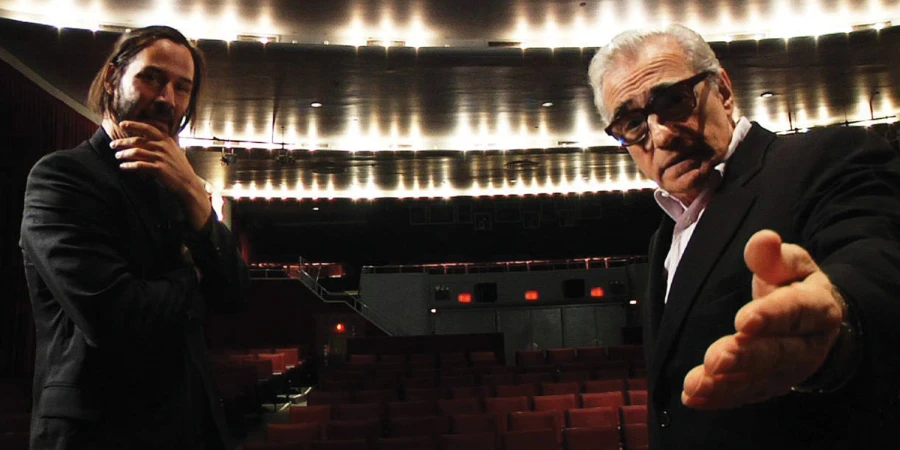

Side by Side (2012) is not a traditional movie with heroes, villains, or plot twists. Instead, it is one of the most important documentaries ever made about modern cinema itself. Directed by Christopher Kenneally and produced and narrated by Keanu Reeves, the film explores one central question that reshaped filmmaking forever:
Is digital technology killing film — or saving cinema?
Detailed Summary
The Birth of Motion Picture Film
The documentary begins by explaining how traditional motion picture film works. Cinematographers and directors describe the physical nature of film stock, light exposure, grain structure, and mechanical cameras.
Key filmmakers such as Martin Scorsese and Steven Soderbergh explain that film was not simply a recording medium but a craft requiring discipline, planning, and limitation.
Film was expensive. Mistakes mattered. Every frame counted.
This limitation shaped the language of cinema for more than a century.
The Arrival of Digital Technology
The documentary transitions into the emergence of digital video in the late 1990s and early 2000s.
Early digital cameras were considered inferior:
- Low resolution
- Flat colors
- Poor dynamic range
Yet they offered something revolutionary: affordability and accessibility.
Independent filmmakers suddenly had tools once reserved for studios.
This moment marks the beginning of the industry’s internal conflict.
Film vs Digital: The Great Debate
This is the heart of Side by Side.
The film presents both sides without choosing a winner, allowing legendary directors and cinematographers to debate openly.
Supporters of film argue:
- Film has organic texture and depth
- Highlights and shadows behave more naturally
- Film forces creative discipline
- Archival longevity exceeds digital formats
Supporters of digital argue:
- Unlimited takes increase performance quality
- Lower cost enables creativity
- Lightweight cameras allow new shooting styles
- Post-production flexibility is unmatched
Notably, directors like Christopher Nolan and Quentin Tarantino passionately defend film, while George Lucas and James Cameron strongly advocate digital.
The documentary never mocks either side. Instead, it highlights that cinema itself is evolving.
How Digital Changed Filmmaking Forever
The film then explores how digital technology transformed every stage of filmmaking:
- Production
- Editing
- Visual effects
- Color grading
- Distribution
Editors explain how nonlinear editing replaced physical cutting. Colorists discuss how digital grading allows visual manipulation impossible with photochemical film.
Studios explain that digital projection eliminated shipping thousands of film reels worldwide.
At this point, cinema is no longer just changing — it is becoming something new.
What Is Lost and What Is Gained
As the documentary approaches its final act, the tone becomes reflective.
Several filmmakers express concern that something intangible may be disappearing:
- The ritual of projection
- The tactile nature of film
- The shared discipline of limitation
Others argue that technology has always evolved, and storytelling remains the core.
The central idea becomes clear:
Tools change. Storytelling survives.


Movie Ending
The ending of Side by Side is contemplative rather than dramatic.
The film does not declare a winner between digital and film. Instead, it acknowledges that the transition is already complete. Digital has become the industry standard, while film has become a creative choice rather than a necessity.
Keanu Reeves concludes by emphasizing that cinema has always evolved alongside technology. Silent films became sound films. Black-and-white became color. Practical effects met CGI.
The documentary ends by posing a quiet but powerful question to the audience:
What matters more — how a movie is made, or what it makes us feel?
Rather than closing the debate, the film intentionally leaves it open, allowing viewers to decide where they stand.
Are There Post-Credits Scenes?
No. Side by Side does not contain any post-credits or mid-credits scenes. The film ends traditionally after the final montage and closing credits.
Type of Movie
Side by Side is a feature-length documentary focused on film technology, cinema history, and creative philosophy, blending technical discussion with personal storytelling from industry legends.
Cast
The documentary features interviews with:
- Keanu Reeves (Narrator and Producer)
- Martin Scorsese
- Christopher Nolan
- Quentin Tarantino
- James Cameron
- George Lucas
- David Fincher
- Steven Soderbergh
- Danny Boyle
- Robert Rodriguez
- David Lynch
- Wally Pfister
- Vittorio Storaro
Film Music and Composer
The score was composed by Marco Beltrami, known for his work on both independent and blockbuster films.
The music is intentionally subtle, serving as an emotional undercurrent rather than a dominant presence, allowing interviews and ideas to remain front and center.



Filming Locations
The documentary was filmed across multiple locations in the United States, primarily:
- Los Angeles, California
- Film studios and post-production houses
- Editing suites and projection rooms
These locations are essential because the documentary focuses on real working environments where the digital transition actually occurred.
The spaces themselves become part of the story.
Awards and Nominations
Side by Side received recognition primarily from documentary and film-education circles, including:
- Nominated for Best Documentary at several international film festivals
- Widely screened at cinematography schools and industry events
- Praised by the American Society of Cinematographers
Though not an awards-heavy film, its cultural impact far exceeded trophies.
Behind the Scenes Insights
- Keanu Reeves personally initiated the project after conversations with filmmakers on digital workflows
- Many interviewees spoke without scripted answers, creating unusually candid discussions
- Christopher Nolan insisted on being interviewed on film rather than digital
- George Lucas requested his interview be shot digitally as a philosophical statement
- The documentary took several years to complete due to rapid technological change during production
Inspirations and References
- The real-world transition from photochemical film to digital cinema
- The history of Kodak and Panavision
- Early digital cameras such as the Sony CineAlta
- Industry debates from the early 2000s
- The rise of digital projection worldwide
There is no fictional source material; the film is rooted entirely in real industry history.
Alternate Endings and Deleted Scenes
No alternate endings have been released.
However, several interview segments were removed due to length, including deeper technical discussions about sensor architecture and data compression that were considered too specialized for general audiences.
Book Adaptations and Differences
The film is not based on a book. However, it is frequently used alongside academic cinema textbooks due to its educational value.
Memorable Scenes and Quotes
Key Scenes
- Quentin Tarantino passionately criticizing digital projection
- Christopher Nolan explaining why film still matters
- George Lucas calmly stating that film will inevitably disappear
- Editors demonstrating physical film cutting vs digital editing
- Projectionists describing the disappearance of their profession
Iconic Quotes
- “Film is not a format. It’s a discipline.” – Christopher Nolan
- “Digital is inevitable.” – George Lucas
- “The question isn’t which is better. It’s what you do with it.” – Steven Soderbergh
Easter Eggs and Hidden Details
- Several interviews subtly reflect each director’s philosophy through lighting choices
- Film advocates are often shot with warmer tones
- Digital proponents are frequently framed in cleaner, sharper images
- Vintage cameras appear in background shots throughout the documentary
- Editing rhythm shifts subtly between analog and digital segments
Trivia
- The documentary was partially shot on film and partially on digital intentionally
- Some interviews were captured using experimental early 4K cameras
- Kodak engineers were interviewed shortly before the company’s bankruptcy
- The title refers to physical film strips being viewed next to digital frames
- Many film schools use this documentary as required viewing
Why Watch?
You should watch Side by Side if:
- You love movies beyond just watching them
- You are curious how modern films are actually made
- You want to understand why movies look different today
- You care about the future of cinema
- You enjoy thoughtful, intelligent documentaries
It is especially valuable for filmmakers, students, and serious movie fans.
Director’s Other Works (Christopher Kenneally)
- Reel Time (2003)
- Love, Hate & Propaganda (2004)
- We Are the Marines (2017)
Recommended Films for Fans
- Hearts of Darkness: A Filmmaker’s Apocalypse (1991)
- Visions of Light (1992)
- Lost in La Mancha (2002)
- American Movie (1999)
- The Story of Film: An Odyssey (2011)