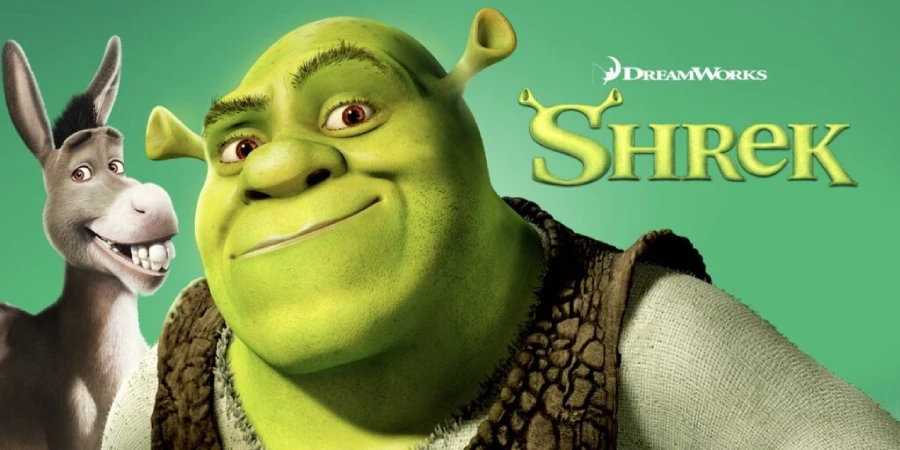

DreamWorks’ Shrek (2001) is one of the rare animated films that changed not only the fairy-tale parody genre but also the trajectory of Western animation. Below, you’ll find a full deep-dive covering story breakdowns, behind-the-scenes details, awards, inspirations, trivia, and more. Spoilers are fully included, as requested.
Detailed Summary
Opening: The Anti-Fairytale Beginning
Shrek, a solitary ogre who values privacy above all else, lives peacefully in his swamp. But peace ends when Lord Farquaad banishes all fairy-tale creatures to Shrek’s land. This chaotic invasion introduces characters like Pinocchio, the Three Little Pigs, and Donkey, who quickly becomes Shrek’s unwanted companion.
Journey to Duloc and Farquaad’s Quest
Shrek marches to Duloc to demand his swamp back. Farquaad agrees but on one condition: Shrek must rescue Princess Fiona, who is imprisoned in a dragon-guarded castle. Shrek reluctantly accepts, dragging Donkey along. Their dynamic becomes one of the film’s most charming comedic engines.
Rescue Mission: Dragon, Princess, and Surprises
The rescue sequence is one of the film’s most iconic:
- Donkey accidentally charms Dragon, who falls in love with him.
- Shrek and Fiona escape together, though Fiona is puzzled by her rescuer not being a traditional prince.
On their journey back to Duloc, Shrek and Fiona bond. They share a sense of misfit identity, humor, and growing affection. But Shrek overhears only part of a conversation and mistakes Fiona’s shame about her curse for disgust toward him. His insecurity creates the emotional rupture leading to the final act.
Fiona’s Secret Curse
Fiona hides a major secret: every night she transforms into an ogre-like creature due to a spell that can only be broken by “true love’s first kiss.” She believes herself unworthy and fears rejection, creating a powerful emotional conflict.
Movie Ending
Shrek storms the wedding between Fiona and Farquaad, determined to express his feelings. Once he confesses, Fiona decides to reveal her curse publicly. Farquaad mocks her and was planning to exploit her royal status before disposing of Shrek.
At the climax:
- Dragon bursts in and eats Farquaad, delivering one of the most memorable villain exits in animated history.
- Fiona and Shrek kiss. The spell activates but with an unexpected twist: Fiona remains an ogre permanently. Instead of disappointment, Shrek reassures her that she looks perfect to him.
- The film ends with their joyous swamp wedding, complete with music, dancing, and Shrek finally realizing that he doesn’t have to live life alone.
This ending strongly emphasizes the film’s core theme: love is not defined by appearance but by authenticity.
Are There Post-Credits Scenes?
Yes—there is a short post-credits sequence. It features Dragon reuniting with Donkey at the swamp wedding party, giving a fun comedic payoff to Dragon’s affection for him. There is no major plot-related teaser, but it serves as a humorous coda.
Type of Movie
Shrek is a fantasy-comedy adventure film with heavy use of fairy-tale parody and subversion. It blends heartfelt storytelling with sharp humor aimed at both children and adults.
Cast
- Mike Myers as Shrek
- Eddie Murphy as Donkey
- Cameron Diaz as Princess Fiona
- John Lithgow as Lord Farquaad
- Vincent Cassel as Monsieur Hood
Film Music and Composer
The film’s original score was composed by Harry Gregson-Williams and John Powell. Its soundtrack became legendary thanks to songs like “All Star” by Smash Mouth and the emotional “Hallelujah” cover used in a key montage. The music balances comedy with emotional depth, particularly in moments involving Fiona’s internal conflict or Shrek’s loneliness.
Filming Locations
While Shrek is animated and not physically filmed, the production was based at PDI/DreamWorks in Redwood City, California. The digital environments—like the swamp, Duloc, and the dragon’s castle—were built to parody and invert traditional fairy-tale imagery.
For example:
- Shrek’s swamp uses earthy, irregular visuals to reflect his identity.
- Duloc parodies Disneyland aesthetics with sterile, overly perfect designs.
- The castle plays off classic fantasy tropes but adds modern humor and danger.
Awards and Nominations
Shrek made history by winning the first-ever Academy Award for Best Animated Feature in 2002. Additional highlights:
- Nominated for Best Adapted Screenplay at the Oscars
- Won multiple Annie Awards
- Selected for the National Film Registry in 2020 for cultural significance
Behind the Scenes Insights
- Chris Farley originally recorded most of Shrek’s dialogue before his death; Mike Myers re-recorded everything and later insisted on the Scottish accent, which dramatically improved the character.
- Eddie Murphy’s Donkey is widely considered one of the best comedic voice performances in animation.
- Animators studied animal movement and facial expression to craft Dragon’s emotive personality.
- Lord Farquaad’s height was deliberately exaggerated for comedic contrast with his authoritarian personality.
- Myers recorded some lines over 20 times to get the emotional tone right.
Inspirations and References
- The film is based on William Steig’s 1990 children’s book Shrek!
- It parodies classic Grimm fairy tales and Disney films (most notably Snow White, Cinderella, and the Disney princess formula).
- The tone takes inspiration from Monty Python-style British comedy, especially in its sarcasm and fourth-wall humor.
Alternate Endings and Deleted Scenes
While no radically different ending was produced, several deleted ideas existed:
- A longer version of Fiona discussing her curse with Robin Hood’s Merry Men
- A comedic extended escape sequence from Dragon
- Additional scenes exploring Farquaad’s obsession with perfect order
Book Adaptation Differences
The book Shrek! is far more surreal and cartoonish:
- Shrek is even more grotesque and proud of it.
- Fiona is not secretly cursed; she is naturally an ogre.
- The story is simpler and more whimsical, lacking the emotional romance arc.
The film adds:
- A deeper emotional core
- A romantic narrative
- Themes of prejudice, acceptance, and self-worth
Memorable Scenes and Quotes
Key Scenes
- Shrek’s mud shower and introduction, establishing his unapologetically messy lifestyle
- Donkey and Shrek crossing the rickety bridge to Dragon’s castle
- The entire “Welcome to Duloc” sequence
- Fiona singing with a bird, leading to a comedic twist
- Shrek overhearing Fiona talking about “a beast”
- The final wedding showdown
Iconic Quotes
- “Ogres are like onions.”
- “That’ll do, Donkey. That’ll do.”
- “I’m a Believer!” (song ending)
- “This is the part where you run away.”
Easter Eggs and Hidden Details
- The Magic Mirror’s presentation mimics classic 1970s dating game shows.
- Duloc’s architecture subtly mocks Disneyland.
- Fiona’s martial arts scene parodies The Matrix (1999).
- The Three Bears have a dark visual gag: Mama Bear from the opening scene later appears as a rug in Farquaad’s chambers.
- The dragon’s gender is never stated directly, yet her romantic interest in Donkey makes it clear.
Trivia
- Shrek was originally supposed to be hand-drawn, not CGI.
- DreamWorks used some leftover technology from Antz to build Shrek’s world.
- The film’s success helped DreamWorks become the primary competitor to Disney/Pixar.
- Chris Farley’s version of Shrek had an entirely different personality—more insecure and awkward.
Why Watch?
Because Shrek is more than a fairy-tale parody. It’s a smart, emotionally reflective story wrapped in humor, satire, and bold animation. Whether it’s your first watch or your fiftieth, the film remains fresh, clever, and unexpectedly heartfelt.
Directors’ Other Works
Andrew Adamson and Vicky Jenson have collectively worked on:
- Shrek 2 (2004)
- The Chronicles of Narnia: The Lion, the Witch and the Wardrobe (2005)
- The Chronicles of Narnia: Prince Caspian (2008)
- Shark Tale (2004)
- Post Grad (2009)